

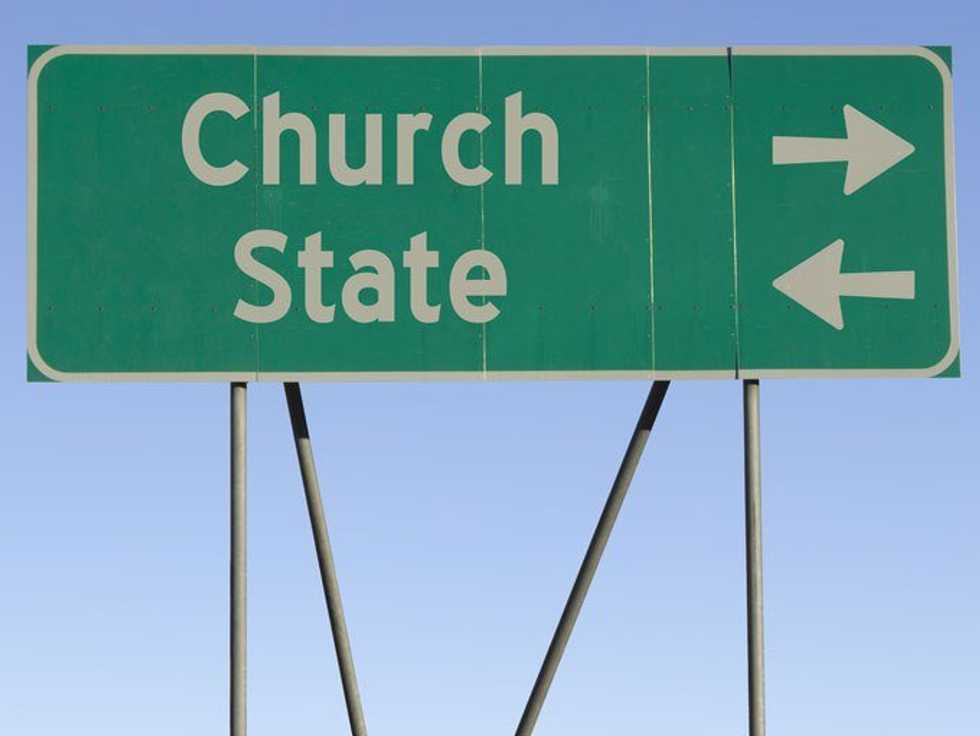
Perhaps you don’t know this, but that famous refrain “the separation of church and state” actually comes from Thomas Jefferson and is no where in the constitution. In fact, it’s more like an interpretation of the Establishment Clause and Free Exercise Clause in the First Amendment.
“Congress shall make no law respecting an establishment of religion, or prohibiting the free exercise thereof; or abridging the freedom of speech, or of the press; or the right of the people peaceably to assemble, and to petition the Government for a redress of grievances
This amendment was lauded by Jefferson and others for creating a “wall” between church and state but it didn’t prohibit states from establishing an official religion, as seen by Massachusetts state-religion of Congregationalism up until the 1830s. In fact, until Everson v. Board of Education in 1947, the Establishment Clause didn’t apply to states at all. In this case New Jersey native disputed the tax funded reimbursement of parents who had children who took buses to both public and private schools. His argument was that the government was rewarding private, religious schools and thus violating the First Amendment. And while the final verdict sided with the schools, stating that the reimbursement of funds was too scattered to be a religious advantage, both the affirming and dissenting justices vehemently supported the separation of church and state. However, by looking at Justice Hugo Black’s majority opinion, we can see that this “wall” isn’t so easy to see and even harder to enforce. He writes:
“The 'establishment of religion' clause of the First Amendment means at least this: Neither a state nor the Federal Government can set up a church. Neither can pass laws which aid one religion, aid all religions or prefer one religion over another…In the words of Jefferson, the clause against establishment of religion by law was intended to erect 'a wall of separation between Church and State…That wall must be kept high and impregnable. We could not approve the slightest breach. New Jersey did not breach it (330 U.S. 1, 15-18)
The separation of church and state seems easy to understand at first light; the church cannot be involved in state affairs and the state cannot be involved in church affairs. But just take a look at our money—“In God We Trust.” True, it is argued that “god” isn’t specified and thus gets away with being any god from any religion; and true, that statement is a part of our heritage as a Christian country, which cannot be denied. But if we are to take Justice Black’s words seriously, “neither can pass laws which…aid all religions…” then we can see that indeed this wall isn’t really as high and impregnable as Justice Black declared it. In fact, where is this wall? How high is it? And how much can the government do to enforce this separation when religious sites are tax exempt, our money trusts “god” and most of our presidents swear their presidential oath on a Holy Bible?
Clearly we have a long way to go but perhaps we are moving in the right direction. Recently the Oklahoma Supreme Court has struck down the 6-foot tall Ten Commandments statue that sits in front of the Oklahoma Capitol grounds as “obviously religious in nature and are an integral part of the Jewish and Christian faiths" and thus in opposition to the First Amendment. And before we all groan, “Um…duh?” at the very least we can appreciate that we are taking a guided and mature step in the right direct— Wait, the Republican opposition is calling for those Oklahoman Justices to be impeached?
Sorry guys, building this wall is going to take a whole of hell lot longer.