We are all equal in America. They've told us so since the beginning, and therefore it's true. Isn't it? Of course it is. Except for the flaws, the loopholes, the things which get overlooked. Society has so many of them, and in today's world, our generation has decided they cannot be ignored any longer. Truly, it's about time. After generations of having received unfair treatment for women, being denied voting rights, given unequal pay, hitting glass ceilings, and being shamed for expressing sexuality and so forth, it is finally time to lay down the law and make some changes.
After having spent my childhood raised in a very traditionalist home, I am now a (semi) college educated, born-again feminist, and proud of it. I believe women and men should have equal rights, I could never seriously consider a relationship with anyone who disagreed, nor could I have a close friendship with someone who was unable to see the legitimacy of this (the exception being I believe we must bear in mind, of course, cultural variation considerations).
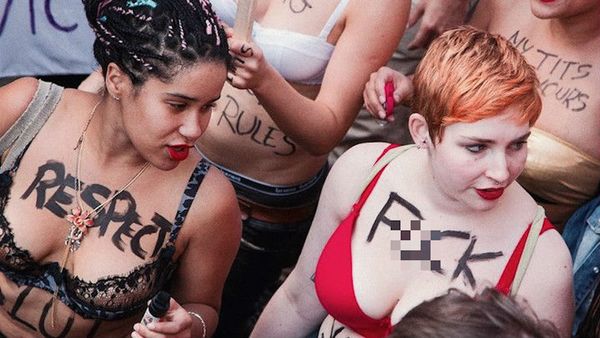
However, despite this, or perhaps because of it, I have also had to look at feminism from an objective perspective as well. When the word is used freely in conversation, the image of bra burning and men hating radical women is brought to mind all too often, causing the sadly familiar pause in a conversation. Many women are hesitant to use the word "feminist" to describe themselves, and for many men this question is answered with something along the lines of a conflicted "What do you mean by that?" It's unfortunate, and, in this day and age, to hear that so much. One has to ask why. Why does the stigma surrounding feminism exist? It's impossible to write people off as ignorant without ourselves accepting that by doing this, we too are being ignorant. So I asked questions of those who weren't sure. I went to Google, trusty research tool that it has become. Most of all, I did some reflecting myself and instead of simply tying it up in a nice little bow of why everyone who is unsure is wrong, I attempted to give validity to opposing points of view.
Don't worry guys, I'm still a feminist. But I'm removing my rose colored glasses on the subject, and here's why:
1. Women's pity party.
We have all met people like this. They take feminism too far and claiming equal rights, but what they really mean is sexism towards men. They embody the epitome of what the negative stigma was created by; hating men, resenting and blaming them as individuals rather than blaming society for the ways it has treated women over the years. These people's opinion conjures up the image of bra burning and unfairness and gives true feminists who speak for equality a bad name, berating any person, male or female, who disagree as opposed to debating in a calm and rational way. The record, for both men and women, needs to be set straight on this issue once and for all.
We, as women, do not want a pity party for the mistakes of generations before us but instead ask for change and progression. We cannot ignore, however, that some women take this too far, and must acknowledge, to some degree, the injustice that men are forced to endure because of the misguided interpretation of feminism that some women bring about. In order to be an authentic feminist, this brand of hate needs to be recognized and stopped. Women are NOT victims. We are people who have endured unfair treatment, but we are strong, capable of overcoming adversity, and we do not need or want pity. Anyone who asks for anything else has a skewed view on what feminism truly is.
2. Emotional inequality for men.
It has been brought to light more and more frequently the sexual inequality women are forced to bear, not just in American culture, but in cultures around the world. I have such strong opinions on this, but what women often seem to overlook is that men are forced to bear inequality too. From the time they are young they are told that expressing their emotions is not okay. "Be a man" "Be tough" "Boys don't cry" "Stop being such a sissy" "What are you, a girl?" Exposure to such sexist undertones at such a young age, whether it is from parents, teachers, doctors or other children, it is emotionally scarring. It forces children to see the world differently.
Expressing emotions makes them weak, and if weakness is equated to being feminine, they must prove masculinity by blocking out emotions. So what have we created? Men who are afraid to feel, who cannot live authentically because of this? Men who can't cry, can't hurt, can't be tired or afraid without being shamed? We have created men who have lost their power to attempt to understand the emotions they aren't allowed to feel, and thus, they have looked to gain this power back in other ways. Maybe they advance in their careers or work out too frequently to become the biggest and the strongest, maybe they take up a hobby, maybe they drink. But few are able to work through the damage society has done to them, and few even realize it's there. It affects them in all aspects of life, from the sad movie they can't cry at to the inability to have a meaningful conversation with their guy friends about the fight they had with their significant other. Too often they instead channel these emotions into anger or sweep them under the rug completely. So, while many of them smile and say yes, we believe women should be recognized as equal, they themselves have a need for equality that is so ironically overlooked.
3. Domestic violence.
Taboo subject, but the story is as old as time. The narrative, however, differs depending on which wronged party is questioned about it. Ask the woman involved and she will tell you "We got in a fight. He shoved me into a wall. I have bruises. He's an awful person." Ask the man and he will say "The b**ch is crazy. She started screaming at me, came in swinging and I tried to defend myself by pushing her off me. Now she's told all her friends and family that I beat her up, like I'm some kinda monster and everyone hates me. Whatever."
Likely, neither of these stories are completely accurate. Also, there are important biological factors of the way the human body is built to be considered, men generally being naturally stronger and bigger than women.
Personally, after having moved to San Diego at the age of 13, I found myself in a family background of emotional instability, volatile and frequent domestic violence and uncontrolled anger. It was very different from the home I had grown up in during my early childhood. On both sides, when faced with a situation where no one knew how to deal with their emotions, uncontrolled anger often resulted in dangerous and violent situations that went too far.
As feminists, both men and women, we need to stop casting blame on either side and each takes responsibility for our own individual actions.