

Whether you've read the Harry Potter books or not, you've probably heard something about the author of this beloved series. Here are 5 lessons for creatives from the life of J.K. Rowling.
1. Rejection is a part of growing in our craft that should never stop you.
You've probably heard the story one hundred times, but it's true. Rowling's first Harry Potter manuscript was rejected by twelve publishers - TWELVE - before she was picked up, on a whim, by Bloomsbury. Failure is your most true and honest friend. Yes Rowling's overall story might seem like a shimmering fairy tale but in retrospect, imagine the blow she must have felt being rejected time after time. What if she had believed that she wasn't good enough. What if after her fifth rejection she stopped? We wouldn't have some of the most beloved stories, characters plots and themes that we have today. In her 2008 Commencement speech at Harvard University, she highlighted 'the fringe benefits of failure" stating that hitting rock bottom enabled her to build a brand new, solid and strong foundation for her life. She was able to strip away the things that were non-essential; the things that did not matter. Only then was she able to focus on the things and people who actually mattered: her daughter, herself, her friends and this idea she had growing in the back of her mind (that idea turned into 7 wildly successful novels... and you know the rest).
Of course her life didn't suddenly take a direct uphill path to glory and fame after her realization. It took hard work and perseverance and guts. She had to adopt an attitude that said "Who cares? What else do I have to loose?" Life became an opportunity to take advantage of every fiber of positive energy that came your way. Think of it this way: you will never know what you're made of and how strong you truly are until adversity tests you and the ground you stand on. Knowing yourself is a true gift.
“Failure gave me an inner security that I had never attained by passing examinations. Failure taught me things about myself that I could have learned no other way. I discovered that I had a strong will, and more discipline than I had suspected; I also found out that I had friends whose value was truly above the price of rubies.”
- J.K. Rowling
2. Truth is the most inspirational thing we could throw into our creative space
“It’s so difficult to describe depression to someone who’s never been there, because it’s not sadness. I know sadness. Sadness is to cry and to feel. But it’s that cold absence of felling — that really hollowed-out feeling.” — J.K. Rowling
Rowling never shied away from her experiences even when they took on a very dark path. Instead she poured her truth into her writing and was able to conjure up a brilliant characterization that not only depicted the darkness she felt but that had a way out. Dementors, one of Rowling's most disturbingly dark creations, were based on her struggles with depression. After her mother died, Rowling found herself battling this mental illness, and instead of pushing it to the back-burner and letting it eat away at her mind, she emptied her darkness into her writing. She laments that The Dementor's "kiss" cause the victim to be stripped bare and made to feel as though "They'd never be happy again." Rowling used her personal pain to create and lived completely in her truth.
“You can exist without your soul, you know, as long as your brain and heart are still working. But you’ll have no sense of self anymore, no memory, no . . . anything. There’s no chance at all of recovery. You’ll just — exist. As an empty shell. And your soul is gone forever . . . lost.”
― J.K. Rowling, Harry Potter and the Prisoner of Azkaban
3. Our Art Reflects Our Faith
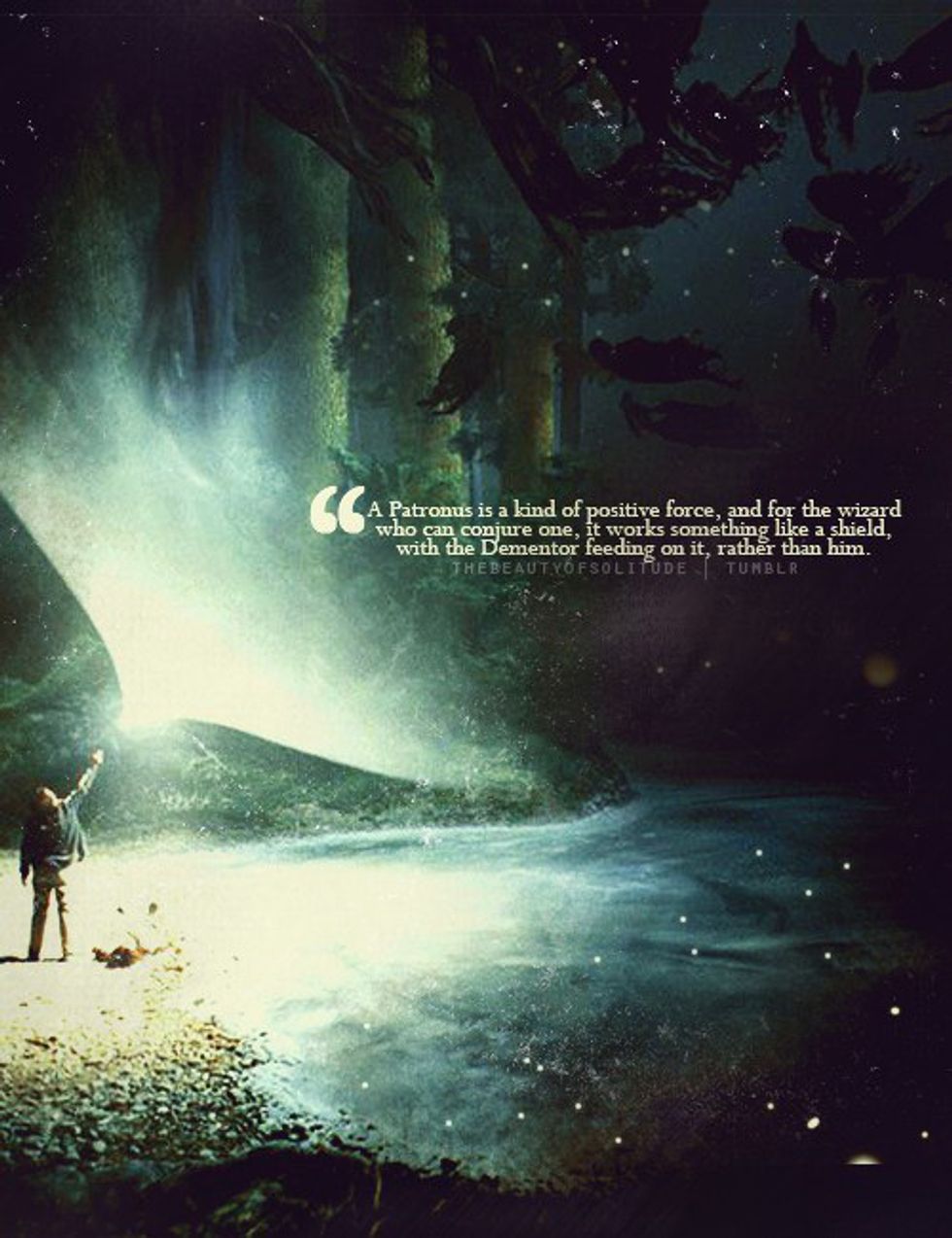
On the flip side of Rowling's darkness, she made it clear that her hope was not lost. It became absolutely apparent to audiences that darkness was not in fact all consuming and there was a way out if only you sought it out. In the movie, Goblet of Fire, Dumbledor says something that he doesn't say in the book:
“Happiness can be found, even in the darkest of times, if one only remembers to turn on the light.”
Happy thoughts are continually referred to as a source of power and light in the books. A boggart, which was a creature that could turn into one’s worst fear, could be defeated with laughter; showing it that it doesn't control you nor do your fears. To successfully use a Patronus charm, the charm one conjures to fight a Dementor, that person must bring their happiest memories to the forefront of their minds. It makes the spell especially difficult to cast because you must think of and draw from your happiest memories in a time where they are literally being sucked from you.
Rowling has given loads of support to her fans even now to tell them that you should never ever shy away from or be ashamed of your mental illness but you should always seek help too. Rowling always makes certain that she assures everyone that there is a life after depression. You can get there.
4. Guard Your Heart; not everyone is who they seem.
Through her many characters, some beloved, some hated, we see a theme reoccurring. Everyone is not who they seem. Some we believed to be horrid when they weren't, others we believed to be good when they weren't.
Snape was probably at the top of many people's most hated list throughout the series. It is revealed to us in the last book that Snape has been working as a double agent for Dumbledore because of his love for Harry's mother. Say what you want about Snape's character but he was not the cold hearted, unloving, evil greasy man we all thought him to be. He was a hurt, wounded boy who grew to be a hurt and wounded man. He laid down his life for the son of the woman he never stopped loving Dolores Umbridge came packaged with pink poufs, tea-cups and many many cats. All the makings of an irritating aunt. She turned out to be one of the nastiest women in the novels forcing students to carve into their own flesh and write with their blood. We all thought Sirius Black was a back-stabbing lunatic who screwed Harry over. Like Harry, we blamed Sirius for his parents' deaths and hated Sirius for betraying his friends only to learn that he was wrongfully convicted. Sirius was forever wounded by the loss of his best friend, James Potter, and became like a father to Harry once the truth was discovered.
Don't pay attention to appearances or rumors or things that you've heard about someone. Not everyone is who they appear to be. Some might smile in your face and stab you in the back while others might appear to have wronged you but really they had your back all along.
5. Inspiration is everywhere if only you open your eyes
During her late twenties, following a failed marriage and struggling as an underemployed single mom, and going through a period of depression, Rowling found inspiration. As many probably know, she first had the idea for Harry Potter while waiting, delayed on a train, traveling from Manchester to London King's Cross in 1990. Rowling came up with the idea for the wizarding game of Quidditch in a Manchester hotel room after arguing with her then boyfriend. Sometimes Rowling found herself with an idea or an itch of inspiration, but she didn't have any paper. So, like any dedicated writer, she wrote on anything she could get her hands on.
“The names of the Hogwarts Houses were created on the back of an aeroplane sick bag. Yes, it was empty.”
- J.K. Rowling
Inspiration can appear at any time, but it can only be turned from wondering idea to art or writing if we make it so. We must make it so that we are constantly cultivating a space to be creative and to make our inspirations and ideas a reality. Always be ready to capture inspiration when it comes.
“We do not need magic to change the world, we carry all the power we need inside ourselves already: We have the power to imagine better.”
- J.k. Rowling