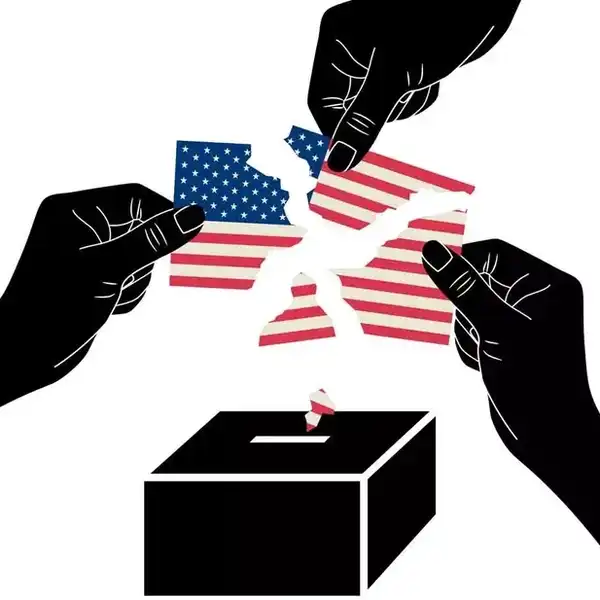
When American voters go to the polls this election season, they will see the familiar names of the Democratic and Republican candidates, along with some names that may be completely unknown to them. A few third party candidates, such as Ross Perot or Ralph Nader, gained widespread recognition from running in previous elections, but most candidates outside the mainstream seem to have little impact on American politics. Two political parties dominate the political landscape, and third parties seem permanently stuck to the irrelevant fringes.
Most voters see third parties as wasted votes. The general assumption is that if a third party candidate has no chance of winning, it’s foolish to lower the chances of the next-best, big-party candidate. Voting for a lesser-of-two-evils candidate who can win would be better than voting for an ideal candidate who will lose.
But are third party candidates truly irrelevant? Perhaps “winnability” doesn’t matter as much as most voters seem to think. If the third party candidate can exert an influence on the big two parties, the objective may be accomplished. Think of American political ideas as fitting on a spectrum from left to right. Assume that most voters fit somewhere in the middle, as moderates, and that the distribution of political opinion is symmetric. Democrats of course occupy the territory to the left, and Republicans the territory to the right.
Next, assume that there are only two candidates, and that people vote for the candidate whose ideas are closest to their own. Any “space” on the spectrum between the two candidates will therefore be split evenly between them, as the voters cast their votes toward the nearest candidate. To gain more votes, each candidate has the incentive to move toward the other candidate, attracting more of the votes in the area between them. Therefore, both candidates will gravitate toward the middle of the voter spectrum. Looking at politics this way, we can understand why Democrats and Republicans so often appear to have virtually the same policy proposals. Voters on both the far left and the far right will be perennially frustrated as they see the candidate closest to them moving toward the middle.
The solution, for some on the fringes, is to start a third party. It is true enough that there is no significant chance that a third-party candidate would be elected to national office, but that is not the point. As we saw in the 2000 presidential election, even the loss of a few voters can constitute a serious threat. If the Republican does not respond by making important concessions to those on his right, he could lose the election to a candidate from a unified left. Of course, the Democrats have their own third parties with which they must contend.
Additionally, and as was mentioned earlier, third party voters do not always vote with the goal of their nominee winning an election. Their votes are freedom of speech, votes deviating from the status quo of a two party system, in which they can voice their dissent and display a desire for change or something other than the Democratic or Republican options.
If you vote this election season, and are inclined to favor a third party but are concerned that you might “throw your vote away,” distinguish your vote from the rest of the crowd and go with that third party. But remember, too, that society is not built on political accomplishments. Whatever happens this year politically, the final outcome will display the overall tone of the American people. The amount of voters who went to the second choice, however, as well as all those third party candidates, also had a representation of dissent. That is what a democracy is all about.