


The amount of women deciding not to have children has nearly doubled since 1970. Today, one-in-five women are child-free by the time they reach menopause. While that is a high percentage of women choosing not to reproduce, it is still stigmatized in our society today.
While some people genuinely do not want to be parents, there are other structural issues that lessen the incentive to have kids.
1. Affordability
Having a child is expensive, and for those families that have two working parents, the price of quality daycare is outrageous. The average cost of annual daycare is often priced more than in-state tuition for college. Just look at the costs for Connecticut:
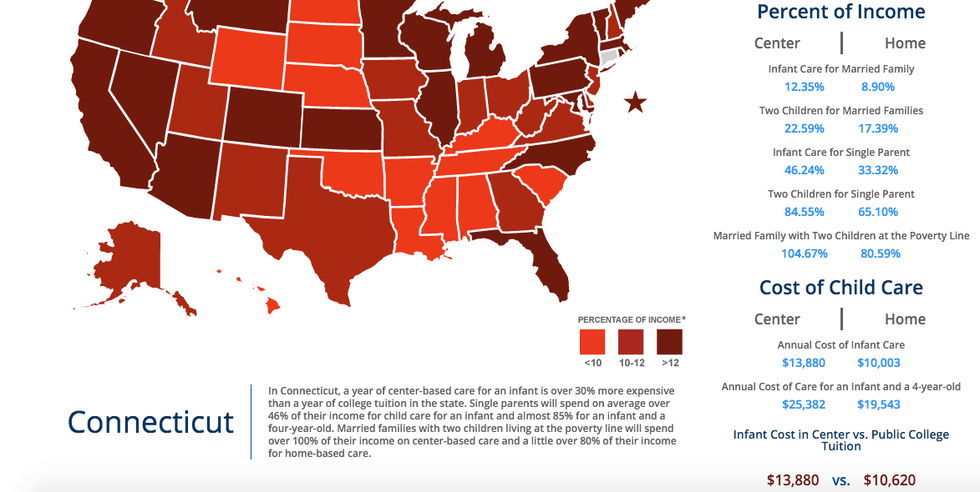
Take a close look at the cost for a married family with two children at the poverty line. The cost of child care exceeds 100 percent of their income. How is a family supposed to live like that? They have to choose between having two working parents whose income only goes to child care or having one working parent with half the income. Even for families above the poverty line, the cost of daycare burns a hole in their paycheck, though nowhere near as much.
Subsidized child care would do wonders for the families of America, as would paid parental leave. When mothers take one year of maternity leave, they lose about 20 percent of their lifetime salary. As it is described by this New York Times article, "one of the worst career moves a woman can make is to have children." Also referred to as the motherhood penalty, "mothers are less likely to be hired for jobs, to be perceived as competent at work or to be paid as much as their male colleagues with the same qualifications."
Women in general get paid less than men due to the gender wage gap, but when you add motherhood to the equation, the gap widens a considerable amount. Right now, women earn roughly 80 percent of what men earn. Among women, a single, unmarried woman makes 96 percent of what men make while married mothers only earn 76 percent. Yikes.
2. Career
Women who choose their careers over having children are often called selfish, not to mention "anti-religion, anti-family, and counter-cultural." There are all kinds of families today, though. Some happen to be child-free. Even the U.S. Census Bureau doesn't specify children in its definition of a family.
But what about men who choose their career over having kids? They're called bachelors.
Men are not stigmatized like women are for choosing their career over a family. In fact, it's a win-win situation for men. If they don't become a father, nothing happens to them, but if they do, they get "daddy bonuses." On top of that, men who are fathers are actually paid more than men who are not, so within a marriage, having a child actually increases the gender wage gap as women watch their salaries decrease and men watch theirs increase.
Additionally, while times have changed a great amount, women still tend to be the primary caretakers of their children, which in turn jeopardizes their career. The majority of both men and women of the millennial generation hope to have an egalitarian relationship with their future partner, but they often have different ideas for back-up plans.
When a child comes into the picture, it is sometimes hard to uphold an egalitarian relationship. When this kind of situation arises, men tend to lean towards a neo-traditional relationship where the majority of the childrearing falls on the mother. Women, on the other hand, would rather remain single and keep working.
Women of the millennial generation are more career focused than ever. They are willing to remain single in order to advance their careers, which is mostly due to the fact that they are able to support themselves on a comfortable or luxury salary without any dependence on a man. It's easy to see how this kind of a free lifestyle would be hard to give up.
3. Change of Lifestyle
Becoming a parent is a life-changing decision and it's not something you can change your mind about after the fact; this is a lifetime commitment. Women are constantly reminded that their biological clocks are furiously ticking away, but they are barely given enough time to make a decision.
More and more women are pushing off marriage and families until they are in their late twenties to early thirties, but even that doesn't seem like enough time. The way medicine is progressing, it isn't uncommon for people to live into their late nineties or even 100 years old. That means your decision on whether to have a child or not is made only about a third into your life. That's a lot of pressure for a decision that will affect the majority of your life. How can you know you if you'll regret your decision or not in 20 years? What if you have to pass up opportunities you had been waiting for because you have kids?
What if you don't like kids? Some women are naturals when dealing with children, while others are not. It is not reasonable to assume that every woman has maternal instincts. Approximately half of the world's population is made up of women and every single one is different than the next. By applying a stereotype to all women, it puts pressure on them to conform. In fact, some women don't feel like they have a choice, especially when their rights to their own bodies are being challenged in matters concerning abortion.
Forcing a woman into motherhood can have negative affects for her and her children, mentally and physically. A lot of couples fear a child will ruin their relationship. For some people, this is absolutely true. When a child is involuntarily brought into the world, they often grow up in unsatisfactory conditions. They aren't the only ones affected either. If there are older siblings, they too often suffer from neglectful parenting as a result of the unplanned pregnancy.
Having children also comes with a great amount of responsibility. That means less time to travel, less nights out on the town, and less alone time. Those are three huge aspects of life and relationships that some people are not willing to give up.
While these are not the only reasons more women are choosing not to have children, they are common ones. It would be unreasonable to assume every woman wants to be a mother and they shouldn't be criticized if they decide against it. Instead, they should be praised for their decision against bringing a child that they are unwilling to take care of into this world. The face of families are changing and will continue to do so as we learn to become more accepting of different lifestyles and the changing social norms.

















