

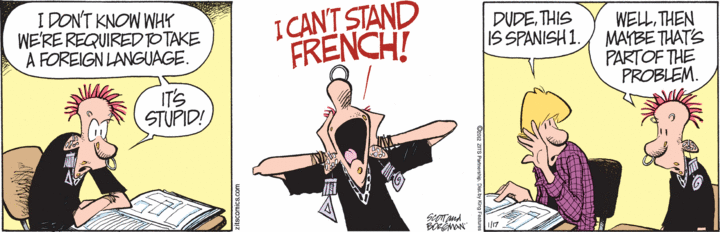
If you are a college student, then chances are you have to take a year or more of a foreign language in order to graduate. Now, regardless of whether or not you actually want to learn a foreign language, the truth is that any knowledge of another language can be extremely helpful.
Employers love it when their workers know how to speak another language. Fluency in a second language makes you more marketable as a job candidate because it allows your employer to explore new worldwide markets.
So even if you don’t want to spend time and money learning a new language, I would argue that you should use your language requirement as an opportunity to learn as much as you can. If you don’t, those credit hours really do just become a waste of time and money.
Now, I know that I’m a little bit biased (I am a Spanish major after all), but learning to speak different languages really is a useful skill. I know that a lot of students are leery of learning a new language because it seems like such a huge undertaking, but it really doesn’t have to be. There are dozens of different ways to improve your language skills, and they don’t all include spending hours slaving over a grammar textbook. Some of them are even . . . dare I say . . . fun.
Here are just a few suggestions of alternative ways to work on your language skills:
1. Listen to music in that language
Listening to music in a foreign language isn’t just entertaining, it’s also educational. If you find a song that you really like (and chances are, you will), you’ll probably find yourself wanting to sing along. And when you start to do that, you can’t help but to pick up a few of the words in the song--you may even find yourself looking the lyrics up online and learn even more words that way.
But the main advantage of listening to music in a different language is that you are exposed to different native accents of that language. This exposure is helpful because it will make it easier for you to understand native speakers when you meet them. Native speakers talk really fast, and being familiar with their accents is very helpful in understanding what they’re saying.
For all of my Spanish-speakers out there, I’d like to recommend Pablo Alborán (check out “Deshidratándome,” “Me iré,” “Quién,” “Recuérdame,” “Yo no lo sabía,” and “Inseparables”), along with Melendi (look up “Tocado y hundido,” “Mi primer beso,” “Tu jardín con enanitos,” and “Tú de Elvis y yo de Marilyn”), and Juanes (“A Dios le pido,” and “La camisa negra”). You should also look up “Vivir mi vida” by Marc Antony and “Maria, un, dos, tres” by Ricky Martin.
2. Watch movies or TV shows in that language
This is a great thing to do because, just like music, it is both entertaining and educational. You get some more exposure to the language and you also get the added benefit of having a sort of window into their culture. For Spanish, I would recommend Tres bodas de más. It’s a great movie (it’s pretty hilarious), and you also get a pretty good look at the culture of Spanish humor.
3. Go on YouTube and watch interviews in that language
Just like movies, YouTube videos can be very entertaining and educational. And you’ll probably get an even more authentic indication of the culture from interviews because they’re (usually) not scripted. Just listen to and watch a few videos each day--any exposure that you get to the language will be good exposure.
There are lots of other things that you can do in addition to what I have written (such as reading and writing in the language you’re learning), but the majority of those are things that you should already be doing in your class at school. I just want to provide some fun options for things you can do at home to improve your second language. ¡Buena suerte!