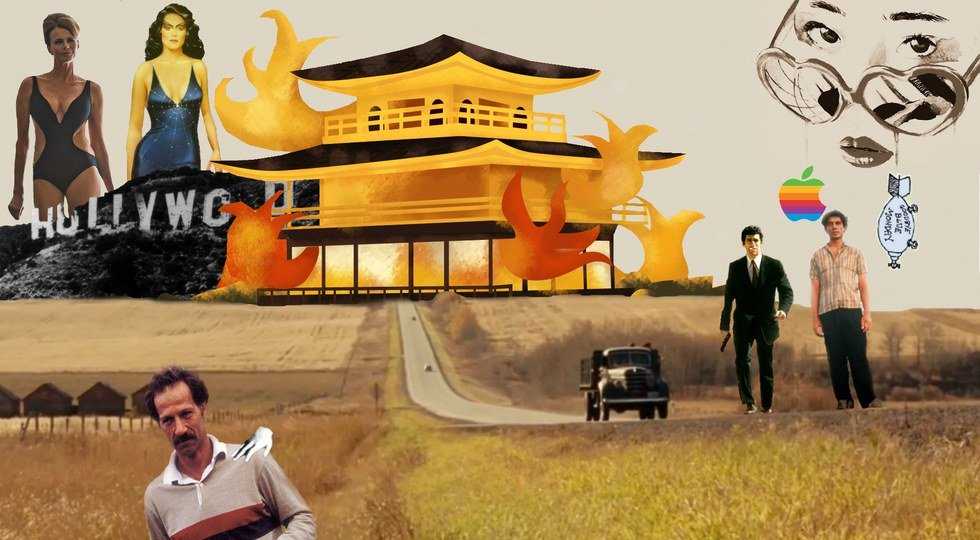
My New Year's resolution for 2015 was to read a book a month. I'm a slow reader and had a few daunting obstacles: a 60-hours-a-week job in the spring (working on Nicolas Winding Refn's "The Neon Demon," coming soon to a theater near you!) and my last semester in university, which involved writing two theses. But I did it! I read 12 books in 12 months! Pat me on the back, everyone.
Now that I got my narcissism out of the way, I should mention my system for choosing the books. There wasn't one, really; I just read whatever interested me at the time. I did decide short stories and plays didn't count, and I tried my hardest to be as diverse as possible in terms of genre. And I hadn't read any of these books before, so it was all unfamiliar terrain.
Below is a countdown of what I thought of every book, from worst to best. And let me know if you agree or, more interestingly, if you disagree. Contrary to popular belief, I like being proven wrong.
12. "Breakfast of Champions" by Kurt Vonnegut

(June. Audiobook read by Stanley Tucci)
Ugh. Every single page just screams, "ZANY ZANY ZANY IRONY ZANY!" I'm sure Vonnegut's a better writer than me, and this wasn't so bad that it made not want to read his other works. But damn, the joke of explaining every single mundane object in the story as if the reader were a zany alien reading about zany characters gets old fast. At least Tucci is a good reader and is able to differentiate characters without doing creepy voices.
11. "On the Road" by Jack Kerouac
(February. Audiobook read by Will Patton)
They're driving. They smoke a bit. They get in a truck. They talk about sex. They sometimes do it. And that's about it. Besides the occasionally cool factor of listening to it on my road trip out to Los Angeles while driving on precisely the same roads Kerouac describes, the book is pretty boring by today's standards. Sex, drugs, and booze is just another Tuesday night in the life of the 21st century twenty-something. Also this narrator was terrible.
10. "Of Walking In Ice" by Werner Herzog
(December. Actual book)
It's a bit unfair to judge this against the rest of these reasonably cogent books as it's essentially a stream-of-consciousness diary written by a weird German director as he treks across Europe, but it has some interesting moments. It's definitely the weirdest book I read, but also probably the most boring. It's more for Herzog completionists than for anyone else.
9. "Inherent Vice" by Thomas Pynchon

Similarly with Vonnegut's book and with, I assume, the rest of the post-modernist writers, it's way too "zany" for its own good. In its ridiculously complicated story of a pot-smoking private detective in 1970 Los Angeles, the book seems more concerned with crapping on the sentimentality of modernist writers and showing off how it's smarter than its readers. It ranks better than "Breakfast of Champions" by the mere virtue of being genuinely funny at times and having at least some slivers of melancholic pathos.
And on another note, what disappointed me so much about the film adaptation was how close it was to the source material. It's not a great book, but it provides enough excellent springboards for a great movie. Unfortunately, writer-director Paul Thomas Anderson deifies Pynchon to the point where he drags the author's flaws into the film. Frankly, Anderson is the better writer.
8. "My Last Sigh" by Luis Buñuel

The autobiography of one of my favorite directors reveals itself to be the memoir of a man I think of much less now. Basically, he paints himself as a ludicrously rich brat who turned into a bit of a boring old man. While his involvement during the largest political conflicts of the early twentieth century are fascinating, I really wanted to know more about his artistic processes. He also comes off as cruel to people different from him. I still love his films, but I kind of wish, in this case, I didn't know how the sausage was made.
7. "El beso de la mujer araña" by Manuel Puig

(August. Actual book, read in Spanish)
Now we're getting to the books I actually really liked. I read this book as part of my Undergraduate Research Scholar final essay. While I'll still hold that the film is superior, its mix of brutality with regards to the Argentine treatment of homosexuals and political revolutionaries as well as its effective emotional resonance make this a powerful read.
6. "The Day of the Locust" by Nathanael West

It's not perfect. The last third drags on more than it should, and it has that weird "Great Gatsby" feel of thinking it's showing you the vicious underbelly of humanity when, in 2015, more disgustingly immoral things occur in the average boardroom meeting.
But what's really interesting about the book is how raw its portrayal of struggling backstage people in Hollywood productions is. I've worked on film crews, and little has changed since the era described in the book. Thus, I found the book very disheartening and depressing at times, which is what West was going for. So good for him.
5. "Steve Jobs" by Walter Isaacson

(October. Actual book)
Walter Isaacson's biography on the brains behind Apple Computers is the longest book I read but easily my fastest read. Isaacson is an expert at condensing exhaustive information into an easy and logical order without ever dumbing down the information. It's really, really good, and I don't see the need to read any other book on the tech god. Whether you love him (like me) or hate him, it's a fascinating read, neither idolizing the man nor defaming him. The only reason it doesn't rank higher than the next biography is simply because Isaacson's terse prose (which is sometimes punctuated by unnecessarily flowery adjectives) doesn't quite reach the next book's poetic heights.
4. "Before Night Falls" by Reinaldo Arenas

(September. Actual book, translated from Spanish by Dolores M. Koch)
The autobiography of gay Cuban poet Reinaldo Arenas is a heartbreaking, staggering read. Arenas easily convinces you Castro's regime, at least in the 70s, was as oppressive as any of the worst dictatorships during the twentieth century. (It's also better than the movie, which I liked very much.)
3. "Lolita" by Vladimir Nabokov

(April. Kindle eBook)
It's definitely creepy, and it made my stomach churn more than once. But in his first-person narrative of a pedophile's obsession with his stepdaughter, Nabokov paints an unflinchingly upsetting and blackly comic view of the depravity of humanity. The fact the author was Russian and uses so much English wordplay is astounding and not praised enough. It's probably the most famous book on my list, and rightly so. It's a masterpiece. (As is the movie, directed by Stanley Kubrick and starring the brilliant James Mason.)
2. "The Long Goodbye" by Raymond Chandler

(May. Audiobook read by Ray Porter)
It's old hat to describe Raymond Chandler as gritty and hard-boiled, but damn, do those adjectives reflect the book's tone. It's tough, funny, and noir as hell. It's as hopelessly convoluted as "Inherent Vice" but 10 times as fun, and Chandler makes you long for a seedy Los Angeles full of crooks, dames, whiskey, and a lot of smoking. They don't make crime stories like they used to.
Ray Porter plays a really good Marlowe, the protagonist private eye, but the female voices are, admittedly, pretty creepy. I'll be reading Chandler via the more traditional method next time.
1. "The Temple of the Golden Pavilion" by Yukio Mishima

(March. Kindle eBook, translated from Japanese by Ivan Morris)
It's not as sexy as that cover implies, but my favorite book of the year is one of the most philosophically interesting and narratively engaging books I've ever read. Renowned author and legitimate madman Yukio Mishima (watch the movie "Mishima: A Life In Four Chapters" for more about him... you can borrow my DVD, it's cool) drew from the real-life story of a mentally ill acolyte monk who burned down one of Japan's most famous historical buildings, the Temple of the Golden Pavilion, and turned it into a thesis on the meaning of beauty.
In Mishima's fictionalized version, the acolyte narrator is afflicted with a terrible stutter and a less-than-pretty countenance. He is upset that the Temple he spends much of his time in merely exists, and in his view, nothing so beautiful can occupy his same physical plane. His mission to destroy it is derived from a perceived obligation to maintain the his own and the world's sanity, as if he must bring balance to the Force.
It's weird stuff, but it's an engrossing and fascinating study of the nature of beauty.
Let me know what you think and comment on Facebook! Happy reading!