

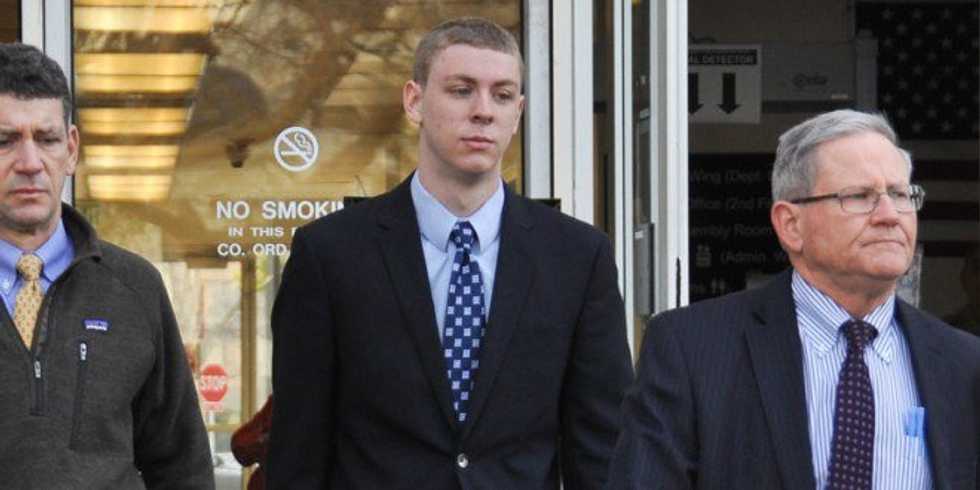
In January 2015, 20-year-old Brock Turner was seen by two eye witnesses sexually assaulting an unconscious woman lying on the Stanford campus behind a dumpster, according to prosecutors. Trying to escape, the witnesses held Turner back until police officers arrived.
The 23-year-old victim sought charges--which many rape victims on college campuses are systematically discouraged to do--and, against all odds, in March, Turner was found guilty of three felony charges of sexual assault, according to Mercury News. Only what seemed as a triumph of justice (that too often escapes the victims of rape and sexual assault on college campuses), quickly became another national travesty upon Turner's sentence hearing.
Initially facing a maximum of 14 years in a state prison, and the prosecution later aiming for a 6-year sentence, last Thursday Turner received a total of six months in incarceration and on probation (lowering the incarnation time to 3 months), requiring him to register as a sex offender.
This purposely light sentence, according to the presiding judge, was in reaction to the fear that a longer sentence would damage Turner's future, having a “severe impact” on his life as champion swimmer who once aspired to compete in the Olympics. This point was reiterated throughout the trial. Turner's future.Turner's aspirations. Turner's life.
Posted on Twitter by Michele Dauber, the Stanford law professor who helped draft new university procedures for penalizing sexual violence, Dan Turner, the offender's father, allegedly wrote a letter contesting his son's sentence.
The letter highlights concerns over Turner's loss of appetite, change in his "happy-go-lucky" mood, his anxiety, his depression, his dedication.
"That is a steep price to pay for 20 minutes of action out of his 20 plus years of life."
That line made our blood run cold. The line that ignited a social media fire.
I do not contest that Tuner's life has been "deeply altered" as his father alleged phrased. The point is he was deeply altered by a decision he, himself, made.
The fact that Brock Turner was athletically talented, intelligent, "charming," male, and white (yes, the latter is very important the US justice system, especially in sexual assault cases, but you already knew that).
Whether the 23-year-old victim was a college graduate working full time visiting her sister did not matter. There was no speculation over the victim's aspirations and goals that were altered because of her attack. Nobody paid attention to how her family was adversely affected or how concerned they are over her mental health.
The attack she did not choose to happen. The attack that she could not have prevented by simply not doing so--like Turner could have. The rhetoric surrounding this case is centered around Turner.
Even through the backlash on this sentence on social media, or the defense on Turner's behalf, everything is about the offender. The "debate" (and there shouldn't be a debate at all) is rooted on concerns (or lack thereof) on the offender's life and compromised Olympic future. His "gifted ability." His admittance to Stanford. His swimming scholarship. His struggle with feeling homesick. His academic success.
His attack. Not her assault.
Admittedly, I myself, while writing this piece, by responding to bigoted Facebook posts, am actively researching more about Turner and his background than thinking about the implications of the victim.
Even the use of a portrait picture instead of a mug shot in reliable news sources, showcases how media presentation implicitly paints a picture of a man fallen from grace due to circumstances beyond his control. If this were a fictional story, Turner would be the villain. Instead, this is patriarchal reality and he is the "all american swimmer" instead of the sex offender.
The fact that Stanford has banned him from campus and taken the correct steps to protecting the victim (which tends to be a rarity for universities), doesn't matter.
This is more than societal victim blaming, this is about victim-disregarding.
In the victim's letter directly addressing to her assailant, she depicts something that I hope will shift this rhetoric.
"You don’t know me, but you’ve been inside me, and that’s why we’re here today."
No matter what we try to make it, the case is about something horrible that happened to her. The life of her assailant is and should have been inconsequential to his action that will irrevocably affect this woman's life for the rest of her life.
She describes her reading an article about the details of her own assault.
"And then, at the bottom of the article, after I learned about the graphic details of my own sexual assault, the article listed his swimming times. She was found breathing, unresponsive with her underwear six inches away from her bare stomach curled in fetal position. By the way, he’s really good at swimming."
As she phrases, is Turner's list of achievements supposed to "cancel out all the sickening things that have happened"?
Instead of Turner being on trial, it seemed as if the victim was. She described in the letter the questions she was asked.
"I was pummeled with narrowed, pointed questions that dissected my personal life, love life, past life, family life, inane questions, accumulating trivial details to try and find an excuse for this guy who had me half naked before even bothering to ask for my name."
The sentence passed by the judge and the sentence written by Dan Turner represent the cruel reality young women face in this patriarchal society wherein our justice system operates. It represents the fear all rape and sexual assault victim face that their stories, their sides, won't matter in the end. We forget that the life "ruined" is not the assailant's; the life irrevocably impacted is the victim's.
(I may be digressing a bit, but why is it that a white convicted sex offender is described as talented and bright, using his best academic picture, but an unarmed black teen shot by a rogue police officer is described as a gangster, using a mug shot? Well, I suppose that is a story for another day.)
It is my hope that the attempts for a sentence revision is carried through in order to ensure the safety of the victim. It is her life and her future we need to be concerned about.