

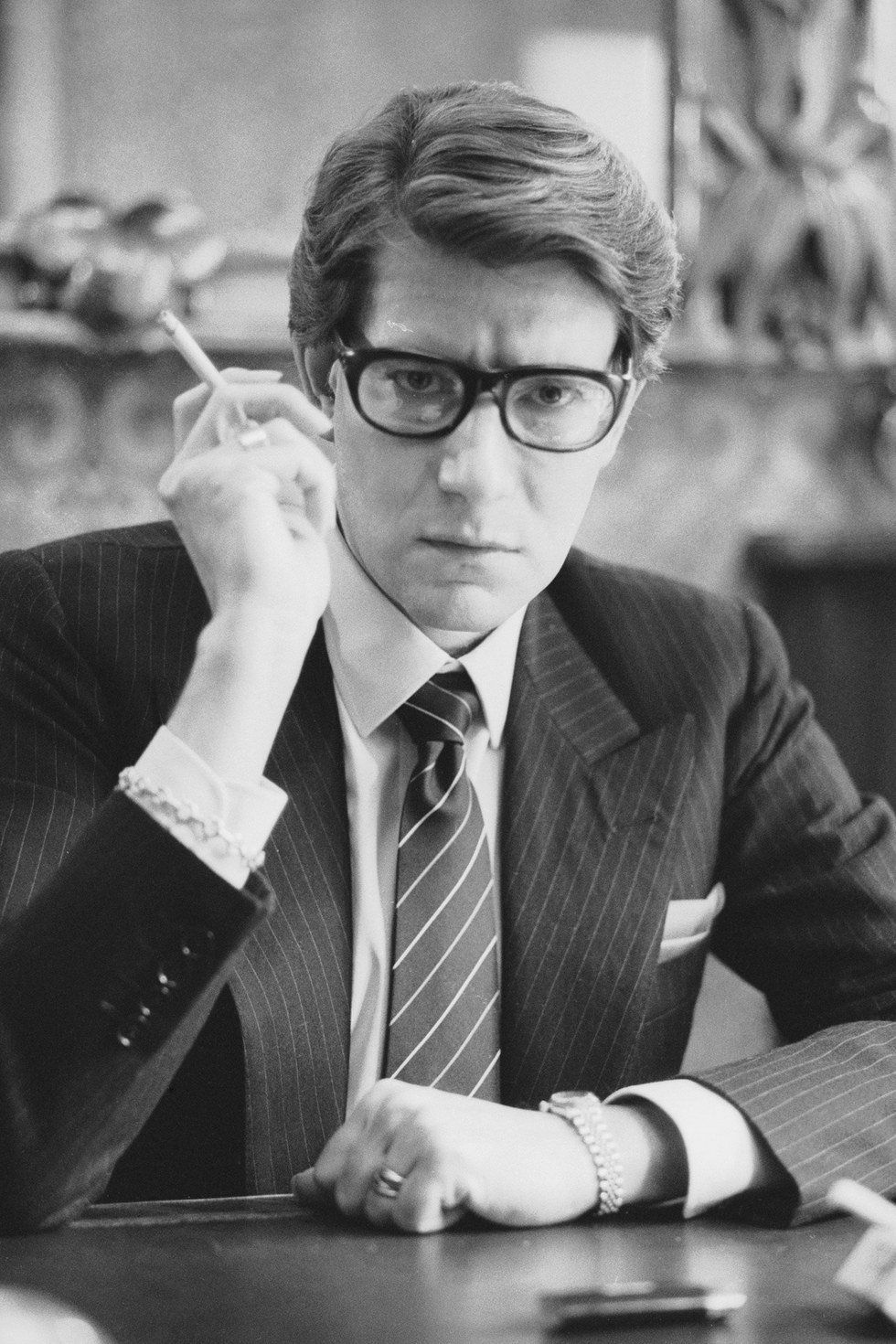
Widely regarded as one of the most influential names in the fashion industry, Yves Saint Laurent left behind a legacy that successfully challenged societal ideals on gender and sexuality, while simultaneously prompting the creation and acceptance of garments perceived as staple pieces in today’s wardrobes. His designs have been featured in countless editorials, museums, and art exhibits and have been worn by royalty and celebrities around the world. Now, as consumers in the 21st century, it is crucial to reflect upon the life and workings of Yves Saint Laurent, to better understand just how this creative genius transformed French couture into dynamic pieces of art that are still utilized today.
Born August 1, 1936, in Oran, Algeria, Yves Henri Donat Matthieu-Saint-Laurent spent his early childhood living in a villa by the Mediterranean Sea. He and his sisters, Michéle and Brigitte, were the children of Charles and Lucienne Andrée Mathieu-Saint-Laurent, a well-off couple who endeavored to create a secure environment for their children’s upbringing. It was in this close-knit family structure that Yves first confided his own predictions of reaching great magnitudes of eventual success for his designs. From a young age, he would become immersed in his mother’s fashion magazines and physicalize this inspiration through the creation of elaborate garments for the paper dolls he kept at home. At school, however, Yves lacked the protection of his kin and instead faced relentless torment and scorning from his classmates, for appearing to be homosexual. As the state of both his mental and physical health deteriorated from this treatment, he sought solace in the world of fashion. Yves would often design dresses for his mothers and sisters, which were some of the first instances of the couturier demonstrating his natural eye for the female silhouette. In 1953, he submitted three original sketches to a contest for young fashion designers, organized by the International Wool Secretariat. Yves was recognized as the first place winner and thus, was invited to Paris to accept his award at a ceremony. . While there, Saint Laurent’s mother arranged a meeting between himself and Michael de Brunhoff, who was at that time, the editor of French Vogue. De Brunhoff, who was both impressed and intrigued at Saint Laurent’s sketches, urged the boy to further his education in fashion, and a year later, Yves moved to Paris and enrolled at the Chambre Syndicale del la Couture.
While studying here, Saint Laurent found that his designs were gaining increasingly widespread notice, and began to see his dreams materializing before his very eyes. After graduating as a star pupil, Yves once again entered the International Wool Secretariat competition, and won, beating out both Fernando Sánchez and Karl Lagerfeld. Saint Laurent’s career was further enriched shortly after, when de Brunhoff noticed striking similarities between Yves’ sketches and the acclaimed fashion designer Christian Dior’s, and introduced the pair. Dior, who would become one of Saint Laurent’s most influential mentors, hired Yves immediately upon viewing his designs. This alliance skyrocketed Saint Laurent’s fashion career and greatly shaped the course of the designer’s professional life.
Saint Laurent went on to flourish at Dior and later lead his own fashion house, designing noteworthy pieces such as the trapeze dress and Le Smoking (an androgynous suit for women). Yves Saint Laurent will always be remembered as one of the most influential names in the fashion industry. Saint Laurent left behind a legacy that successfully challenged societal ideals on gender and sexuality, while simultaneously prompting the creation and acceptance of garments perceived as staple pieces in today’s wardrobes.