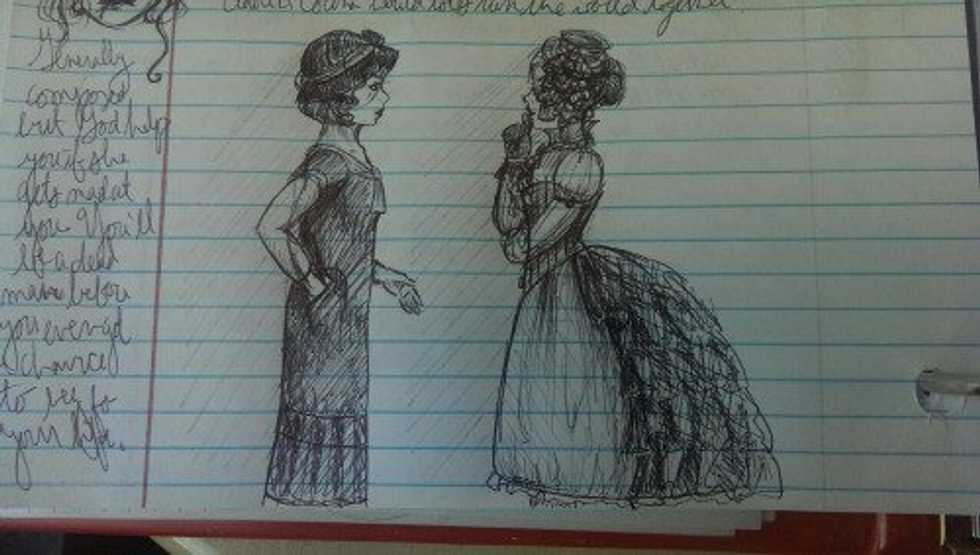
What do the fan fictions we wrote when we were twelve have to do with psychology? If you ask Freud (and I highly recommend that you don’t), an awful lot. But we’re not talking about Freud today. Or ever, really.
Instead, we’re going to talk about humanist psychologist Carl Rogers and his thoughts on self-concept. To briefly summarize this complicated idea, Rogers asserted we have a “real self” and an “ideal self”. The real self is who you are, and the ideal self is who you want to be. His idea of healthy development, called self-actualization, involves the real self becoming more like the ideal self as you grow older, provided you have a safe, healthy environment in which to explore. And then we all go skipping through meadows of flowers without a care in the world. Rogers was an optimist.
“But Julia,” I hear you say, “What does this have to do with writing fan fiction?”
Patience, grasshopper. We’re getting there.
We don’t always have the benefit of exploring our ideal self in the way Rogers would have prescribed. Every childhood is different, but some are more adverse to self exploration. How many times have you expressed a dream, or a desired quality, and been shot down? Even if it was impractical, like “I want to be a princess when I grow up!” It still stings to hear your parents, family, or teachers dismiss your dreams. Lots of kids all over the place are taught to be “practical” in their life goals and to suppress these ideal selves.
This is where fan fiction comes into play. Think back to the self-insert fics you wrote when you were twelve and never published. Anywhere. Ever. What were you like in those stories where you got to live in your favorite world and interact with your favorite characters? Did you have a skill you didn’t have in real life? Could you play an instrument you’d always wanted to play in real life, or speak a language you’d always meant to learn? Maybe your hair was a color you’d wanted to dye it but never got the opportunity to.
You didn’t know it then, unless you had an obsession with humanistic psychology at an early age, but you were expressing your ideal self. Rogers would have loved your fan fiction.
Lest you think you're alone in this endeavor, allow me to provide a practical example. I was really into the Legend of Zelda as a kid, if you’ve never played this game it is an expansive, fantasy universe filled with magic. So naturally, I took this obsession and made a character to fit into the universe and be amazing. She was half light elf, half dark elf, had fire magic powers, was a cheerful and bubbly person, good at math, and was very, very pretty. She excelled at just about everything she tried, and of course had some amazing prophetic destiny attached to her. Of course not all of this was practical, but you get the gist of what I wanted. I wanted to be successful, capable, important, and happy, which makes a hair more sense than me wanting to be an elf (although that would be pretty freaking cool).
My point being, even as fantastic a scenario as that was, it reflected something very normal, something every adolescent does. I got to think about myself in what I thought would be the best possible version. It gave me a goal to work toward. It may seem frivolous and unimportant from the outside, or even for the adolescents at the time, but there’s something to be said for taking our thoughts and putting them down into words. Multiple psychological studies over the years have shown a statistically significant correlation between writing down one’s thoughts and feelings and overall reduced feelings of stress and anxiety. It’s a way of taking abstract ideals and putting them in concrete terms, even if they are a little embellished. And it’s a limitless, entirely free way to explore these possibilities with little consequence.
Although we’ve all buried our old stories and original characters deep down where no one can find them, take heart in the fact that these adventures we went on helped us figure out who we wanted to be today. If you haven’t already deleted your old files or thrown away your old notebooks in a fit of embarrassment, I encourage you to skim your old stories (ignoring all the awkward grammar and misspelled words) and see if you can’t figure out who your younger self wanted to be.
You might just be surprised.