1. Record lowest snowpack in California along with a record drought.
Bottoming out to around 6 percent of total snow coverage in the Sierra Nevada mountain range, this beats out the previous record of 25 percent set back in 1977. California has experienced a record drought that led to little to no precipitation. Thanks to a strong El Niño, California has experienced some much-needed rain, but dry soil combined with heavy rain led to flash flooding and mudslides across many places in California.

2. Record-breaking Boston snowfall.
The winter of 2014–2015 was very active in terms of coastal storms, many of which dumped feet of snow at a time on New England. Boston received a record total of 110.6 inches of snow. To help keep this new record fresh in the minds of Bostonians everywhere, a 75-foot pile of plowed snow and ice did not melt until July 14—you could even follow the evolution of the melting snow pile on Twitter.

3. Record warmth across the U.S. in different months.
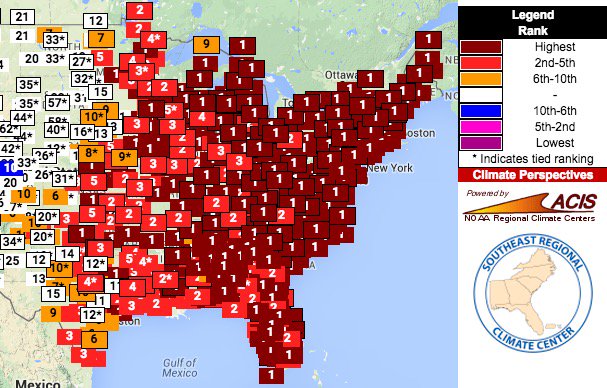
All signs are pointing towards 2015 becoming the warmest year on record (2014 is the current record holder). The U.S. can surely contribute to raising the global average, as numerous states recorded their hottest months ever. Some notable highlights include record warmth across the Pacific Northwest with California, Washington, Idaho, Oregon, and Utah all recording their warmest Junes on record. Most recently, many people along the East Coast recall the record December warmth with close to 12,000 records set for maximum daily temperature. The graphic below shows cities that recorded their warmest December on record along with other cities that experienced near-record warmth.
4. Record rainfall and record wettest months.
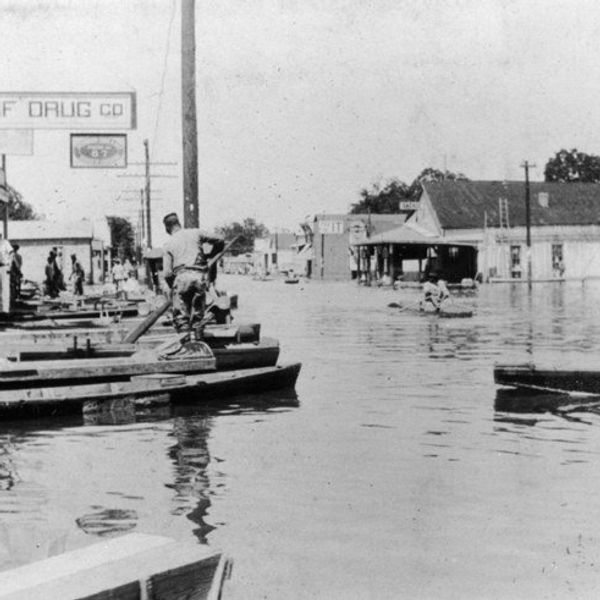
Many states experienced their wettest months on record, ranging from deadly flooding in Texas, Oklahoma, Utah, and Arizona to the catastrophic flooding in South Carolina back in October. Many all-time daily rainfall records were set in South Carolina as moisture from nearby Hurricane Joaquin interacted with an upper level disturbance and a stalled front off the coast of the Carolinas. This interaction led to what some call a "fire hose" of moisture, which was aimed directly at South Carolina. As much as two feet of rain fell in some locations over a 24-hour period, shattering the previous record of 14.80 inches which fell back in 1999 during Hurricane Floyd. Below is a gif of the "fire hose" where you can see the moisture extracted from nearby Hurricane Joaquin and aimed directly at South Carolina.

5. Strongest Hurricane ever recorded in the Eastern Pacific.
Hurricane Patricia had maximum sustained winds of 200 mph and a central pressure of 880 mb at its peak, breaking all previous records for the area. Patricia made landfall in Mexico as a category 5 hurricane, however, Mexico’s mountainous terrain quickly weakened Patricia along with the predominantly rural cities within the storm’s landfall and alleviated a potentially large-scale disaster. The leftover moisture from Hurricane Patricia went on to create flooding problems in Texas.