

Weddings can be enchanting, and a marriage can be a beautiful relationship that two people share. However, it stops being enchanting and beautiful the moment you are continually pressured to get married. It is almost baffling to me that at the mere age of 21, I feel the need to write an article explaining to people why they should stop pressuring me, and everyone else for that matter, to get married. Do not get me wrong, however; if I decide to become a 41-year-old unmarried cat lady, I do not particularly want any pressuring comments then either.
Marriages and weddings have become more of an expectation than a natural occurrence. If you have been with a romantic partner for a certain amount of time, marriage is expected and pressured. This issue seems to be a universal one due to the sensationalism of weddings and marriage.
Because of this, I have been pressured to get married more times than I have cells in my body. For that reason, I have begun to analyze the concept of weddings and marriage and what it all means. After doing so, I have come up with three points that demonstrate why marriages and weddings are less than necessary and why the marital pressure needs to come to a halt.
1. Weddings don’t grow on trees.
Weddings today are ridiculously lavish. The average wedding in America costs $26,444. To put that in perspective, an individual could easily buy two cars with that money, pay off student loans or put a down payment on a house. Using the car example, people do not typically have the money to buy one car, let alone two, in the full amount. Instead, car owners usually decide to pay monthly installments until the one car is paid off in roughly three to five year plans. Three to five years.
All of this money is used to lavishly alert friends and family that a couple will be spending the rest of their lives together, a message that has probably already been conveyed through social media.
Consider for merely a second how the world could be different if people instead put that money toward a good charity or even another life event that serves a greater purpose.
2. The term "wedding" is not a synonym for love or happiness.
When interviewing a homosexual man after the legalization of same-sex marriage, I asked him what this means for him and his partner. He responded by saying now if his partner is ever in the hospital, he can visit him. If he ever dies, his partner will be taken care of with life insurance coverage. If they decide to split up, he will still be able to see the kids, if they decide to adopt. Never did he say I can love my partner more now because same-sex marriage is legal.
For some reason, people are under the impression that the love in a marriage is more profound than the love in a typical romantic relationship. Believe it or not, the term “marriage” does not directly translate into love or happiness. If I love my boyfriend, I do not suddenly fall more in love with him because we are married. If I am happy with my boyfriend, happily ever after credits do not appear after we get married. Marriage also does not translate into exclusivity in the relationship nor does it even mean life commitment anymore. If an individual wants to spend the rest of his or her life with someone else, they can just do it.
3. A wedding consists of mindless tradition.
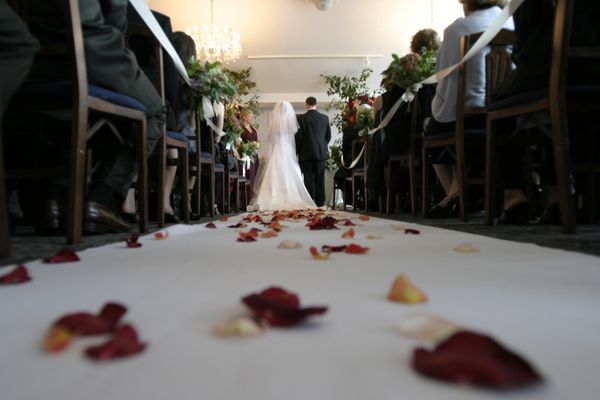
Once the engagement ring is on the finger, a woman will began thinking about walking down the aisle with her father, picking out a white dress, finding a matching veil and tossing a bouquet. But does she actually know why she is doing any of these actions? Most likely not. Instead she will participate in this traditional simply because that is what everyone else has done. These traditions are actually not romantic. In fact, most of the wedding traditions were created to ward off evil spirits. Below are just a few of these traditions and how they came about.
a. Walking down the aisle with a bouquet: This tradition was established to ward off evil spirits and also to fill the air with nicer scents since bathing was not done as often in the old days.
b. Bridesmaids: A group of girls would stand next to the bride wearing identical dresses to confuse these evil spirits.
c. The Veil: Marriages used to be mostly arranged and seen as more of a trade between families. Therefore, the first time the groom and bride usually saw each other was at the wedding. It was common for the groom to run away if he was displeased with the bride’s appearance. Hence the creation of the veil.
Thankfully, those evil spirits finally took a hint, and there have been no sightings of them for years.
There is a moment when you realize that weddings are not necessarily meant for you and your partner. When the pressure continues to build, I attempt to remember that, despite my hate for the weddings, it is for the happy tears of my mother and the joy of my friends.
If I do not crush under pressure, however, my dream is to wear a white dress, take my partner’s hand in mine, and find an individual or a cause that needs $10,000 or so more than we do.