

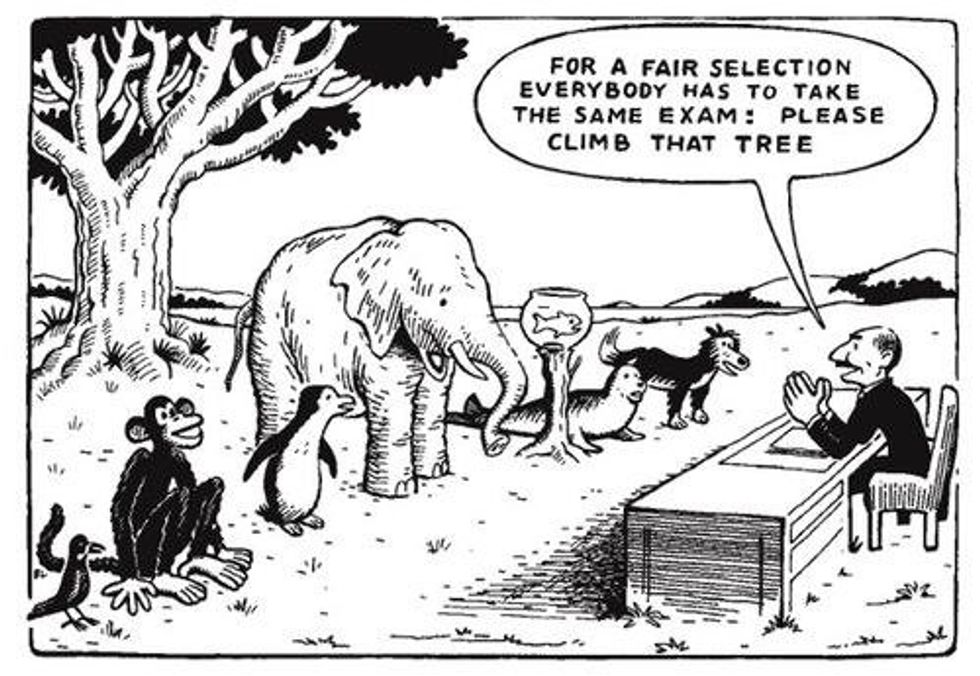
Society is seemingly obsessed with one-size-fits-all categories. The clothing brand, Brandy Melville, prides itself on the ease of shopping for their single-size clothing—no more lugging around three sizes of each shirt to the dressing room—yet many claim the brand only caters to model-esque frames. Under this claim, how could these clothes possibly be one-size-fits-all? It simply can’t be done because of our vast diversity. Brandy Melville has unknowingly portrayed the shortcoming of cramming many attributes—in this case, body types—into a singular category.
For this reason, celebrities such as Miley Cyrus, Ruby Rose, and JD Samson have taken a stand against gender binaries, instead advocating for gender fluidity. Miley Cyrus said in Out magazine, “I don’t relate to what people would say defines a girl or a boy, and I think that’s what I had to understand. Being a girl isn’t what I hate, it’s the box that I get put into.” Sure, categories can facilitate sorting emails, but it seems that the more societal categories we have, the less people fit in. This begs the question, what is the norm?
Perhaps that is the problem in and of itself. Society only caters to specific types of attributes, yet it is impossible to have it all.
Here’s why this issue is so important: some people just don’t fit into any given manmade categories. Sure, one could argue that the millennial generation is hypersensitive to these issues, but even so, categories alone can never account for something as an entirety. It seems silly to claim that someone can like pizza or sushi but not both, so why doesn’t this theory apply to clothes or gender binaries?
As a female, I find that assertiveness is often confused with bitchy-ness. Meryl Streep in "The Devil Wears Prada" is portrayed as a cold-hearted boss while Leonardo DiCaprio in "The Wolf of Wall Street" is an idolized stockbroker, despite his ILLEGAL business deals. Gender roles aside, the notion of “this” or “that” is disturbing. Young boys and girls are growing up in a society that believes they can be beautiful and worthy OR insecure and self-conscious. Let me be clear: I am all of the above. I can look in the mirror and say I am beautiful and competent while also bearing insecurities. I can call myself beautiful—because, well, I am beautiful—without being accused of cockiness. I can be an assertive and successful entrepreneur, yet be submissive in other areas of my life. I can have a blunt opinion, yet too shy to call the doctor to make an appointment—seriously, does anyone enjoy doing that?
If you rely on categories and attributes to determine your worth, you will never be worthy because there will always be a disparity. Instead, the conversation must shift from, “Am I beautiful?,” to “I am beautiful, but I am also flawed.”
















