
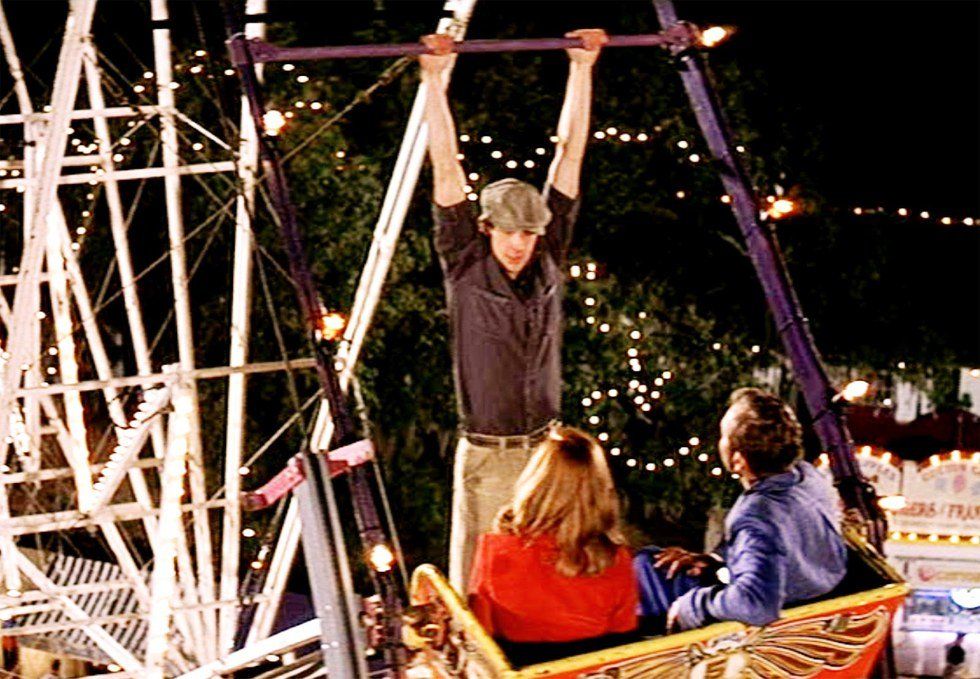
Consider a classic “chick flick” like "The Notebook" This film (and novel) is one of the most popular modern love stories. It follows a relationship between a well-to-do woman and a lower-class, hardworking man. Their beautiful relationship begins when Noah asks Allie on a date, and when he is refused, he asks again, undeterred. Romantic, right? He tirelessly pursues her, and she is perpetually aloof. Finally, he threatens to fall from the top of a Ferris wheel and she surrenders to his advances. Considering the popularity of the story, this scenario is well received.
This scenario—a man persistently pursuing a woman, who indifferently observes his pursuit until he has 'earned' her affection—is not just a thing of romantic comedies. It is the template followed by much of the dating culture today (at least in the straight community). A man must express interest or "make the first move", and then often women are compelled to "play hard to get" and act, to some extent, disinterested. After all, this is the classic beginning of a love story. Possibly this traditional approach is less universal than it once was, but it is still common. Yet, is it fair—or even effective?
First, let's analyze the gentleman’s perspective. Every step of the way, he makes himself vulnerable to rejection; he has to express his feelings and simultaneously impress and please his potential partner, all the while maintaining his confident, masculine persona. Of course, this is assuming he has enough confidence and commitment to follow through. Assuming this hypothetical man pursues more than one relationship, he has to go through this process multiple times. In the average romantic comedy starring Ryan Gosling, these steps are followed through flawlessly. Admittedly, realism isn't a requirement for romantic comedies.
In the woman's case, there are a few possibilities: firstly, a man expressing interest in a woman that feels the same way. If the woman "plays hard to get", her passivity is deceiving; a bystander would have a hard time actually gauging her feelings. She could be desperately in love, but who would know, if she feigns indifference? This poses a problem for the suitor, since he has to guess her emotions. Though the relationship may eventually develop, at best, it's an ineffective process.
The scenario poses another problem if a man expresses interest and she does not reciprocate feelings. Since her aloofness can be misinterpreted as "playing hard to get," he won't take her rejection seriously and instead pursue her with more insistence; after all, Noah didn't take Allie's refusals seriously and they eventually wound up dating. This results in a woman clearly expressing that she isn't interested, yet being bombarded by the “romantic” efforts of a man ignoring her rejection. This scenario is dangerous. It is a case of a woman saying "no" and a man hearing "yes," and it is the fault of miscommunication from an outdated approach to romance.
Not to mention, in a traditional approach to dating, the gentleman is the sole initiator; to start a relationship, a man must approach a woman and explicitly tell her that he is interested. What happens if a woman has feelings for a man, who hasn't yet approached her and professed his love? Assuming a man must initiate the relationship also assumes that a woman must stand passive until such a man presents himself. A woman may be pining for an oblivious male, but unless she can act on her feelings, she might as well have no feelings at all; she is ultimately powerless to control her love life, in this scenario.
What if no script is followed, and it doesn't matter who initiates the relationship? It would be commonplace for a woman to ask a man out on a date, to kiss him first, to call him first and to express her interest in him, even when there is no guarantee of reciprocation. Men wouldn't have to question a woman's true feelings, and they would take rejection seriously. This scenario is healthier for both parties and, thankfully, becoming more common all the time.