

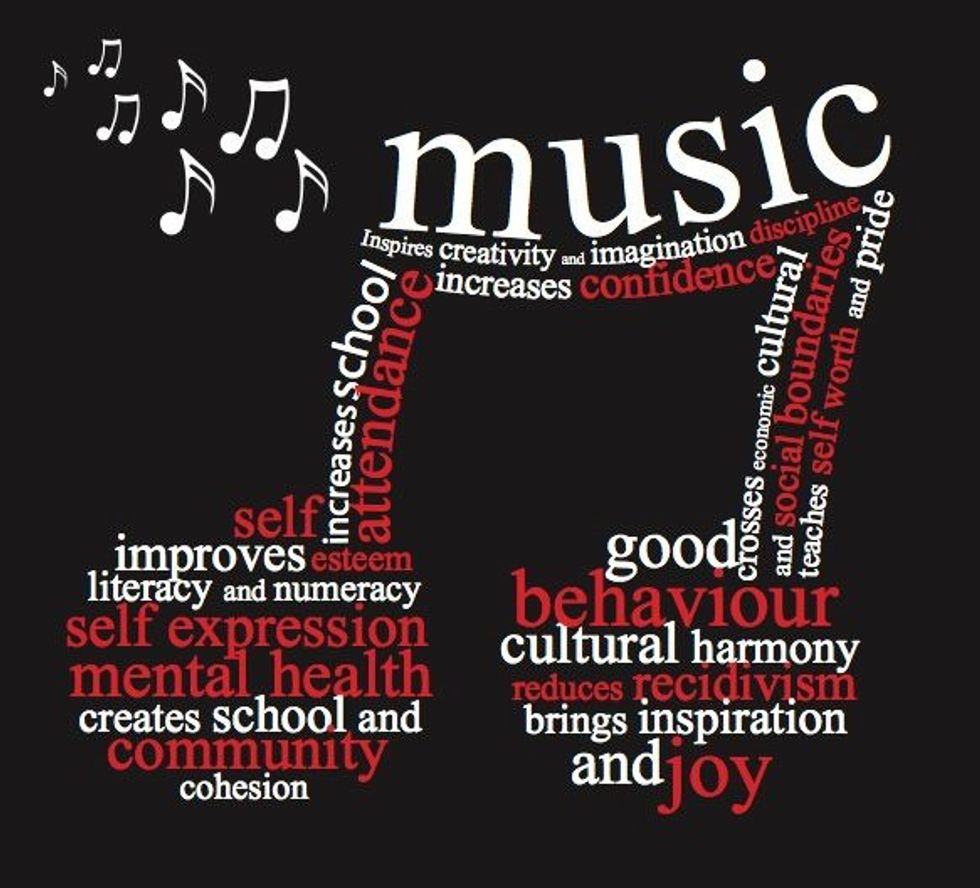
Where can you learn discipline, determination, and improve self-esteem? Music education.
What helps develop language and reasoning? Music education.
What can raise test scores and grades in the classroom? Music education.
Music Education. It’s something beyond valuable that is getting cut from schools all across the country.
In fact, since 2008, 80% of schools have cut budgets or cut programs completely. This is a huge problem that many people don’t realize. Music is extremely beneficial to all ages.
Just let science do the talking. A study by Virginia Penhune at Concordia University shows that musical training, particularly instrumental training, produces long-lasting changes in motor abilities and brain structure. The earlier a child starts instrumental training, the stronger the connection between the right and left hemispheres of the brain. These changes last into adulthood and are proven to affect the ability to listen and communicate as an adult.
Yet, Aside from the studies of science to convince you, I have decided to compile a list of my top five reasons why music education is just as important as “core” subjects are in school. In fact, it should be considered a core subject itself.
1. Improved Performance
Music education improves the overall performance of students, including in the core academic subjects that are often emphasized by standardized testing requirements. Actually, students in music education scored 63 points higher on verbal and 44 points higher on math.
2. Risk-Taking
Performing a musical piece can bring fear and anxiety. Doing so teaches kids how to take risks and deal with fear, which will help them become successful and reach their potential.
3. Teamwork
Music Education requires teamwork. In these groups, students learn how to work together and build camaraderie.
4. Self-Esteem
With encouragement from teachers and parents, students can build pride and confidence when they achieve something new, whether it be hitting a new note on their instrument, or being able to play a hard piece of repertoire.
5. Build Out-Of-The-Box Creativity
Kids who study the arts can learn to think creatively. This kind of education can help them solve problems by thinking outside the box and realizing that there may be more than one right answer.
In my own experience, my school's music education program made my high school career. I started in fifth grade on the clarinet, a shy, nervous middle schooler. By my sophomore year, I had branched out, made lifelong friends, and achieved great things. Until I played my very last note senior year, I put literal sweat and tears into my practice. I had set goals, whether it be to learn a challenging piece of music, or to audition for region band and make it to all-state band. The music education program pushed me to do my best and pushed me to push myself to higher levels. All because of my experience with music, I go to a great college, get great grades, and am involved in multiple and diverse extra-curricular activities. I set goals for myself and think creatively. Without music education, I wouldn’t be where I am today. Because of this, I fight for something so precious and equally as important as any other subject. Why deprive students of something that can be so crucial to their development? It’s shown all across the board that music does nothing but boost a child’s development.
With this being said, it’s music in our schools month. I encourage everyone to go out and support local music programs. Go to your local high schools spring band concert, your local colleges choir concert, and the bake sale for the marching band. I also encourage everyone to bring their music programs to the attention of administrators, parents, colleagues, and communities to display the positive benefits that school music brings to students of all ages. Together, we can help preserve music programs.