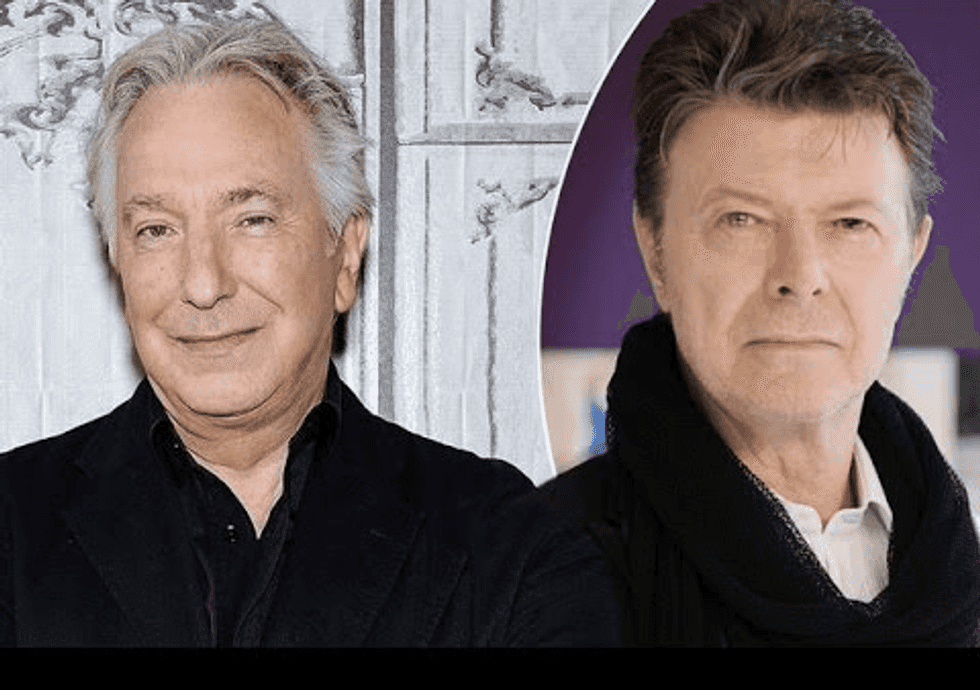
I am not a fan of Alan Rickman. I didn’t know he had cancer, and I didn’t keep up with his work. Though I know I’ve seen him in other movies, I can’t actually name anything he was in except the Harry Potter series. Don’t get me wrong, I didn’t hate him or his works by any means, but I don’t think my apathy makes me a fan in any sense of the word.
So why, when I saw the article headline at 6:58am on January 14th announcing his death, did my heart drop? I read the headline and reread it, and even went to Google to confirm that it wasn’t a hoax, and I sat in disbelief. None of my friends were awake, and I sat waiting for them to find the news as soon as they woke up and opened social media. I needed other people to talk about it, to tweet and Facebook about it, for it to really be real.
Like most people that talked about his death following the announcements, I had never met Alan Rickman - so why did his death affect us so much?
We, as humans, are selfish. In a world of constant change, we desperately cling to anything relatively stable, anything that we think won’t change, or at least won’t remind us of the passing of time. As we grow up and grow older, our lives are a blur of change - whether it’s moving schools, graduating, parents divorcing, relationships, etc. The one thing we rely on to be a constant is the media. We look to our favorite actors and singers to be exactly as they’ve always been.
When we finally do notice a change in celebrities, it’s very drastic and abrupt - they somehow change overnight - like realizing Carrie Fisher is no longer the Leia we knew in the 80’s, or that 1/3 of the cast of Friends now has gray hair. And yet, even though change has occurred, unlike our childhood memories, we can always replay our favorite David Bowie songs or re-watch Friends over and over again, reliving how it made us feel the first time we encountered it; in a sense it’s like time has stopped.
That’s one of the biggest reasons why we’re so shocked by celebrity deaths. We are often guilty of placing celebrities on pedestals and treating them as idols; doing so, however, takes away their humanity - it’s the reason we often invade their privacy in the media, and gawk at them like animals in a zoo. When they die, they remind us not only of our own mortality, but also of their own- that while the characters they played and the songs they wrote live on, they are still capable of dying just like the rest of us “regular” people.
We did it with Steve Irwin in 2006, we did it with Michael Jackson in 2009, Amy Winehouse and Steve Jobs in 2011, Whitney Houston in 2012, Robin Williams in 2014, Leonard Nimoy last year, and now in the early weeks of 2016 we do it with David Bowie and Alan Rickman.
None of this, of course, is to say that we shouldn’t mourn celebrities. We millennials, especially, grew up in a world that has evolved rapidly - when I was younger computers were still ugly, heavy, beige boxes, and now we have computers in our pockets and on our wrists, drones exist outside of science fiction novels, and we’ve seen acts of terrorism and the first black president.
Now more than ever we are able to connect with celebrities in a deeper level - instead of just reading about our favorite singers in magazines, we can follow them on Twitter and read their thoughts and talk to them, and if we’re lucky they respond to us; and we can follow them on Instagram or Snapchat and get insight into their daily lives. It’s only natural that when a celebrity we love dies, we feel like we’ve lost a distant relative. It’s okay to grieve for a celebrity you’ve never met, or feel at a loss for words. It’s okay to cry, and it’s okay to not feel affected at all. The only thing that’s not okay is to become so focused on their death that you forget all the things you loved about their life. You will always have the CDs, the movies, the books, and whatever it was that they poured their passion into.
Remember, in the words of J.K. Rowling: “Hogwarts [and Alan Rickman] will always be there to welcome you home.”