

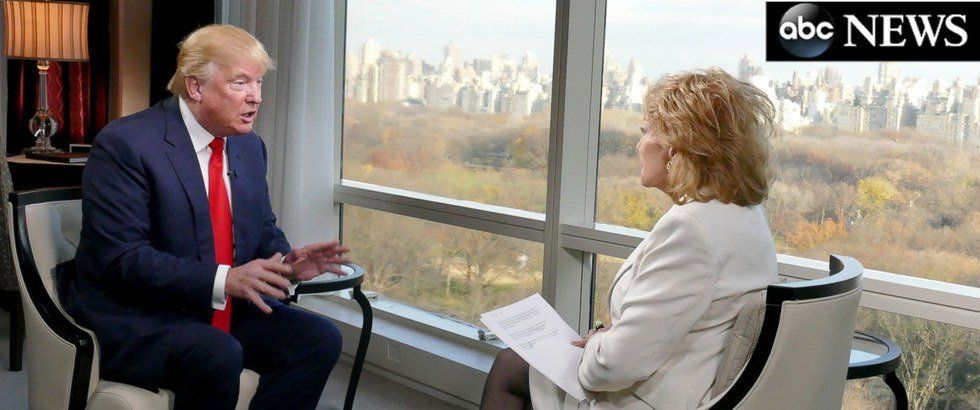
Sometimes we forget, watching politicians exchange barbs on television, that we are watching them on television--what I mean is that everything we learn about the election is mediated through media of some sort, which has as many agendas, blind spots and cover-ups as the politician we read about in our newspaper or online. It's important to keep this knowledge upfront, especially since politicians can rise or fall based on media coverage. With that in mind, I present two illuminating anecdotes that shed light on the media’s power during election season.
On March 16th, the New York Times published an article about Bernie Sanders' history as an "effective, albeit modest legislator," working to get policies he likes passed by tacking them as amendments onto larger bills. The piece has a mixed tone, pointing out at one moment how this disproves allegations of Sanders' inefficiency and in the next likening his tactics to a Tea Party Republican. But it was mostly cautiously favorable despite being described as "a left-handed compliment" by Matt Taibbi of Rolling Stone, a surprise coming from an outlet that has endorsed her bid and which has been accused of a pro-Clinton bias.
That all changed once the story went online.
As Taibbi's article noted, several changes were made to the Times' article once it was put on their website. In the first place, the headline was no longer "Bernie Sanders Scored Victories for Years via Legislative Side Doors"; it had become "Via Legislative Side Doors, Bernie Sanders Won Modest Victories." A bit more dour. Some cuts were made and other parts were added. For example, a line in which Sanders' policy was called "very successful" was cut and replaced by two paragraphs that downplayed how succesful Sanders' tactics had been. Overall, the "left-handed compliment" had evolved into a shrug and raised eyebrows.
The New York Times' Margaret Sullivan eventually put out an article of her own, in which she took aim at her own paper's behavior. The Times, for its part, sought to characterize it as nothing more than some light editing to give the piece more perspective, which Sullivan herself denied in her piece.
The takeaway from this incident shouldn’t necessarily be a knee-jerk reaction against the Times. In this case, readers got to see in real-time how a piece got edited to hew to a paper’s agenda, but the sad fact is that things of this sort go on in any large paper. The question is how to address it. I’m in sympathy with Frank Russell of The Hill, who, discussing the Times’ pro-Clinton bias, wrote: “If The Times has decided to forego impartial coverage of political campaigns in favor of more of an advocacy approach, it should make an announcement to that effect.” Not an erasure of bias—which is impossible—but at least honesty, is what we need from our outlets.
For instance, I think we would have wanted more honesty and less forced “neutrality” with Donald Trump. The media has aided Trump in many ways, not in the least by giving him undue respect and failing to call him out on his insane behavior. In fact, they often support him.
A long piece by NPR entitled “How the Media Failed in Covering Donald Trump” showed evidence of news organizations consistently allowing Trump space to promote his ideas and failing to address his out-and-out lies. Vox did an excellent write-up about the latter in which they identified several lies in an interview with George Stephanopoulus. Trump’s lies include:
- Crowds of Muslims cheering in New Jersey as the Twin Towers fell (there were none)
- Obama planning on allowing in 250,000 Syrian refugees into the US (the number of total refugees is possibly 185,000, and Syrians would be a fraction of that)
- The claim that most Syrian refugees are young men (they are mostly women and children), and
- That current gun legislation already bans people on terrorism watchlists from owning guns (it doesn’t).
As the Vox piece notes, Stephanopoulus tried to address some of Trump’s lies, but he shirked from out-and-out calling them lies. For a candidate like Trump, whose appeal is brute, forceful declamations, brute, forceful declamations might be needed to counter him. The press cannot behind a façade of neutrality when people are promulgating such dangerous untruths as Trump does. It doesn’t have to, as the Guardian did, relegate him to the entertainment section: his campaign is about much more than entertainment, and it is a genuinely political matter. But it needs to make clear that the behavior we’ve seen isn’t normal political fare and shouldn’t be treated as such. The throughline between the New York Time editing scandal and the media’s behavior toward Trump is, I think, responsibility. We don’t need or desire news organizations that are just the facts, served coldly, and we obviously don’t want ones that bias their stories without acknowledging it. We want news organizations that can take responsibility for their actions. Keep that in mind the next time you open a newspaper, watch a debate online or turn on your TV.