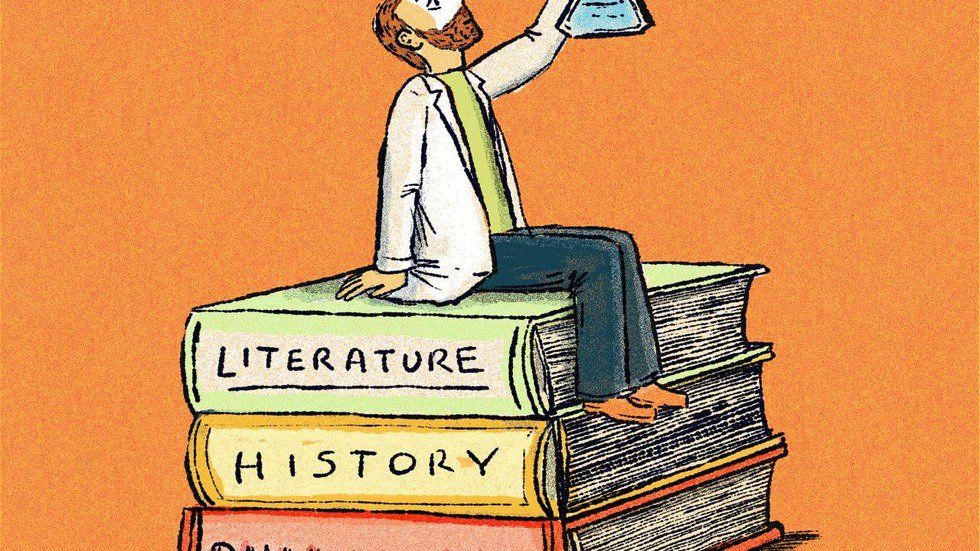
In order to complete my degree in the Honors program at my school, I am required to take a final 1-credit Honors seminar during my senior year, which I did this past semester. The class served as a sort of forum to reflect on all the positives and negatives of our education: our aspirations, our actions, and our lives themselves– past, present, and future. But more than that, it was a forum to be honest – about our fears, our doubts, our joys, our perceptions, our hopes, and our experiences.
Our professor modeled it after a similar experiment at Harvard, though theirs is one intended for freshman who are looking ahead to their college goals and how they can achieve them. Besides asking us questions about our lives though, we reviewed what it means to live a meaningful life, and how our education can take a part in this process of finding meaning. And our main consultant for this was Martha Nussbaum’s book, Not for Profit: Why Democracy Needs the Humanities, which goes on to explain the importance of keeping the humanities alive in our institutions if we have any hope of developing a democracy, and more importantly, a citizenship filled with empathy and understanding for not only those similar to them, but those far different. Rather than stress the fundamentals of what it means to be a human, she argues that the current trend is more focused on how to develop economic growth, with little emphasis on personal growth. “If this trend continues, nations all over the world will soon be producing generations of useful machines, rather than complete citizens who can think for themselves…,” she writes.
In case you’re unsure of what exactly constitutes the humanities, think of the dreaded liberal arts degrees that everyone warns you about.
“There’s no money in that field.” “What are you going to do with that degree?” “Why don’t you study business?”
They’re the subjects that they drill into you throughout your entire life, before they turn around and tell you that you can learn them all you want, but they really won’t provide a living for you after school. They’re the subjects that focus on creation, imagination, and the human spirit. They are “the study of how people process and document the human experience,” as Stanford University describes them. They include English, history, philosophy, religion, art, music, etc., and they are dying out. The world is increasingly telling its youth to become accountants, study engineering, work for a Fortune 500 company – that is, if you want to “live comfortably.” Forget about working in the humanities and human service fields; that’s not where the money is.
What are we saying? Does anyone even hear themselves? It starts in the schools, but then it spreads everywhere else – into our politics, into our media, into our social interactions. Money, money, money. Art is for the rich, reading books is for the bored. History comes from a textbook, and apparently isn’t something we intend to learn from, as the world proves time and time again, and religion is a fraud. This is what we see, and what we are told. “Be practical, study something that will make you money.” But when’s the last time practicality stopped a child from crying? Or gathered an entire village around a campfire and enchanted them? Or when’s the last time practicality even taught someone something new, something profound? When’s the last time it taught them how to be bigger than their own self?
Don’t get me wrong – economics, accounting, science – all these things have importance and immense value and should be sought in their own right by those who excel at them and are passionate about them, but they are not for everyone. Likewise, the arts and humanities are not “for everyone,” but they do at least offer each human a chance to learn about how to connect with others in a profound way, in a way that’s both intellectual and emotional. They are about understanding one another, no matter how different we may be, and through this understanding, offering empathy and a new worldview to those who know only their own.
If we do not encourage humans to learn about other humans, then what hope do we have to fix the problems that face us? Bigotry and hate, racism and sexism, belittling and falsifying; if this is what you see, if this is what you fear, then engage in your own humanities studies. The education system may be failing us, with cuts to arts and humanities programs in favor of advanced technology, but so long as we believe in the humanities and exemplify their gifts to society through our own actions, we can ensure that, at the very least, the fight is kept alive.
For more information on Nussbaum's book, see here.