
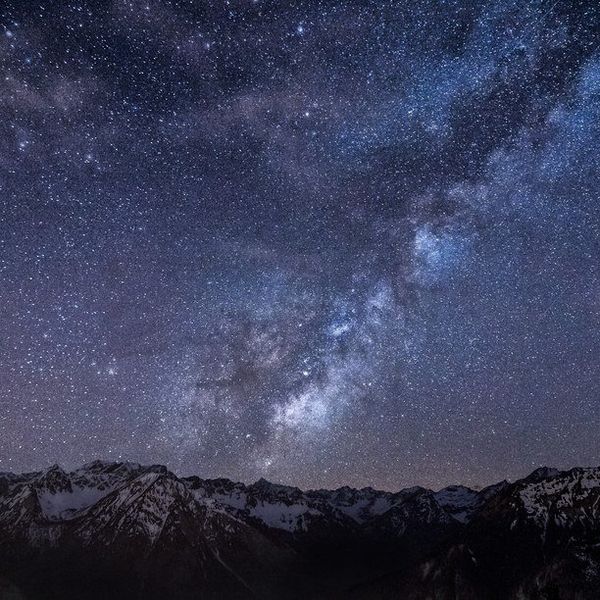
The year is 1590. A man stands in an open field looking to the sky. It is a black, murky color, speckled with various sized white dots. The scientific leaders of the world had an idea as to how our universe worked. As far as humans were concerned, the Earth was at the center of our solar system, and everything else rotated around us in perfect circles. The man was a pioneer for the idea that the Earth was not the center of the solar system, supporting the Copernican theory. That man was Galileo. He was the one who looked to the stars for answers and created his own version of the telescope, which allowed him to make discoveries that were shunned at the time. Since Galileo, we have traveled leaps and bounds, from the early stargazers to the Hubble Telescope; we continue to look to the sky and dream of all that is out there.
The human race has always been a curious species. Ever since our beginnings, we’ve tried to figure out how things work and what the world around us is like. One thing that has peaked our interest, since we turned our gaze to the sky, is space. The vast expansion that our planet exists in has always proved a mystery. Nomads in the Sahara and the people of the Southwest region of America, used stones to mark important events in the stars, like the summer solstice. Other civilizations, like the Ancient Egyptians, Celts, and Mayans, built vast stone structures, aligned to the seasonal risings and settings of the sun, moon, planets and some bright stars. These structures helped them with their farming, telling them when to plant and harvest their crops. To these early civilizations, the sky served as a calendar, clock and navigational aid to help sea travelers find their way on the oceans. (Tools of Cosmology)
With stone structures as intricate as mentioned above, it would not be long before smaller objects were made out of metal for “home observations”. One device was called the Astrolabe. This device was a handheld object with moveable arms to measure the angle of a bright star in the sky. It measured the star’s “altitude”. The Astrolabe had a moveable, rotating map of stars that were lined up to determine the desired data. There were engraved curves that the map slid into to help the user determine when the sun would rise or set and provide other calculations. This tool was developed in the 1st or 2nd century, but did not become standard until the 4th century. The Astrolabe was extremely important to Muslims who used the device to determine the proper time to pray and the direction of Mecca.
“The Great Mural Quadrant” was a massive instrument to measure angles and was much more accurate than handheld devices. The Quadrant was a large 90-degree arc that was attached to a north-south wall. This giant tool was used to measure the altitudes of stars and planets in the night sky. Tycho Brahe built the most famous of this type of instrument. Built in the 16thcentury, Brahe was able to record the positions of certain stars and study the motions of planets over several decades. These measurements were the most accurate ever recorded, until telescopes entered the field that is.
The first telescope was built in the Netherlands in the 17th century. In October of 1608, the national government in The Hague discussed a patent application for a tool that could aid astronomers in “seeing faraway things as though nearby”. (Tools of Cosmology) Now enter Galileo. Galileo did not invent the telescope; he did however redesign the current model of the time to allow for a higher magnifying power. This optic tube was mostly for Galileo’s own use and that of his patrons. His design was a tube with two lenses, that allowed for much better quality of an image. With this new design, Galileo helped support the new idea that the Earth and other planets orbited the sun.
Now, enter Johannes Kepler. Kepler suggested a new and improved design of Galileo’s optic tube. He made the recommendation in his book, Dioptrice in 1611. Kepler’s design could be built with two convex lenses; the only flaw was that the image would be upside down. Other than that, it was a brilliant idea. The images were much brighter and the scope had a much larger viewing field than Galileo’s design. Kepler’s telescope was widely accepted by the middle of the 17th century. By the beginning of the 18th century, long refracting telescopes were a thing of the past. A new design of telescopes was gaining credibility, the reflecting telescope.
The use of telescopes led to many important discoveries. Galileo observed objects like the moon through his telescope. He wrote that, “The surface of the moon to be not smooth, even, and perfectly spherical, (…), but on the contrary, to be uneven, rough, and crowded with depressions and bulges. And it is like the face of the earth itself, which is marked here and there with chains of mountains and depths of valleys”. (Australia Telescope National Facility). Galileo also observed the planet Jupiter. He discovered four objects that would move, throughout each night, sometimes disappearing behind the planet or passing in front. Galileo inferred that these objects had to be moons that orbited Jupiter like our moon orbits Earth. He was correct and his theory weakened the Ptolemaic Model which, like many models of the early days, thought the Earth was the center of the universe. The moons that Galileo discovered are known as the Galilean satellites; Io, Europa, Ganymede, and Callisto.
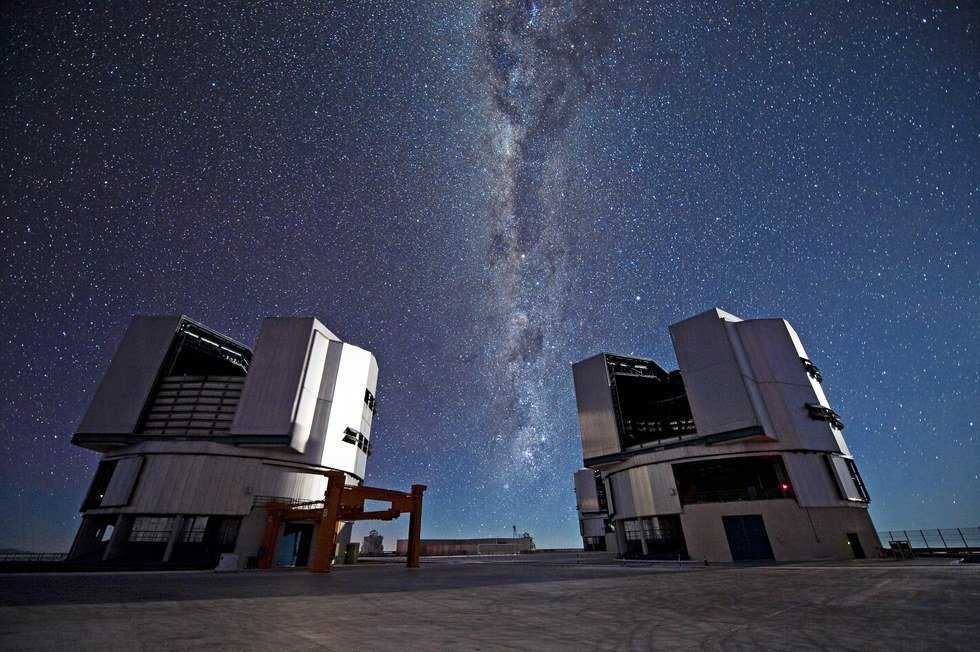
As far as telescopes are concerned, the observatories we use now are much more powerful, accurate and colorful than any telescope Galileo peered through. But those were the stepping-stones to the imaging we have now. Without it, we would not have pictures of galaxies millions upon millions of light-years away. The Hubble Telescope is one of the most powerful telescopes we have to date. The main mirror of the telescope is 2.4 m (7 feet, 10.5 inches) across and is 13.3 meters (43.5 feet) long, the equivalent of a large school bus. Hubble has a fixed orbit around our planet and is constantly photographing the universe around us while traveling 17,500 miles an hour. Since it has been in motion, it has traveled more than 3 billion miles at an orbit 350 miles above our planet’s surface. In 1990, Hubble was the first optical telescope to be placed in space. Since that time, Hubble has observed more than 38,000 celestial objects. Beginning in January 2014, Hubble has generated 844 gigabytes of data per month. Last April, Hubble celebrated its 24th Anniversary and from that date, its observations have produced more than 100 terabytes of data. Over 4,000 astronomers have used the telescope from all corners of the globe. These scientists have published more than 11,000 scientific papers on the data collected by Hubble. This unequivocally made the Hubble Telescope the most productive instrument ever built. In circulation, there is a guide that currently lists the coordinates of over nineteen million bright objects, fifteen of which are classified as stars.
Hubble has been a huge source of information for the human race. We have seen galaxies, stars and black holes that we would have never been able to see before Hubble was commissioned. The data collected is absolutely mind-boggling, and the pictures, breathtaking. One of Hubble’s most famous discoveries was that of Hubble’s Deep Field in 1995. This deep field was seemingly a dark spot in our sky, a fleck of darkness amongst the many stars in our sky. We thought it was bare, a speck with nothing at all. We could not have been more wrong. That small spot in the sky has revealed around 3,000 galaxies, some as old as 10 billion years. This area has since become one of the most studied regions in our universe and is being studied using many methods, including, but not limited to, radio and infrared wavelengths. We can only see so much in our own galaxy, or in our neighboring ones. This discovery showed us a wide variety of differently shaped galaxies that were very irregular compared to the ones we had seen before. Some of the smaller structures in this speck of sky, mostly composed of gas and young stars, may be the building blocks of spiral and elliptical galaxies not yet formed. Hubble’s discovery of the galaxies was like finding buried treasure. We now had a better understanding, or a better idea as to how galaxies were formed or evolved; providing us more pieces to the three-dimensional puzzle that is our universe.
Back when Galileo was looking at the stars, through a small telescope that could only see as far as the edge of our solar system, he could not have imagined how big our universe is. He could not have known how small we are compared to the galaxies that would make Earth look like a grain of salt to a skyscraper. Recently, our space technology and imaging has improved to a point of infinite possibilities. In fact, NASA has just started a project to colonize Mars. The process has already begun to choose the right astronauts for the job and the scientists are currently working to build robots that can build the new colony. I never thought I would one day see a man on Mars, but it is looking like that just might happen in my lifetime. With all the success and praise our scientists, astronomers and astrophysicists have received and will receive in the years to come, we need to remember where it all started. Without the first humans looking at the stars to tell them the seasons or harvesting times, without the Romans and Mayans building huge stone structures to help them with their agriculture, without humans looking to expand and using the stars as a map, we would not be here today. Their curiosity and ingenuity showed and taught each following generation that the sky is the limit. It is a result of their curiosity that we find ourselves exploring the stars. From the Apollo 11 mission to the Mars Curiosity Rover, we have slowly begun to extend our hand into the unknown, testing the water for the first time ever.
I, as a young adult, look forward to what the future will bring since space has always been something that has fascinated me. Reading about the Hubble telescope and missions to space makes me wonder what we’ll discover next. Galileo and I share this common trait. We both looked to the stars and wondered what could be out there. Even though we lived thousands of years apart in time, we both dream of what the universe has to show and offer us. Humans crave knowledge and fear the unknown. We have barely scratched the surface to the secrets of the universe and I look forward to what we will discover in the coming years. The universe is big, it is vast and complicated and ridiculous, but sometimes, very rarely, impossible things just happen. We call these miracles. I know someday we will spread out further into the universe, and it will take more than a few miracles in order for that to happen. So, until then, I will continue to lie out on my deck and look at the beauty that is space, the final frontier, and our ongoing mission to explore. And for me, like Galileo, it all started when I first looked up and saw stars.