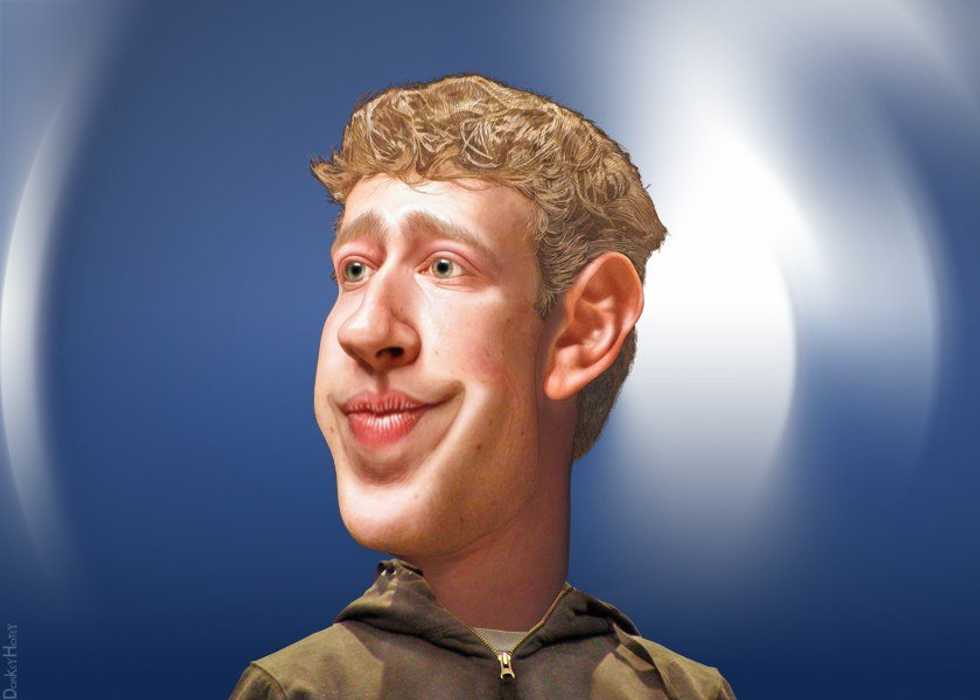
Okay, so maybe life-ruiner is slightly too strong a term to describe the Internet mogul, whose net worth is just shy of thirty-five billion US dollars. Nevertheless, in my ever-hyperbolic white-girl rhetoric, I found myself saying this exact phrase to a friend the other day: “Mark Zuckerberg is ruining my life." And I don't think I'm alone in feeling that way.
Facebook is, in short, the worst. In an article on Medium.com back in January, 19-year-old Andrew Watts puts it aptly when he explains Facebook as “an awkward family dinner party we can't really leave." The crucial aspect is the latter half of the phrase: we can't really leave. Watts goes on to say that, while it may be “weird and annoying to have Facebook at times," it's “even more weird and annoying" when someone doesn't have Facebook.
But I would argue that Facebook is even more than an annoyance. When we all registered for Facebook back in high school, we could never have known that it would become what it is today: a global social media empire whose unflinchingly domineering regime has a stranglehold on nearly all of our online activity. I first learned of this during my first year in college when I decided to delete my Facebook. Of course, “deleting" is a euphemistic term considering that the process of permanently deleting a Facebook page involves putting in a formal request and waiting up to ninety days for the process to be completed. So I chose the easier alternative, opting to deactivate my Facebook which would keep the page intact but effectively make it invisible to my friends and the overall Facebook community.
I experienced a kind of euphoric relief the moment I pressed that button and confirmed my decision to deactivate my Facebook. Even though I would simply have to sign in again to reactivate, the fact that I was inaccessible to my peers through Facebook gave me a much greater sense of the privacy I had been longing for. No longer was I tempted to waste time rifling through the photos of a high school acquaintance or looking up the profile of my long-lost crush. I lived in my own world, not anyone else's and that comforted me. Life without Facebook was a peaceful, notification-less life, and I began to spend time focusing on cultivating real relationships and hobbies that I hadn't previously had time for.
However, what I discovered and what many college students who deactivate their Facebook pages no doubt also discover, is that operating through college life without Facebook is akin to losing a sense — in terms of getting information from all of the various groups and organizations you're involved with, lacking a Facebook puts you at a great disadvantage. Without a Facebook, I found myself at the constant mercy of friends and acquaintances to give me meeting times, event invitations, and general announcements from my sorority and other campus groups.
I eventually came to the sad realization that not having a Facebook was simply not an option for me, at least during college. It was too integral to the everyday goings-on of campus life, and the handicap that came with deactivating was greater than the general relief I felt at not having a Facebook. I began to wonder how this seemingly benign social media platform came to control a good portion of my life and how it went from being a fun way to connect with friends to an ad-riddled nuisance that I can't seem to escape.
Sadly, Instagram is slowly becoming just as frustrating to participate in. Zuckerberg bought Instagram for $1 billion back in 2012 and since then has launched Instagram advertisements, which are the photos that appear as “sponsored" posts in your Instagram feed, regardless of whether you follow that specific account or not. Although these ads began to appear back in 2013, they seem to have become even more omnipresent since then. Recently, I have started to see ads for hair care products and clothing companies multiple times a day. In doing so, Zuckerberg is actually destroying one of the reasons for buying Instagram in the first place. By filling the app with ads, the hipster anti-consumerist attitudes that Instagram originally fostered are slowly being stripped away.
All of this is just to say that being a member of Facebook and Instagram is quickly becoming a less and less pleasurable experience for me, and I know I'm not the only one. Suggesting a solution to this problem is all but useless. With Facebook growing “25–33 percent year-over-year," according to Business Insider, the company has the potential to become a one trillion-dollar company within the next five to seven years.
Having said all of this, I am necessarily putting myself in the position of a hypocrite. After this article is published on The Odyssey, I will most likely post it to Facebook, encouraging my friends to read and share it with others on their own Facebook pages. It will (hopefully) receive a few likes, maybe a share or two, which will add to the page views that my article collects. I stand to benefit from using Facebook, which is the exact reason why I can't do without it. Facebook is like your 90-year-old great-aunt: senile and sometimes even rude, but she sends you a check every year on your birthday, so you're always in some way indebted to her. And, for better or worse, it doesn't seem to be going away any time soon.