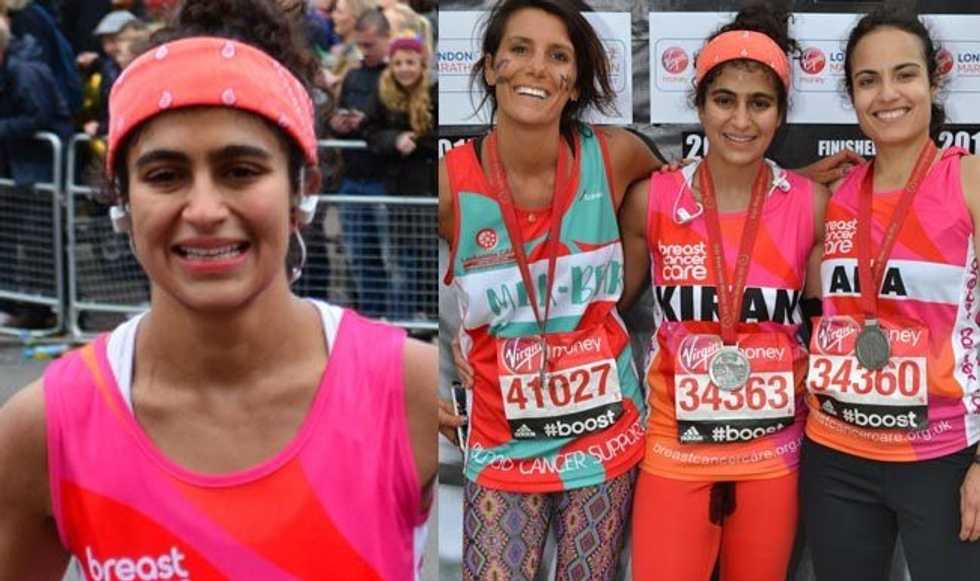
Recently, M.I.A. drummer, Kiran Gandhi, has made headlines for running the entire London marathon while menstrual blood ran down her legs. Gandhi sought to make a statement about accepting vagina-owners’ periods as a natural part of life. She also sent out a shout-out to all her “sisters” across the world who didn’t have access to feminine hygiene products.
There are multiple reasons why this act reflects a push toward gender equality. And though it might seem that battling the stigma which surrounds menstruation is a first-world, white feminist issue, it’s actually an integral part for movements striving to ensure education, improved health, and –subsequently - better quality of life for women and girls all around the globe.
Those with female reproductive systems typically begin menstruating during puberty, from age 10 to 15, with the average age being 12 years old.[1] A menstrual cycle, or period, can last for any time between 3 and 7 days roughly once a month. During that time, “the average amount of blood lost during a period is 30-40 milliliters (ml), with 9 out of 10 women losing less than 80 ml. Heavy menstrual bleeding is considered to be 60-80 ml or more in each cycle.”[2]
Vagina owners only have their periods until they reach menopause, which occurs around age 51 for most Americans.[3] Let’s do some calculations: If you think of it, if a person with a vagina becomes pregnant, say, twice during their life, that’s a total of 18 missed period cycles (to account for around 9 months of pregnancies for each child). From age 12 to age 51, then, the hypothetical person would experience about 450 menstrual cycles in their lifetime. If each cycle lasts around five days each, that’s 2,250 days of menstrual bleeding. That’s approximately 6 years of a person’s life spent menstruating all together.
It’s incredible that, even though a significant portion of a vagina owner’s life is spent menstruating, our society has deemed it a shameful topic. Women[4] are bullied into feeling guilty for their own anatomy and the natural processes associated with it. This is partly a capitalistic move, as tampon and pad companies have great success marketing methods of concealing the ownership of their products –not to mention the gendering of bags into “purses” for the specific use of tastefully hiding feminine hygiene materials. However, it’s also an attempt to make women feel embarrassed of their femininity.
Tampons, pads, panty liners, and menstrual cups are the modern tools with which to collect menstrual blood for later disposal during one’s cycle. Without them, blood can soak through clothing, thus ruining them and any other objects the clothing touches. Unless we want to literally paint our towns red, it’s important for us to view feminine hygiene products as necessities for women. Public institutions often provide necessities to their purveyors –especially those required to maintain general hygiene and health- at no cost. Examples range from toilet paper to soap to water fountains to hand sanitizer.
Unfortunately, as a result of long-perpetuated stigma, this is not the case for menstrual products. People with vaginas are forced to buy products at unnecessarily high prices in order to prevent the consequences of bleeding through their clothing. Other items, such as household paper, newspaper, or leaves, can irritate the body and cause health problems.
These alternatives are frequently go-to solutions for poor women, homeless women, or women in isolated areas. Because public restrooms do not provide protection against these avoidable issues, women and girls either resort to those ill-advised tactics or sequester themselves away from the rest of the world.
In rural places where children must travel long distances to school, menstrual cycles are particularly difficult to manage for girls. Some end up staying home for days each time their period comes. This leads to missed lessons, and sometimes becomes so unsustainable that girls opt not to attend school at all.
While the world has improved as far as making education more accessible to girls in particular, mismanaged menstruation throws a wrench in the vision of an education for everyone. Until we remove the stigma shrouding menstrual cycles, we cannot hope to make necessary products available to everyone. We must choose between shaming our world’s women and educating them. The choice is clear.
[1] All About Menstruation –KidsHealth: kidshealth.org/kid/grow/girlstuff/menstruation.html
[2] Heavy periods (menorrhagia) - NHS Choices:
www.nhs.uk/conditions/Periods.../Introduction.aspx
[3] Menopause: Click for Symptoms and Home Remedies:
www.emedicinehealth.com/menopause/article_em.htm
[4] “Women” will serve as shorthand for all vagina owners from this point on, though it does not technically include those of all gender identities.