
I may be going to hell for this, but when I heard that Antonin Scalia had died this past Saturday, I wasn't sad. Scalia was disturbingly anti-minority, using make-your-jaw-drop derogatory phrases during Supreme Court proceedings. He used the term “flagpole sitters” to describe gay men and suggested that black people belong on a “slower track” of schools. A prolific writer and dynamic speaker, he left a mountain of discriminatory comments to sift through. I don’t have the space or the stomach to list them here.
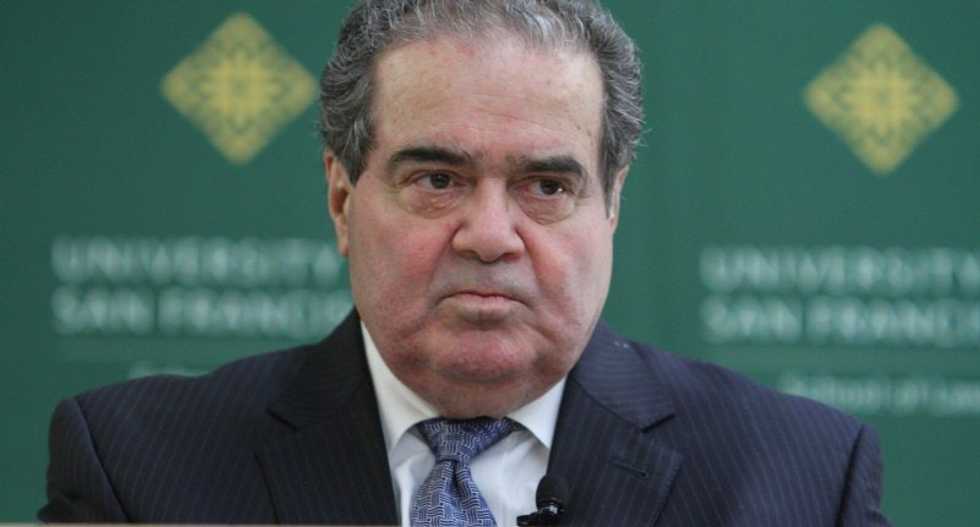
The controversial justice died at 79. Appointed to the Supreme Court in 1986 by Ronald Reagan, the Sicilian-American was the nation's longest-serving, most polarizing justice. During his three-decade career on the Supreme Court, he stubbornly fought against civil rights. He left his indelible mark on American law with colorful, scathing opinions and dissents. He changed the course of history — after the voting controversy of the 2000 presidential election between Bush and Gore, Scalia was one of five conservative justices who halted the recount of Florida ballots. We will never know who won that state. Truly, democracy at its finest.
Scalia saw himself as a strict originalist, which means that he believed the United States Constitution should be understood exactly as it was written at the time that it was adopted. Scalia unflinchingly took an archaic document created over two centuries ago at face value. Sounds great! I’m dying to live in the 18th-century! I’m so into frontier life, slavery and wooden teeth!
Perhaps Scalia genuinely loved colonial times. I imagine him sneaking away for long weekends to colonial Williamsburg, armed with a musket and a three-cornered hat, screaming about the rigidity of the constitution. In fact, the Texas dude ranch where Scalia died catered to the rich and famous — an ideal place to enact a rugged frontier fantasy.
A more nefarious suggestion, however, is that the justice used his originalism to further advance his extreme conservative views. He was opposed to minority rights, women’s rights and affirmative action. What better weapon to use when challenging historic court decisions from the 60s and 70s than claiming patriotism with a blind and unwavering dedication to archaic laws?
He drifted alarmingly close to Sedition Act territory when he criticized the landmark 1960s court decision New York Times v. Sullivan, the single most important case protecting freedom of the press under the First Amendment. He suggested that damaging a public figure’s reputation was cause for libel, an implication that would leave the press alarmingly vulnerable to mountains of lawsuits. I’m sure, however, that our founding fathers emphatically wanted press freedom. It’s one of the ideas that set the new nation apart from those damn Brits on the other side of Atlantic Ocean.
That’s the thing about Scalia. It’s hard to review his career and see anything but an ideology of hate, thinly veiled by his rigid adherence to an antique document. This guy actually said that executing innocent people is OK if they have been allowed a “full and fair” trial. I mean, come on. That sounds like a guy who has a thing for executions, just like he had a thing for torture. Under his receding hairline and portly frame, Scalia was an eternally argumentative 6-year-old, sitting at the dinner table and refusing to eat his vegetables for five hours just to prove a point. His "point" included disdain for minorities who have struggled for their civil liberties, torture for the un-convicted and death penalty for the factually innocent. So excuse me if I don’t tip my hat.