



Last year, NASA announced a ground-breaking discovery: flowing liquid saltwater has been found on Mars' southern hemisphere.
Yay!
Although these developments don't mean that life is present, it does provide hope for future man-made excursions into Mars' vast and barren landscape. Most of these, according to NASA, will only occur in the second quarter of the 21st century. That is, unless someone else gets there first.
Well, that has the potential (note: potential!) to happen rather soon.
But a bit of historical context: back in 2015, there was media frenzy behind a proposed mission bound for Mars; it was called "Mars One". 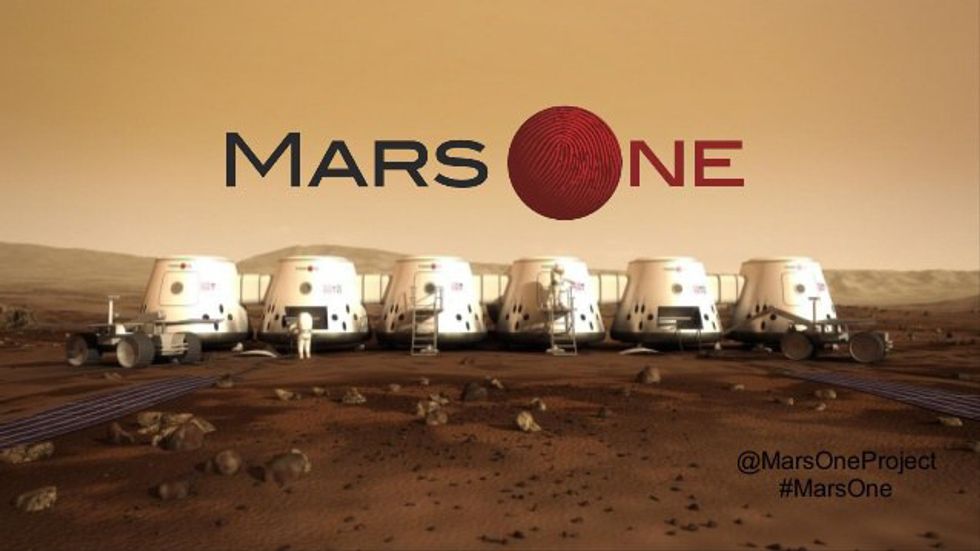
The expedition, based in the Netherlands, was destined to reach the red planet within 10 years of its initial announcement. The project was started in 2012, headed by Dutch entrepreneur Bas Lansdorp.
Mars One, as an ongoing program, has so far garnered major support from many factions, including Lockheed Martin and Paragon Space Development -- two very prestigious aerospace companies. The company behind Mars One hosted a website, had several presences on social media, ran a crowdfunding campaign and even had a list of potential candidates for the trip.
It is still a controversial, and logistically speaking, a near-impossible task that smells more of corporate greed than an escapade with the end-goal of finding contributions to add to the field of science, unfortunately. To spare you the details: if it's not made official by NASA, it more than likely won't work. But who knows?
Nevertheless, we now have yet another proposed trip to Mars -- not authorized by NASA -- that once again arouses suspicion.
The specifics behind this excursion are simple: another rich and self-proclaimed space-entrepreneur, Elon Musk, owner of the Space Exploration Technologies Corporation (otherwise known as SpaceX) wants to send people to Mars in 2024, with contact made with the planet by 2025. SpaceX is a private space company, with no affiliation with NASA. Musk's statement suggests a rather ambitious goal.
“I think, if things go according to plan, we should be able to launch people probably in 2024, with arrival in 2025,” Musk said. Here we have an absurdly rich man who wishes to tackle one of the most robust missions known to mankind, but with an air that, like the Mars One project, seems to do little to convince the proprietors of the science community that this is legit.
At the moment, we have three separate projects that are working to get humanity to Mars -- two of which are planning to get there before the end of the next decade.
I suggest we leave it to the experts, who expect the first real, actual exhibition to Mars to commence in the 2030s.

















