

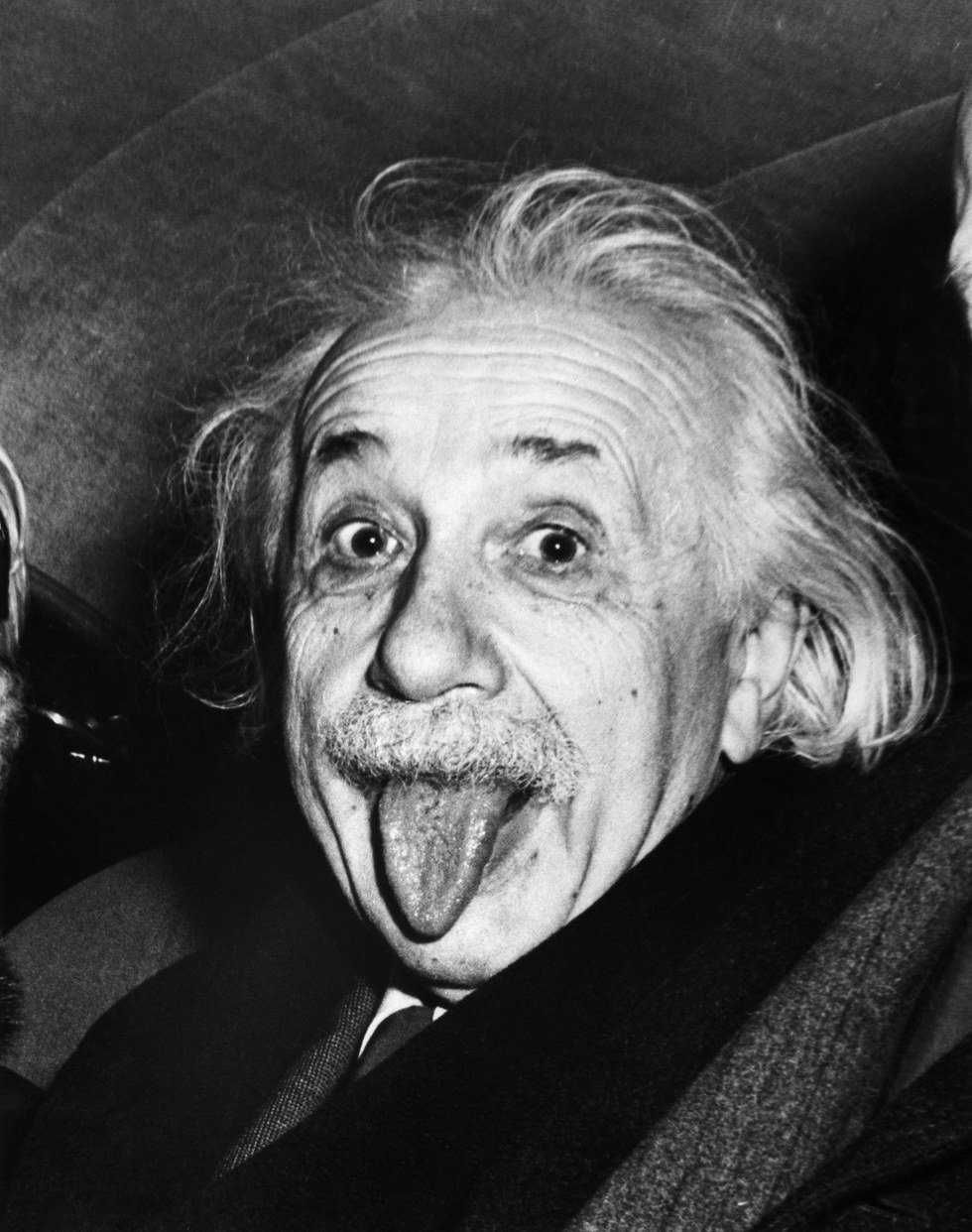
Albert Einstein is considered one of the greatest scientific minds by both the scientific community and the non-scientific community, but why is he famous? What did he do? These are questions that could be asked if one does not know much about Einstein.
Albert Einstein was born in the German Empire on March 14, 1879. He studied physics and mathematics and published some of the most important papers in the field of physics to this day. Four of his five most famous discoveries were made in 1905, which is commonly known as his annus mirabilis or his miracle year. Within this year he wrote papers on the photoelectric effect, Brownian motion, special theory of relativity, and mass-energy equivalence (which is probably his most famous theory). And later in 1915, Einstein published his general theory of relativity.
The paper that brings most of Einstein’s fame in the non-scientific community is the mass-energy equivalence. If you have ever heard of Einstein you most likely have heard about his famous equation E=mc2. But what does this mean? E means energy, which is the ability of a system to work. M is the mass of the object or the amount of matter in an object. C is the speed of light, which is a constant equal to 299,792,458 m/s (670,600,000 mph). What this equation shows is if all of the mass of an object would be able to be converted into energy the amount of energy would be equal to the mass times the speed of light squared. The fame of this equation comes due to the infamy of what it is made up of… math.
When looked at from the view of either a mathematician or a physicist the math of E=mc2 is quite simple. All you need to know to be able to solve for the other variable is either energy or mass. Once you have one of those you plug in with the equation and do some multiplication and/or division. So the fame of this equation may be due to its simplicity or it may be due to its hidden complexity. This equation can be more complex than it seems if the object whose mass is being converted into energy also has momentum (p). If the object has momentum then the equation is changed and made a bit more difficult. It would look like E2 = (mc2)2 + (pc)2 . While this equation may look more difficult than the previous (which it is), it still uses the same math, but one just needs more information to start with. To make this simpler we can put it in terms of a triangle with energy being the hypotenuse (side c) and the legs being mc2 (leg a) and pc (leg b). We can use Pythagorean Theorem to show that a2 +b2 = c2 which is equal to E2 = (mc2)2 + (pc)2 .
The complexity of the mass-energy equivalence scales many levels depending on what is happening in the situation. It is truly representative of what Einstein did in his scientific career to become one of the greatest scientist known to all of mankind. But while we have explored the paper the fame of it is still unknown. The best guess would be that the equation is such a complex statement defined by simple enough math to be understood by almost everyone. While this is his most famous paper it is not the only reason he is famous, especially not in the scientific community, but it may truly be one of the major reasons he is famous in the non-scientific community.
http://www.scientificamerican.com/article/signific...