Tree. Trees. The tree is tall. Its leaves are green in summer, orange and brown in fall, nonexistent in winter, and flowering in spring. Trees are beautiful, they are plentiful, disposable, a nuisance for homeowners, welcome in the summer sun and when we get caught in a rainy storm. They are useful for making our supplies for going to school or papering our apartment walls with decorations. But why are trees so loved and disregarded all at once?
This month, National Geographic is all about Yellowstone Park and the Battle for the American West. When we think of the West, we first think of mountains and open plains, and also the early explorers who trekked through heavily forested terrain. For those wanting to understand the massive land we call our nation, check out The Men Who United the States by Simon Winchester. His first section is all about trees and how they dominated the minds and lives of our forefathers on the East Coast.
In New Orleans, we pride ourselves for the various parks, the green spaces found in our small city winding along the banks of the Mississippi River. The two biggest parks, Audubon Park and City Park, are covered in trees. On most days you can find hundreds of people enjoying themselves, napping or reading in the shade underneath the trees, using them as markers for goals to play games like football, soccer or Frisbee. You can often find people who have hung a hammock between two trees that grow close together, or walking on a rope four feet in the air, tied tight between trees.
Here, the most prevalent and adored trees are the live oaks because they are so large and majestic. They represent eyes into the past, as they lived and grew when the city was being settled three hundred years before. They knew Jean Lafitte and Marie Laveau. They saw the slave trade and the city’s racial disorder at its worst. They remember when Mid-City was all green space, and when Downtown looked like a scattered market with foliage in between all the shops and stops. They remember when they could have looked at each other from one side of the city to the other, before their kinsmen were cut down to build St. Charles Avenue mansions and before their vision was obstructed from the multi-story hotels and office buildings on Canal Street.
Thinking back on my time here in New Orleans, trees have a huge place in the story. The years at Tulane when I took the streetcar down St. Charles to go to the French Quarter, we would leave campus, which itself is covered in gorgeous magnolias and live oaks, and pass Audubon Park, a field of green covered in giant trees. The trees shading the way down the streetcar line continued for ten blocks or more until the area began to near Downtown, when more stone and brick buildings appeared. In Downtown, there are not many trees, and in the neighboring areas the houses are tight together with little room for live oaks. But do we notice this? Imagine the city with no trees at all. On lazy hot spring and summer days, what would we do without the parks?
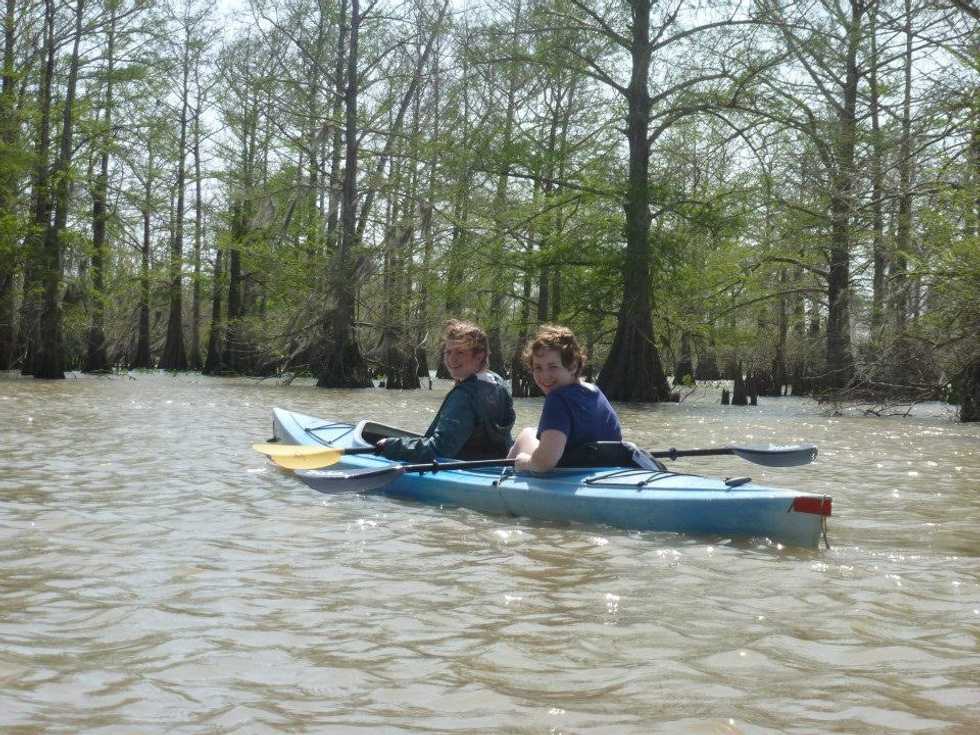
At the same time down in Southern Louisiana, people are working to put back the trees that careless generations have removed, for the Gulf of Mexico oil industry. A few years ago I had an opportunity to go to Venice, Louisiana, and organize a volunteer trip for Tulane students. We teamed with Lost Lands Tours, a local kayak tour guide company that provides all the equipment and takes groups out into the bayous of South Louisiana for an educational tour of the area, while explaining the dangers of losing more of this land to erosion and the effects on our ecosystem. On the tour I took with them, I learned that many cypress tree groves were dug up to make canals for the oil cargo ships coming into port, instead of taking the longer route already established through the mouth of the Mississippi River.
The tour was catered to our desires and the leaders searched for a contact who plants cypress trees in the area to take us out as well. We learned how he uses his own free time and money to find locations that are barren of cypress trees but which have enough earth below the water’s surface to support the tiny tree roots. Then, he hopes that for many years, a huge hurricane will not come in and wipe them out. We were able to walk out onto the muddy lands and see the tiny crabs crawling from under the dirt we disturbed. Then, with a tool, we would open a small space and plant a tiny sapling. These trees used to be our natural barrier from hurricanes and made the landing of these storms much less devastating, as you can learn at the Audubon Aquarium IMAX show Hurricane on the Bayou.
Another popular activity in New Orleans is kayaking on Bayou St. John near City Park. After renting kayaks on multiple trips to that area through Bayou Paddle Sports, I decided to purchase my own kayaks and go whenever I wanted, because I moved to the Seventh Ward (twice). The allure of the bayou is that it spans from the Tree of Life, where most days you will see volleyball groups playing in friendly matches with rainbow-colored nets. The bayou winds its way under a few low bridges, where you must flatten yourself to securely pass. It then continues past Esplanade Street and becomes lined with trees all the way to the Greek Orthodox Church, where the Greek Festival is held every year. The passage into Lake Ponchartrain is not open, but you can book special rentals to paddle board of kayak in the lake. Kayakers attend festivals on the bayou in boat yearly for the Greek Festival and for Bayou Boogaloo, both of which offer food and music.
Parallel to Broad Street and Carrollton Street is Jefferson Davis Boulevard, which boasts a wide green neutral ground and many trees. You can see the green backyard of City Park from I-610, and once a year that visible patch is covered with thousands of colorful flowers. Across the lake on the north shore, about an hour drive from the city is Big Branch Marsh, which holds a monthly free volunteer opportunity called Work / Play Day. Half a day of work in the gardens or cleaning in the bayou, and half a day in canoes on the bayou to see the trees and water, and you can escape from the inhabited world.
I have heard residents say they love New Orleans but long for more access to green and to differing terrain. But look close by. For mountains, you must travel northeast or northwest. But for trees, for green, for nature and for opportunities to bond with nature, you must not go too far. Next time you walk, drive or bike outside look for the oak trees, the green spaces and the history that surrounds us. Look for later articles about the new bike paths and ways to find history in the city simply by opening your eyes. Go on out, the weather’s fine!