
Might as well admit it now: you are insecure. We all are-- at least to some degree.
There are many identity quizzes floating around the internet nowadays, such as this Buzzfeed quiz entitled "What Kind Of Person Are You Actually?". Why? Well, they're popular. But, what I want to look at is why they're popular.
Since nearly the beginning of time, people have looked for confirmation of their identity from many sources whether they be people that they perceive to have spiritual connection/authority, such as a priest, a psychic, an astrologist, an oracle, or people who study what we’d call more “academic” subjects, such as scientists, or philosophers, or artists, such as playwrights, lyricists, poets, or painters. Just as Amy Adkins said,
"Throughout the history of mankind 3 little words have sent poets to the blank page, philosophers to the agora, and seekers to the oracles: Who am I? From the ancient Greek aphorism inscribed on the temple of Apollo, ‘Know thyself’, to the Who's Rock anthem, ‘Who Are You?’ Psychologists, academics, scientists, artists, theologians, and politicians have all tackled the subject of identity. There hypotheses are widely varied, and lack significant consensus. These are smart, creative people, so what's so hard about coming up with the right answer?” (Who am I, a philosophical inquiry).
What is so hard about it? Well as many sources explain, it is not only the answer that is difficult to grasp, but the question itself.
But, after all these years, I think that I can help get you one step closer to the answer (with some help from others). Personally someone that brought me a little closer to the answer is Hank Green.
In his Vlogbrothers video, Who Am I video, Who Am I?, Hank points out,
"I can describe myself all day long, I can take personality tests that validate my behavior until the cows have baby cows, and then those baby cows have their own baby cows, and those third generation cows finally come home, but that won't change the fact that myself is just a story that I tell to myself that is just like any other story: subjective, and incomplete, and at least a little bit of a lie. I got my way of seeing the world, I got my values, I got the stuff that I care about, the people I care about-- all those things. They're important, they're real, but where did they come from? Certainly not things that I was born with. I am me-- right now-- I have not always been this me."
So, as Hank Green said early in this quote, one reason we may want to identify ourselves is because we want to validate our behavior. Now, why do we feel that our behaviors need to be validated? Well, valid is defined as, "well-grounded or justifiable: being at once relevant and meaningful." In other words, we want to have our actions be justifiable, which is defined as "able to be shown to be right or reasonable". Once we define it as such, it's easy to see why you'd want your behaviors to be validated. Who doesn't want their actions to be right, reasonable, meaningful, and relevant? We search for an "identity" or, a label, really, that will prove our actions to seem, well, not crazy. For comparative purposes. Let's say you start having some symptoms. You've been throwing up, for the past few days, you have a fever, and a sore throat. What would you do?
That's right, you'd go to the doctor. Okay, but why would you go to the doctor?
Right again: you want to know what's wrong with you! There's some sense of relief and comfort you get when you know why your body's been doing these things. You may not be jumping for joy when your doctor says, "you have the flu", but you are glad that it was diagnosable, and has a name (an identity, if you will), so that not only, do you know that you don't have some weird unidentifiable illness, but, it's treatable, and you know that there are many other people who have the same thing. Starting to sound familiar? Let's put this back into context. For a possible scenario, I'll use a group, or identity, that is near and dear to my heart: music geeks. Here's a scenario: you were always a part of all things musical. Whether it be church choir, or private bassoon lessons. You loved making music, performing, and learning about what makes music sound good. You walk into high school orientation, and you see a group of people with big fancy hats and uniforms on. They're all having fun and laughing together. You walk over to them, and they introduce themselves as the marching band. One of the girls introduces herself and explains why she joined marching band, "I've just always loved music. I took flute lessons growing up, and I always loved it. Now I get to spend time with a bunch of other people that appreciate music the way I do." When you begin school, the first thing you'll probably join is marching band. Why? Because they behave similarly to you. They learn instruments, they study music, they enjoy music, and they're all in one big group, and accept and enjoy each other. Once you join marching band, you'd probably consider yourself a "music geek", or a "band geek". Why? Because everyone who does the same things that you do call themselves that. When you call yourself a band/music geek, your actions of studying music, participating in ensembles, and learning an instrument are now validated. They make sense. "She's a music geek, of course she does those things." No one will question you. Now, on the other hand, if you considered yourself a "jock", those actions would not be "validated", and you'll probably get the occasional, "you're a jock and you play the tuba?" Your action is not "validated" by your chosen identity, or label.
We want our actions to make sense, we do not want them to be constantly questioned. Who wants to be asked why they do what they do all day long? There are more important things to tackle. In order to validate their actions some people, well, all people to some extent, use their possessions, especially clothes, to make their identity clear.
For example, out of these four people, who would you say would probably have some common interests?
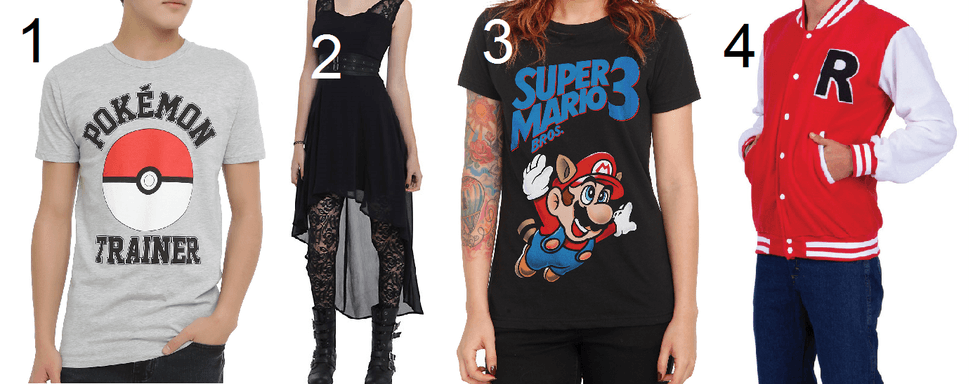
You probably said one and three, right? They both chose to wear shirts that advertised a video game. It's a pretty safe bet that those two would get along the best. Yes, this is stereotyping. But stereotyping, to a point, will always be a necessary part of life. It's how friendships begin, and we use them to help ourselves define ourselves.

On consumerism and validating your identity, Psychology Today says,
"In general, psychologists who study consumers understand that people are largely motivated to spend money not just on things that they materially need, but that bolster their sense of identity. They purchase not just goods and services, but mythologies. Imagining themselves as rugged, rebellious patriots, they buy a Harley-Davidson. Imagining themselves as respected and well-heeled, they buy a Lexus."
So now that we know why you care what your identity is, let's figure out what your identity actually is.
At the beginning of his video, Hank Green attempts to define himself using various labels such as sexuality, race, gender, astrological sign, Myer Briggs personality type, his place of residence, his hobbies, his appearance, and his values/opinions, his occupation, and even his fictional communities, such as Harry Potter house, and even his Divergent faction. Now, after he tells you all that, assuming you have never met him, do you know who Hank is? You could memorize these facts about Hank, but would you know him? Would you know him even if you'd spent a lot of time with him personally? At this point you're probably wondering, well, what does knowing someone mean, then? Ah, precisely.
"Figuring out who you are, at least at this particular moment, is all about trying to tease out which bits are you trying to fulfill other people's expectations for your whole life what bits you want to change to make yourself better, and what bits you cherish as vital to your you-ness. But people who are like, 'be yourself', and they expect that to mean something-- that is not advice, that's an existential crisis waiting to happen. These tools that we use to help us define ourselves, to help us figure out who we are, they are fine as tools, but they are not walls to box ourselves in with. You will wake up one day and you will not be they you you once were, and that will keep happening to you until you die, which is kind of wonderful. Why live life as just one person, when you can be so many different people? A little scarier, perhaps, but as with a lot of things that scare me-- turns out, also pretty fun."
So, who are you?
(I hope you were prepared for an existential crisis today.)
My answer is this: there is no "you" in the way you'd probably think.
So why are you considered the same person? Why do you get called by the same name? Well, first of all, it'd be pretty complicated otherwise. But, second of all, I think your name, or the idea of "you", is your spirit-- the supernatural space you inhabit. It cannot be the physical space you inhabit, because people's bodies change constantly, it cannot be your mind because that also changes constantly. You are your supernatural space, and everything else that is "you"-- any way that somebody else would define you, are labels to identify the tangible aspects of your existence, which can be changed and molded constantly. You can change them, other people can change them, and you can be a different kind of "you" forever and ever. The only thing that you cannot change is your spirit.
So go out there, and be a "you"-- some sort of "you". You can be any "you" you want, but try to be a good you-- oh boy, maybe I'll get into that another time.