
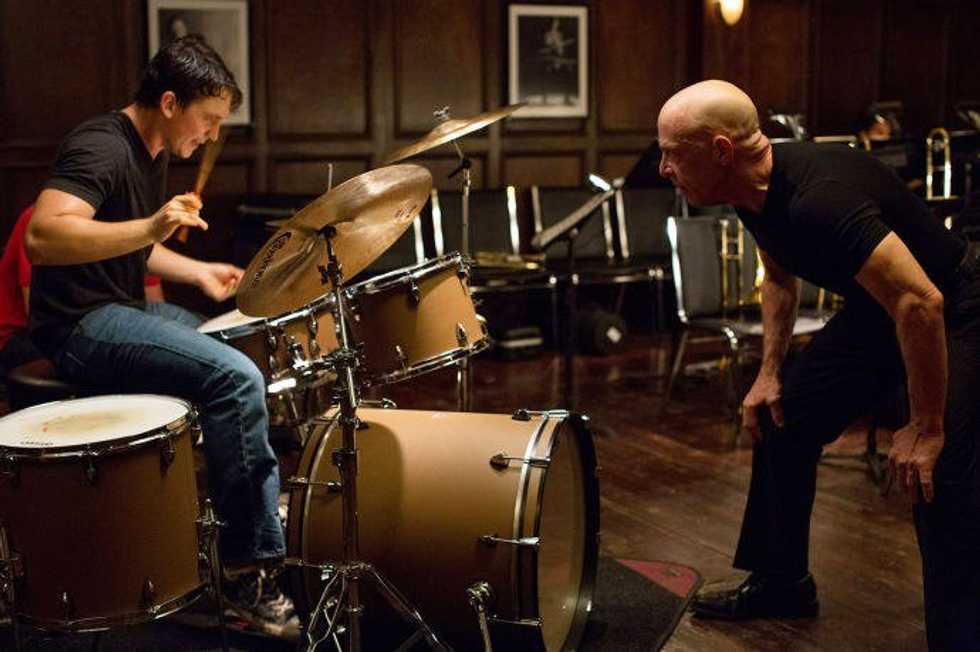
There is no “A for effort” in Terence Fletcher’s master class. But there are flying cymbals and bloody, beaten hands. There’s also mental and physical torture, alluded to from the preceding items, but that’s not actually important. Andrew Neiman is important; he’s a kid with a hell of a lot of talent. Enough talent to get him into Shaffer Conservatory of Music, a school for only the fierce and restless, where he is training to be the next Buddy Rich.
An arduous task.
Damien Chazelle’s daring directorial and authorial feat, Whiplash, exposes every ugly flaw and facet of the characters in a steady crescendo of drum rolls. Climaxes such as these happen three times throughout the film’s 107 minute runtime, a veritable testament to its pulse-pounding aftershocks. The only lulls in action act similar to silence between musical pieces; they allow for background development of Neiman and Fletcher’s lives, with spaces filled by either artful cursing or memorable pep talks.
The film, however, opens modestly. Fletcher and Neimann are introduced in a dimly lit section of Shaffer, where Neiman is practicing the drums, and, on one of his infamous stalks, Fletcher discovers Neiman. Fletcher leaves unimpressed before Neiman can even notice that he’s gone. Afterwards, New York City gets a jazzy sequenced intro as Neiman walks to a local movie theater. It is night time, and buildings are showcased in quick shots, with each riff and brassy blast, as specks and splotches of yellow sodium lamps and fluorescent lights strike out the blackness. Neiman has come to watch a movie with his dad, mild-mannered Paul Reiser, as a routine hangout--and he fails yet again at picking up the popcorn girl. Life is a chance encounter for the budding musician.
Fletcher, played by a flawlessly brutal J.K. Simmons, is a professor feared by all yet regarded by few. His character, whether hated or loved by the film’s end, is irrelevant; his drive to seek out the best of what Shaffer has to offer is where his real purpose lies. Neiman, a deceivingly sweet, plucky, and later explosive Miles Teller, is soon ushered into Fletcher’s arsenal after Fletcher plucks him from his “remedial” class. Neiman soon exudes a sense of accomplishment, finding himself among the upper echelon of Shaffer, in a lacquered golden room. He finds, though, that being in Fletcher’s class means always being great.
Cut to Neiman’s first day. He’s running late, yet class meets three hours after a sweaty Neiman finally makes his way to Room B16. The camera centers on the clock; it’s 9 A.M. Fletcher jokes that Neiman is new, a 19 year old “squeaker.” Neiman smiles, but no one laughs. Neiman was severely duped, as his effort that class is that of a practice session. Soon enough, he is dodging a flying cymbal. Then he surrenders to humiliation as he receives a metronomic slapping from Fletcher. It wasn’t quite his tempo.
Cut to several weeks into class. The rest of Fletcher’s ensemble is seen throughout the hallways, in rec rooms, staring blankly into bathroom mirrors. They’re exhausted, but a familiar rumbling grows louder in the distant. Neiman is within a cycle of drummers; his former friend, Ryan (Austin Stowell), and classroom rival (Nate Lang, Teller’s actual teacher) are changing hands faster than the tempo Fletcher so desires--he, of course, is attacking them with a barrage of colorful insults, veins popping, eyes wide open. This goes on for hours, until Neiman reclaims his rights as core drummer.
The scene is a similar, abusive one. Yet it is a captivating thrill ride composed entirely of blood, sweat, and malediction--a truly inspiring tale. There are too many spoilers and tidbits that needn’t be revealed but simply experienced; there is a brutal realism to Whiplash that drives it and convinces the audience beyond any technical flaws. It delivers itself with well-timed aplomb, much like the eponymous composition featured throughout the film. In essence is that to exceed at almost inhuman abilities, one must abandon almost all human qualities--even if that means dumping your girlfriend and embracing rage as your only emotion.
The film was shot to evoke the darkest, richest aspects of its world; much like the shiny instruments pitched against Fletcher’s unchanging black shirts. Overall, the contrast of hard and soft lighting parallels the film’s pitches in intensity. Sound editing or what is revealed on film and what is heard varied slightly throughout the film; but the quality of its production and the care apparent in the subtleties of the scenes far surpasses any errors. Audiences without a musical background can appreciate the film’s varied characters and thrilling plot while the musically-inclined can enjoy (or pick apart) the experiences provided on screen.
Whiplash provides a fascinating glimpse into self-worth and worthiness, and raises questions about what it actually means to be “the best.”
Chazelle was clearly never told “good job.” You’ll get it if you watch it.