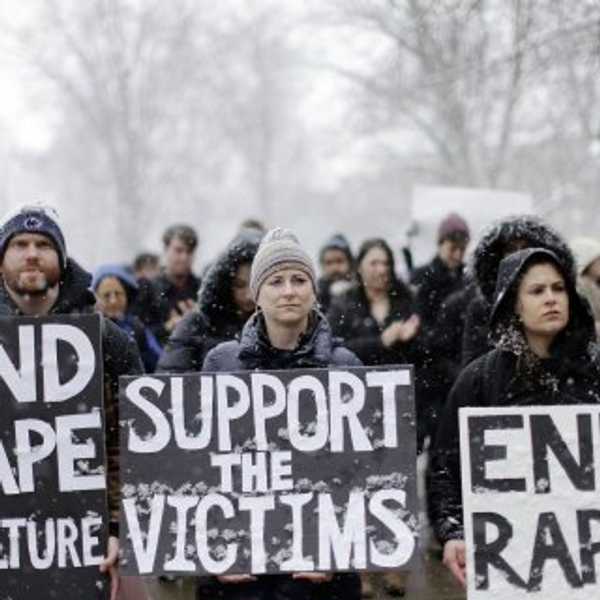

Stanford student Brock Turner's pathetic sentence for raping an unconscious woman earlier this year brought renewed attention to rape culture in America. As Amy Schumer's hilarious parody sketch, "Football Town Nights," points out, rape is more than just an action--the taking of another's body without or even in direct opposition to their consent--it is an attitude of entitlement, ownership, and privilege that saturates American icons of masculinity and capitalism, visible in everything from football to Greek life to voting behaviors. And with the GOP nominee aiding and abetting these markers of rape culture, one wonders: what is the point of legislation if the attitude remains unchanged?
This question came to the forefront during a recent meeting of my undergraduate class, in which we discussed the issue of on-going consent. Two years ago, California passed a "Yes Means Yes" law of on-going sexual consent that has become popular among state legislatures elsewhere. And, as Jaclyn Friedman of the Washington Post points out, most undergraduates support the laws. I also found this to be true of my class. "Should a person have to continue giving consent for sexual activity," I asked? "Yes," they responded. "Because if a person passes out in the middle of sex," one student elaborated, "then you obviously can't have sex with them." "That's right," another student said, "if you notice in the middle of doing it that the other person is resisting, or making a weird face, or whatever, then obviously you should stop." These statements seem to support what Inside Higher Ed has called the "Yes Means Yes World," in which college students are acutely aware that sex is a practice not a product so that, yes, in fact, along with the way a person can change their mind and should be able to do so.
Unfortunately, the enthusiasm for the policy wanes when we start actually talking, well, policy. I asked my students, "so..how often should you be required to ask your partner, "would you like to continue," to be considered lawfully engaged in sexual practice? Every 30 minutes?" My students nodded. "Most sexual activity lasts less than 30 minutes," I objected, "so that means you could be raping your partner for almost the entire duration." My students murmured in agreement. "So what about every 15 minutes? I asked." They nodded again. "But a lot can change in 15 minutes," I suggested, "initial hormones and adrenaline can decrease, you can sober up, or you can just have had enough time to realize, after the heat of the moment, that you don't want to do this." They got uncomfortable but I didn't hear any objections. "What about every 5 minutes, then? What if every five minutes you asked your partner, "would you like to continue?" that seems to be a fair standard of liability."
At this point, the vocal pushback began. One student said, "but if I have to ask every five minutes it's really going to kill the mood." Another student said, "I mean, if I notice they're making faces or just aren't into it, I don't need to ask them, I'll just stop." I raised a number of additional objections, not the least of which is that all of this puts the liability on the partner to "avoid" getting raped--something we've been trying to move away from with public education campaigns directed at preventing rape, not simply preventing getting raped. "People might not want to speak up, "I responded, "they might not feel safe, or they might be afraid of upsetting their partner, or they might not want to appear prudish or uninterested. These are all reasons why rape victims passively "consent" to sex and then later report that they hadn't consented. This is the whole reason we need an on-going consent law, because you can't just "read the signals' to tell if someone is interested."
Ultimately, this became the subject of our latest class debate project, in which three teams of students will debate three positions on the issue of initiating sexual contact (we decided that full on intercourse was too fraught with peril). They will debate three different standards for consent to sexual contact: verbal consent (which gets to the heart of the on-going consent norm), non-verbal consent (what I would consider the status quo), and no verbal consent (which is what I would call the position of the current GOP candidate and a bunch of other very misguided misogynists who couch their entitlement in a "real men doesn't ask for permission" cliche).
I have hope that the debate will clarify the stakes for students and put the "ongoing consent" into a more desirable light. But, in the meantime, what this event suggests is that while policy debates over rape and sexual consent are showing signs of improvement, with more and more students agreeing that consent is a good and desirable thing, the insidiousness of rape culture with its entitlement, self-certainty, and objectification still hides in the details. Bottom line: if "the mood" or "appearing passive" is too much to sacrifice to ask your partner every few minutes, "hey, you having a good time?" "hey, does that feel good?" "hey, do you want to keep going or should we go grab ice cream instead?" then you probably know that deep down inside you do not want the answer and you already do not have your partner's consent.