I began writing this on Wednesday morning. Just hours before, late on Tuesday night another black person lost his life. Alton Sterling, a 37-year-old black man was shot and killed by police officers while selling CDs in front of a store in Baton Rouge, Louisiana. He was alleged to be armed. A widely-circulated video of the incident, which seems to show an officer aiming a pistol at Sterling and firing while Sterling was immobilized by another officer, kicked off protests in the streets of Baton Rouge.
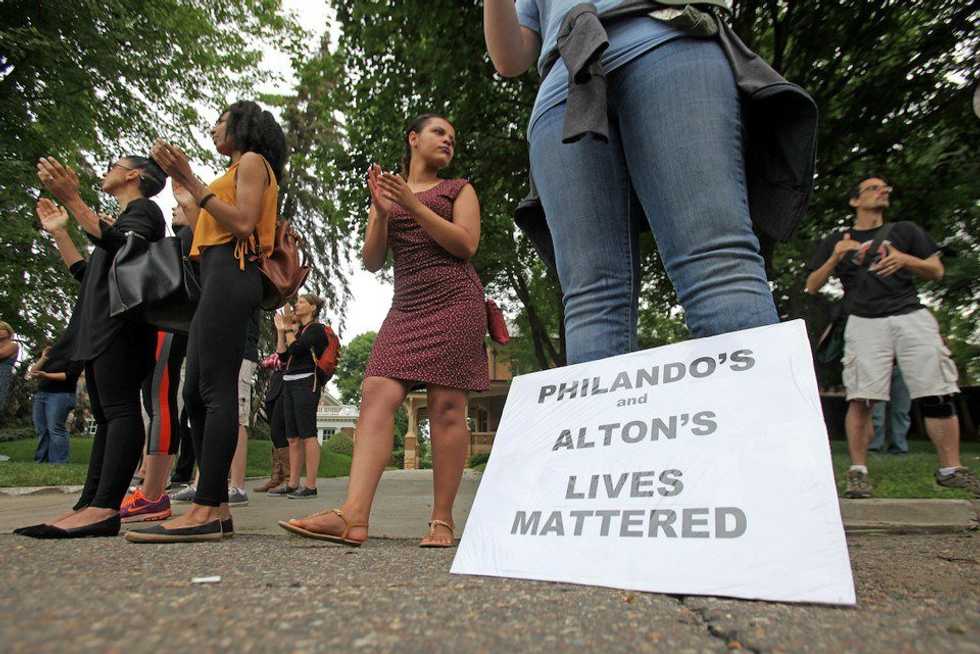
A day later, I was still writing. Late on Wednesday night another black person was killed. Philando Castile, a 32-year-old black man, was shot and killed by a police officer during a traffic stop in Falcon Heights, Minnesota. Pulled for a busted tail-light, Castile's four-year old daughter saw her father shot mere inches from her.
The next shooting may not come tonight or tomorrow. By the math, though, every two days a black person of some age—14 or 18 or 43 or 37—armed or unarmed, sober or under the influence, resisting arrest or providing officers with identification will be shot and killed by an officer or officers. Video of the incident will likely be circulated. Protests will likely follow. But any sort of end to this violence remains truly unlikely.
According to The Guardian’s “The Counted” project, Sterling was the 560th person killed by police this year. Castile was the 561st. Despite mass protests, the countless videos of police violence and brutality, and despite a national conversation that acknowledges police brutality as both racially unjust and part of a broad pattern of behavior, the number of people killed by police looks likely to match last year’s number. Vigilance, complaints, scrutiny, and even the rare prosecution have done little to stop routine violence.
There is a sense of normalcy to what should be anything but. In Baton Rouge, growing crowds necessitated an immediate press conference from District Attorney Hillar Moore to announce that the Department of Justice would be investigating Sterling’s death right away. Just a year ago that might have seemed an impossible victory. Now, it is unclear if even these events will result in justice or an end to the killing.
Moore’s press conference also suggested why policing is so difficult to change:
"Well again, you know, it’s another person that’s dead, killed by law enforcement officers who have the authority by the state and the people— because we get our power, really, from the people, not just a piece of paper—that authorizes law enforcement to take a life in certain situations. Which is always—that’s why you guys are here in this situation and not on the streets of Baton Rouge where we have other killings, because this is potentially a state-authorized killing. [The law] gives law-enforcement officers the authority and mandates them to kill when in defense of themselves or others. So I think whenever there’s that situation and law enforcement officers [are] involved, it’s a completely different case than a person in the streets being killed."
Police officers are indeed in the business of state-authorized killing, When they exercise that authority, their actions deserve greater scrutiny than other homicides.
The right to kill is an accepted part of the American doctrine of self-defense. But officers are not treated like ordinary Americans. Officers are allowed a far more generous interpretation of self-defense in disciplinary and court proceedings. In practice, simply claiming that they feared for their lives often provides sufficient grounds for acquittal. In essence, police officers are given lethal weapons, taught and authorized to use them rather liberally, and then deployed in a manner as to create situations to use those weapons.
At some point, a system created in which killings are inevitable soon approaches a system in which killings are deliberate so as to make the difference difficult to discern.
The expansive authority of police to kill forestalls accountability for all but the best-documented and most-egregious acts of violence by police officers and reduces the ability of the criminal-justice system to meet its burden of safeguarding citizens. Because police officers are agents of criminal justice, they benefit from a presumption that their acts are just. But if widespread police killings are in fact an injustice, then there is a pressing need to look beyond individual trials for some systemic remedy.
There is little public will to do so, however. As Moore put it, the agents of the criminal-justice system “get our power, really, from the people, not just a piece of paper.” Those comments laid bare exactly why incidents of police brutality—even killings—seem like routine elements of American life. It’s because they are. They are not random incidents, but the predictable and inevitable consequence of common encounters enabled by policy and sustained by the will of society. If there actually is any resolve to keep history from repeating itself and to end the parade of death, Americans will have to challenge the state’s authorization of violence beyond individual police acts, and investigate the purposes of policing that drive its use. Until then, people will continue to die.