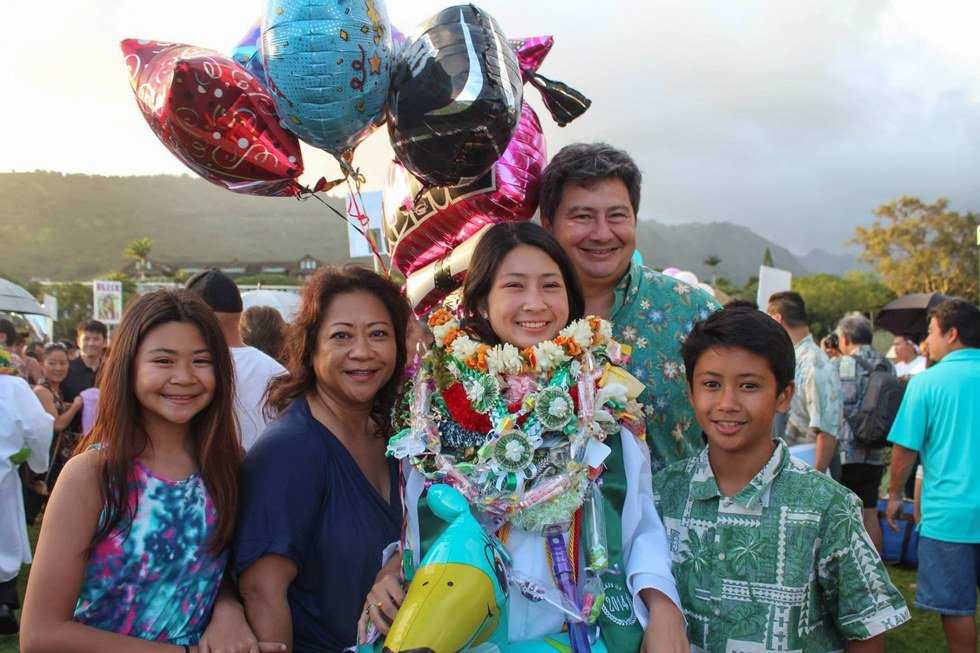
I was lucky enough to grow up in Hawaii, a state that prides itself on being a melting pot of cultures. The way people in Hawaii talk and the way they even eat are all influenced by different cultures, predominantly Asian cultures. It has always been easy to see how these cultures came together. Often after school I would walk to a local marketplace for an after school snack. At that small marketplace was Korean barbecue, sushi, manapua, Thai food, and crack seeds, to name a few options.
Growing up in such a diverse state naturally contributed to people being open-minded to other cultures. People grew up not only learning about their own heritage but many others. As someone who is a mixture of Chinese, Portuguese, and Filipino, I grew up going to bon dances (a Japanese celebration for the dead), popping firecrackers on Chinese New Year, and performing in May Day dances (a Hawaiian celebration).
I never thought about how my experience as an Asian, or multiracial person, would change if I grew up elsewhere. My first memorable encounter with racism was during middle school when I traveled to Washington DC. At the airport, people tried to talk to me in Chinese. When I told them I spoke English, they proceeded to talk in slow broken English so I could understand them better. What I understood was that they saw me as different. A few days later, at a museum, a Caucasian boy around my age asked condescendingly, “What are you doing here?” before pulling at the edges of his eyes to resemble the squinty Asian eyes I bore on my face. I did not know what to make of these situations as a sixth grader; I knew the way these people were talking to me and treating me was not OK, but as a child with a large group of my friends, these worries quickly faded from my mind.
Back on my little island in the middle of the Pacific Ocean, I did not have to worry about racist comments. I felt there was minimal classification and organization of people by race. This idealistic mindset was challenged on multiple occasions, but one occasion has stood out to me, and continues to confuse me. Being unaccustomed to controversial discussions over race, I was surprised one day during high school when I found myself in an awkward situation. I was sitting in Asian Studies participating in a class activity on personal identity and ethnicity. At one point during the conversation, someone brought up being Filipino.
“Oh, I’m Filipino too,” I commented simply.
To my surprise, the girl sitting next to me turned to me abruptly and told me I was not, in fact, Filipino. Given that I am mixed, I brushed off her comment, thinking she assumed I was another ethnicity. I explained to her that I was half Filipino, a quarter Chinese, and a quarter Portuguese.
“Yeah, so you’re not full Filipino. You’re not Filipino,” she said assertively before turning back towards the board.
I sat there trying to work through what she was trying to tell me. If I was multiple races, and not being fully one race made me not the race at all, was she telling me I was nothing?
In general, I take pride in my mixed heritage. One of the first questions I am asked by people tends to be about my ethnicity. I enjoy the look of confusion and the comments about my unique background when I tell people the breakdown of my culture.
However, more and more often I am encountering the same problem I was first faced with in Washington, DC. I, like many other Asian-Americans, am put in a box. Sometimes I am put in a single box: Asian. Sometimes another: White. Sometimes I am put in three different boxes. Sometimes I am put into no boxes at all.
Yes, I am Chinese. Yes, I do participate in Chinese New Year. Yes, I do have my favorite Chinese foods. No, I have not been to China. No, I do not speak Mandarin. No, I do not speak Cantonese (or Shanghainese, or Taiwanese for that matter).
Ye,s I am Portuguese. Yes, that does make me white. Yes, my last name comes from this heritage. No, I do not identify as white. No, I cannot tell you much about this culture. No, I do not want to hear your “portagee” jokes.
Yes, I am Filipino. Yes, I love pancit, fried bangus, and arrozcaldo. Yes, I do have a big, loud family. No, I cannot understand Tagalog nor Ilocano. No, I have never eaten balut. No, I do not want to hear your jokes about a black dog.
As a multiracial person, I have some understanding of each culture I come from. I enjoy learning about my family history, such as how my grandparents (or their parents) came to the Hawaiian Islands: how I came to be the multiracial person I am. I also cooking ethnic food or going to cultural festivals in order to immerse myself in my heritage more.
However, I know I will never understand each culture fully, but that is not the point. I should not feel ashamed for not being able to speak Chinese, Filipino, or Portuguese. I should not feel pressured or obligated to visit any of these countries. Growing up in a predominantly Asian state, it has been much easier to understand and relate to my Chinese and Filipino heritage than my Portuguese. This lack of understanding does not make me any more or less Portuguese than I really am.
As someone who is half Filipino, I have taught some of my full Filipino friends how to make banana lumpia. At the same time, those friends have left my house with baon (leftovers for lunch) while teaching me the meaning behind the word. Being multiracial makes me no more special nor less special than my friends who are only one ethnicity.
Recently, I was able to watch the play Hapa Cup of Sugar, written by my friend Marissa Martinez. The play deals with a biracial family trying to understand the world in which they live. The play explores some of the difficulties people of a mixed background deal with. I related most with the character Leila. She was the oldest daughter in her family and was struggling to find a job post college. As immigrants to the United States, her parents were able to set up a laundromat and send their children to college. Leila, of course, wanted more than that for herself and her siblings. As the play developed, I watched Leila come to terms with understanding how she does not have the same privilege that other people may have. Despite these difficulties, Leila persevered.
Leila taught her siblings that the world is not fair. Many people are put into boxes based on their outward appearance. Because of someone’s outward appearance, they are already seen as one thing without being able to prove their own individuality. However, individuality is all anyone has. Everyone has grown up in unique situations that have contributed heavily to the way they act and what they believe.
All I can ask is for people to be understanding of these differences. It is great that people take pride in their heritage and all the other factors that make them unique, but it is important to respect the various experiences and backgrounds of other people. No one should be judged or defined based on skin tone, economic background, or sexuality (to name a few). People should be allowed to define themselves, on their own terms.
Yes, I am Filipino, Portuguese, and Chinese. But I am also so much more.