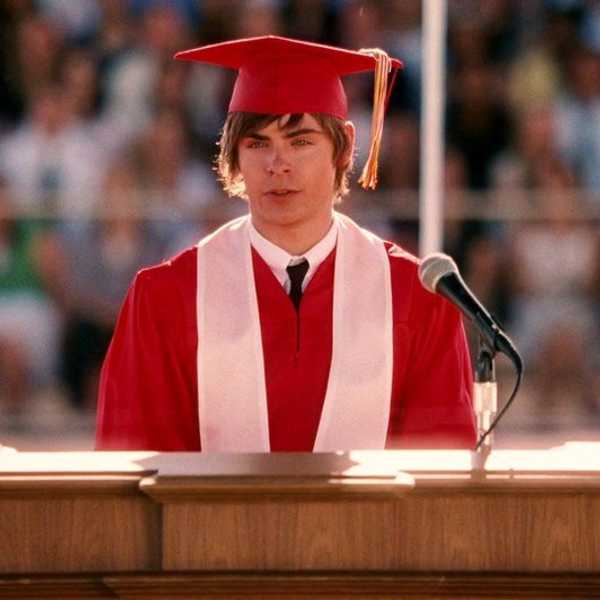


Just one short week ago, I graduated from college; from a little university in southern Michigan. Graduation of any type, of course, is a big deal, a one-of-a-kind accomplishment; yet there is something about graduating from college that is particularly freeing and significant. It was a big day. There were so many people, so many procedures to follow, so many memories to take in and recall with the friends and classmates you've just spent (at least) four years with. It was exciting, nerve-wracking, energizing, and wistful all at the same time. Needless to say, having to sit still through a whole graduation ceremony with so much emotion and adrenaline coursing through your veins is not easy. I personally was antsy, getting sick of both the mortarboard slipping off my head and the heels I was wearing pinching my feet. I just wanted to get my diploma and then spend the rest of the time with my friends in order to say my goodbyes properly; foregoing all of the pomp and circumstance. This was how I was feeling when the president of the college announced the commencement speech speaker, an alumnus of the school who no one had heard of before, yet was someone important enough to be trusted with the task of sending off three hundred eager twenty-somethings into the world. He was an older guy, with gray hair, glasses, and a noteworthy profession like doctor or professor or something like that. As he stepped to the podium, I settled into my too-small folding chair, hoping for a speech that would be both meaningful and concise, something inspiring and also short enough to get me to my diploma as soon as possible.
At first, the speech was fine. He started out with the story of Chicken Little, saying how many people in our world today believe that the sky is falling and have little hope for the future; however, he himself did not believe that this was the case. He talked about how so many members of the older generation think that the younger generation is too immature, too unprepared, too puffed up with a sense of entitlement to bring about any positive change to the world; yet he did not agree with this notion and thought that the younger generation was often treated unfairly and was underestimated in a lot of ways. As a member of the younger generation, I agreed with this premise. I think there are people out there who hold a stigma against youth and who don't give us enough credit for the things we can accomplish, who focus only on what's wrong with us instead of what's right. I found myself nodding along with the speaker, glad that someone of his age and caliber was recognizing the pressure his generation often puts upon the youth of our country, pressure that perhaps has never been seen to this extent before in the history of our nation. Finally, someone who understood. Finally, someone who was standing up for us. Finally, a commencement speech that was hopeful and encouraging rather than serious and a little ominous.
And then he took it too far.
He went on to berate the older generation, or "the Ancients" as he called them. He essentially said that everything they believed about youth was wrong and that (to paraphrase) "When the Ancients are right, they are afraid to turn the knowledge they have onto themselves." He said that old people never did anything bold or commanding, never started revolutions or dreamed big dreams (Which is clearly untrue. Revolutionary War anyone? George Washington was at least in his fifties at the time). In his concluding remarks, this speaker said that the young were right and the old were wrong, and that only the young have the power to save our country or move on to bigger and better things.
Now, while I agree that our generation often gets the short end of the stick, this does not mean that I believe we are some perfect generation diminishing under the tyranny of our forefathers. Our generation, just like any other, has made its own share of mistakes; has messed up and done things that are not worthy of praise or admiration. As someone who works closely with youth, I see how mean students today can be. I see how the love and appreciation for great art, nature, and learning is not as strong as it was in past generations. I have witnessed time and again kids who have contemplated suicide because of cyber-bullying or who cut themselves because they no longer have the confidence or self-esteem left to stand up for themselves or love themselves for who they are. I have seen kids throw tantrums at the grocery store and have to be placated with tablets and video games because they have learned that these fits can be used to manipulate their parents into giving them what they want. These are real problems that the youth of today are facing all the time. We are screwed up, we are scared, the rules our parents and grandparents and great-grandparents once lived by no longer apply. And yes, while a lot of these problems are partially the responsibility of our elders, we cannot blame them for everything. We also have the freedom to make choices and must take the appropriate credit for our actions.
In my mind, what is most offensive about this commencement speech is that the speaker chose to break up the generations into the categories of right and wrong, as if age falls under the constructs of black and white morality. Again, while the older generations have played a part in influencing the younger ones, there is still a lot we can learn from them. One thing that amazes me about the Ancients is their work ethic. So many great scholars worked countless hours to gain the level of learning and understanding that made them noteworthy. To use a recently popular example, Alexander Hamilton, our nation's first Secretary of the Treasury, wrote countless essays, read countless books, and worked tirelessly to build our country into what it is today. Now, when I look at my generation, I see a lack of that ethic. Oh sure, it's definitely still there for some people, but as a recent college student, I know a lot of people (including myself) who prefer to procrastinate on work or do the bare minimum to get a passing grade than actually work harder to improve ourselves or our peers. We would rather watch Netflix than put our minds to writing great essays or studying great things. We put in as little work as possible so that we can stay on the couch and watch The Office. The work ethic of our forefathers is no longer what it once was.
Now does this mean that the Ancients were perfect beings and that the younger generation is too messed up to be successful? As I mentioned before, not at all. As the speaker said rightly, there is no reason to fear that the sky is falling, because our generation can carry on and will carry on to do great things. We have the creativity and brains to do it, we are unique in ways our parents and grandparents never had the chance to be. What I am saying though, is that both youth and the Ancients have their pros and cons. Both are brilliant and both are messed up. Both have their failures and successes, both have their problems and solutions. One is not better than the other; how can they be? Age is not a moral issue. Young is not right and old is not wrong, or vice versa. We are both right in some ways and wrong in others. In order to grow and be successful, the younger generation must learn from those who came before, must respect our elders for what they are good at and try to hone those skills for ourselves. The older generations must have more faith in the youth of this country and see that we have capabilities to do amazing things. We need each other; it is impractical to think otherwise. And to praise one while bashing the other does not solve problems or inspire confidence, but rather breeds anger and misunderstanding.
This is what I wish the commencement speaker had said. Because whether old or young, we all still live in this world. And as someone going out into the world outside of college, I want to be able to learn from and appreciate everyone, not just those of my own generation.