
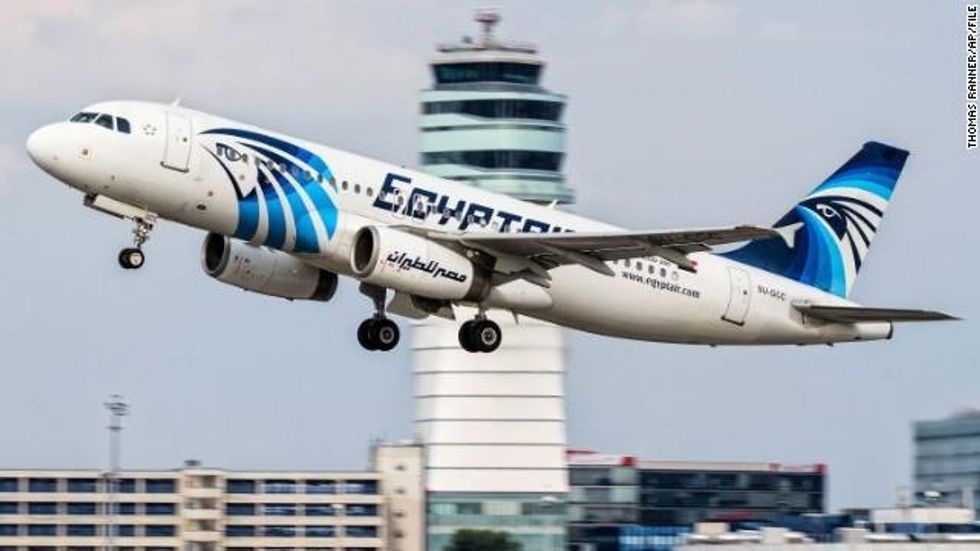
Two years after the still-mysterious disappearance of Malaysia Airlines Flight 370, the world is yet again faced with abrupt tragedy and bewildering wreckage. For many, it may seem as though periodic plane crashes and disappearances are becoming almost common. CNN reports there have been eleven “major” plane crashes worldwide since 2013. According to the Aviation Safety Network (ASN), however, this is not the case. In fact, 2015 was a record low in number of fatal aviation accidents. The incidents of recent years, then, have perhaps simply garnered significant attention. Nonetheless, the May 19, 2016 disappearance and crash of EgyptAir Flight 804 (MS 804) is disturbing—partly because of what we don’t know and partly because of what we do. Currently we have a surplus of the former and a paltry, contested collection of the latter.
The Basics
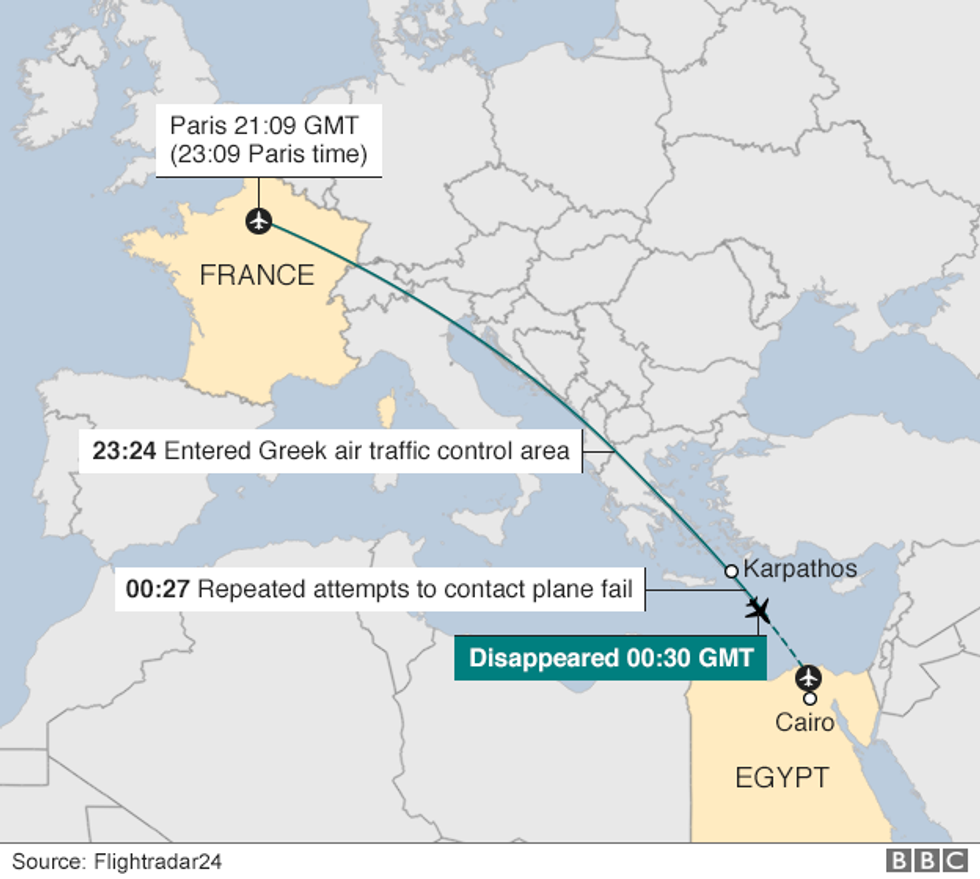
MS 804 was an Airbus A320 flying from Charles de Gaulle airport in Paris to Cairo International Airport in Cairo, Egypt.
The flight was operated by EgyptAir, the flag carrier airline of Egypt, and staffed by seven crew members. The other fifty-nine people included three security personnel and passengers from twelve different nations.
The plane was passing from Greek airspace into Egyptian airspace when the trouble seems to have started. At 00:26 GMT, the plane sent a series of automatic updates to ground facilities. The technical data reported smoke in the lavatory and the avionics chamber, as well as an increase in the temperature of the co-pilot’s window. Because these reports are automated, the crew may not have even been aware of these changes.
Greek air traffic controllers, who had spoken to the pilot just thirty-eight minutes before, made repeated calls to the craft but received no response. No distress call was made. At 00:29 GMT, the plane left Greek airspace and quickly dropped off Greek radar. Egyptian radar subsequently lost contact with the craft at 00:30 GMT.
The Wreckage
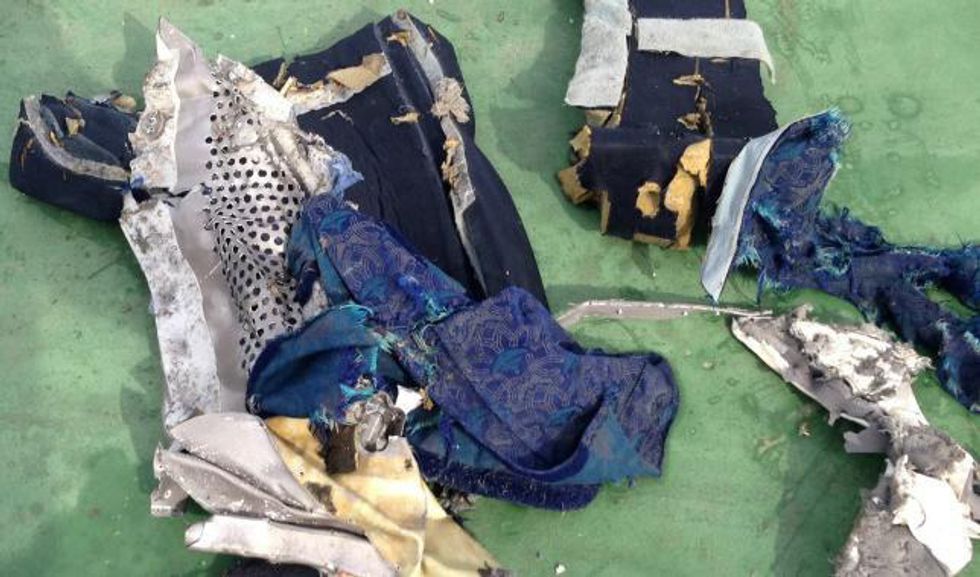 Search and rescue efforts began at 00:45 GMT on Thursday 19 May and have continued since. Because the plane went down over water, the search for debris has encompassed a broad area of the Mediterranean that is up to 10,000 feet deep in places. Pieces of metal and fabric, including those from lifejackets, seats, and personal belongings, have been recovered, as well as small pieces of human remains.
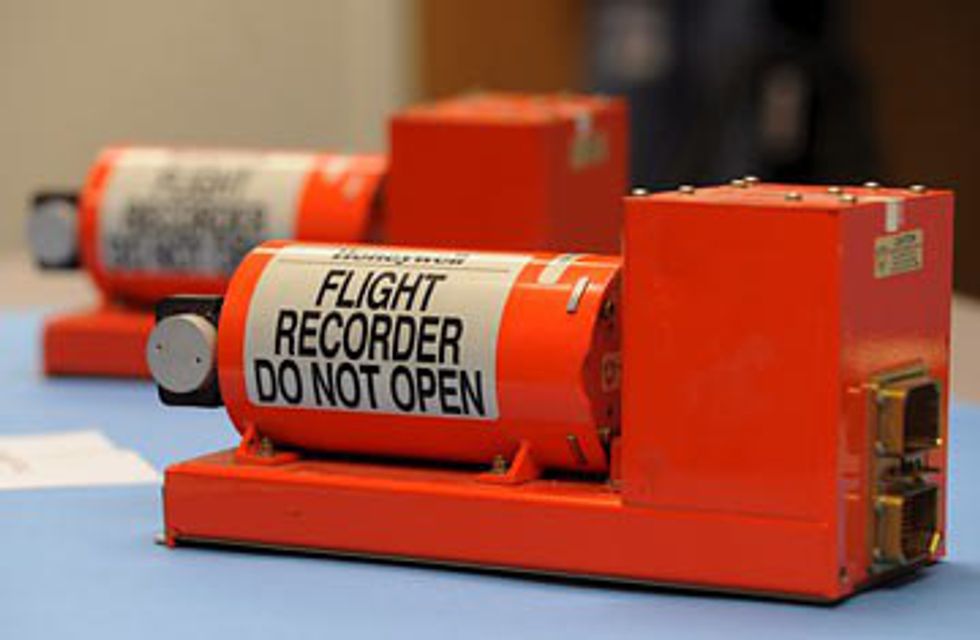
As of the writing of this article, the “black boxes”—crucial to the investigation for the flight data and voice recordings they are meant to provide in such circumstances—have yet to be found. The boxes’ signal is sustained by a battery meant to last up to 30 days. On Thursday 26 May, however, a lead investigator reported that Egyptian search teams had picked up an emergency signal that could potentially help pinpoint the plane’s fuselage. This is reportedly not the same device as the black box, but the discovery may narrow the search area to roughly 3 miles.
The Unknowns
There are some disputes as to what happened in the final moments of MS 804’s flight. While Greek officials report that the aircraft “turned 90 degrees left and then 360 degrees to the right, dropping from 37,000 [11,300m] to 15,000ft [4,600m] and then 10,000ft [3,000m],” Egyptian officials refute this, claiming the plane “did not swerve or lose altitude” before dropping off the radar.
The largest unknown in this equation remains, obviously, why the plane went down in the first place. Mechanical failure, inside sabotage, pilot error, or terrorist attack (a smuggled explosive): these are the theories currently being suggested as information continues to trickle out. None of this, however, will likely be sorted until those precious black boxes (which are nowadays actually orange in color).
Déjà vu?
In my efforts to research the current status of the investigation, I came across a 2001 piece from the Atlantic reflecting on the October 1999 crash of EgyptAir Flight 990. Similar to MS 804, Flight 990 was an Egyptian Airlines passenger craft headed to Cairo when it disappeared over water mid-flight. Unlike MS 804, which slipped off radar over the Mediterranean three and a half hours into its Paris-Cairo journey, flight 990 went down only thirty minutes after takeoff. Whereas flight 990 was a twin-engine Boeing 767 with 217 people on board, MS 804 was an Airbus A320 with 66 passengers and crew members.
At face value, then, these two flights aren’t particularly comparable. Yet there is something about these two crashes that is striking: both planes headed to Cairo, both planes dropped off radar sans distress call, and both planes manned by experienced pilots. The U.S.-based National Transportation Safety Board (NTSB), charged with the Flight 990 investigation, ultimately concluded that the October 1999 crash was the result of deliberate action by one of the pilots. Egyptian officials disputed this assessment, though, and the investigation drug on for two years.
There is no indication in any direction as to the cause of MS 804’s crash at this point in time. Furthermore, these are two separate disasters under differing circumstances. Nevertheless, much can be learned from Flight 990 as the search for MS 804 continues. With authorities from France, Greece, and Egypt all involved, this investigation is likely to face some of the same struggles that beleaguered the Flight 990 case—the same challenges inherent to any investigation that straddles multiple jurisdictions and cultures. If anything, the memory of Flight 990 serves as a reminder to all going forward with the handling of MS 804 that there are not simply literal choppy waters to be navigated. Let’s allow the tragedy to rest with the wreckage.