
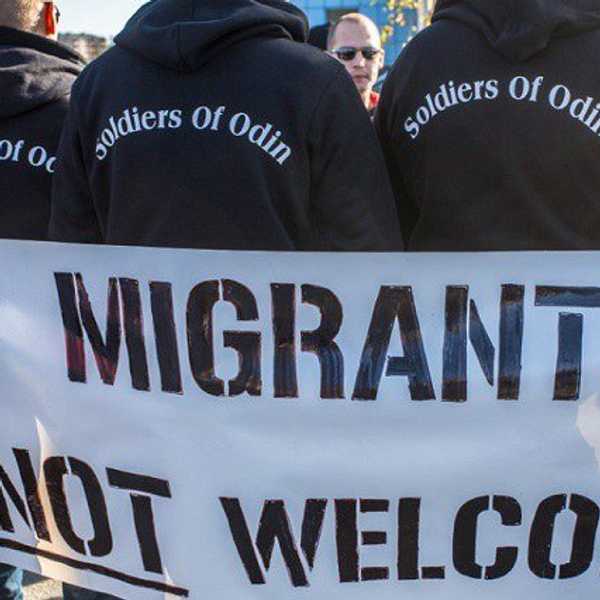
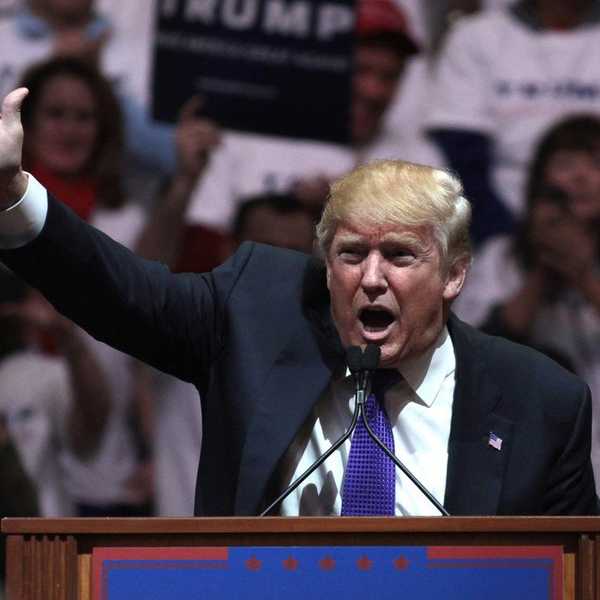
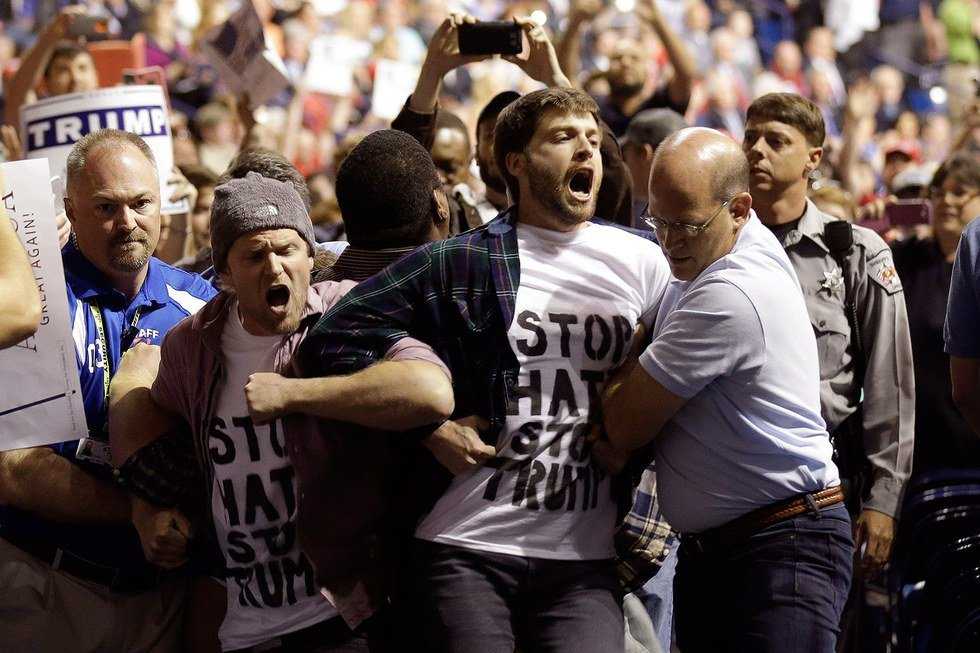
Once again, a protest has taken a turn for the worst and the media has fallen into its predictable cycle. This time around, a rally for Donald Trump’s presidential campaign in Chicago had to be canceled due to security concerns. Protesters showed up to this rally and, falling in line with the decorum of Trump supporters at their events, these protesters were harassed and assaulted. What made this event different is that the protesters fought back. It’s not clear what exactly happened other than chaos ensuing and the rally being canceled, but that won’t stop the media from regressing into its predictable modes of covering protests.
In the past few years, protests have been common in the media with the growing visibility of Black Lives Matter, a peaceful movement protesting police brutality against African Americans. Many protests, unfortunately, have derailed into riots and violence. The time it takes for a peaceful protest to escalate into a riot can be a matter of seconds, with the ensuing chaos blurring one’s sense of perception in terms of who started what.
For the media, someone has to be blamed for the violence in order to create a narrative, as every news story seems to require a protagonist and antagonist. When it comes to protests there isn’t a self-evident narrative and to compensate for this lack of clarity, the media regresses into predictable narratives. Those on the left tend to hold sympathy for the protesters, usually investigating the original purpose of their protest as well as the subsequent riot. Coverage in this way can be interpreted either as sympathetic or antagonistic to protesters, pending on how the event is covered. On the right, coverage and commentary is much less dynamic, focusing exclusively on the spectacle while being unequivocally antagonistic to protesters.
Contrary to what some would assert, riots are not amplified by the media. Riots are berthed from protests and protests are berthed from societal injustice. It does not matter if the media has a camera fixed upon a riot or a protest, a protest or riot will happen independent of the media’s coverage of it, as protests and riots have happened for centuries before news media existed. The most immediate way to prevent violent riots then, is to keep protests from escalating into riots. To do this, we need to re-examine how civil protests are discussed and viewed in general in our culture.
For one, protests are about a specific issue. In the case of the Chicago protest, the issue was that Donald Trump has said some openly racist, sexist, nativist comments while also inspiring violence in some of his followers. This behavior isn’t in passing ambiguous comments, it’s Trump’s brand as a candidate. Because this is his brand as a candidate, many people find the possibility of a Trump presidency terrifying for their well-being and thus worth protesting.
One of the initial reactions to many protests, not just Chicago, is that there is an abundance of other issues to protest. For instance, those who protest policemen murdering black people are often asked why they don’t protest black on black crime. The response is simple: one can protest police violence against black people and black on black crime, they’re two different subjects altogether.
The point of a protest is to draw attention to a specific societal problem, not write a manifesto against all societal problems. To look at a protester and immediately respond with “why don’t you talk about something or someone else” is the equivalent of saying “what you’re protesting is not an issue I consider a problem.” It would be one thing if those antagonistic to protesters, protest-skeptics, would say they don’t believe that Trump’s racism don’t deserve protest, but they don’t say that. Certainly, the burden of proof is on the protester to some degree to prove to the general public that a problem exists, but a proper rebuttal by the protest-skeptic is not to change the subject to something else.
Secondly, one thing that is lost upon protest-skeptics is that protesters have the freedom of speech. It’s true that the organizers of an event such as the one in Chicago have the right to remove protesters for disrupting an event that they have the legal right to hold. What’s also true is that the Trump supporters did not have the right to assault them. No reasonable protester goes to an event intending to initiate violence, because doing so would derail the point of their protests. In the 21st century, protesters know full-well that the media prefers to cover violent protest to non-violent protest, and spectacle over substance. Being a violent protester fulfills a trope that accomplishes nothing. Though it’s possible that protesters created the violence, there’s good reason to believe that Trump supporters initiated the hostility either verbally or physically due to past events. The escalation to violence likely wouldn’t have occurred had the Trump supporters respected the rights of speech of the protesters. Though it’s certainly annoying when someone shows up to a political rally seemingly to disrupt it, in America everyone has the right to do so until those who put on such an event deem it disruptive.
Lastly, whenever a riot happens, it most certainly does not invalidate the original protest against a societal injustice. No one condones the vandalism of property or violence. With that said, if a protest-skeptic is going to dismiss criticism against a societal injustice because of the actions of a riot, that demonstrates apathy towards the issue altogether. In Chicago, it’s unfortunate that the protest against Trump devolved into chaos, but it doesn’t take away from the reality of the social injustice leading up to the situation. In this case, Donald Trump is stirring up division and hatred, and the result is an escalation of violence.
Going forward, we can continue our current course and fixate on the chaotic aspects of Chicago, acting as if these events are impossible to prevent, while holding supposed hoodlums into contempt for protesting in the first place. Such a response, though simple, accomplishes nothing and neglects to examine the source of the violence in the first place. Alternatively, we could take a different path and listen to critical voices of societal problems, respect the right to free speech unequivocally, and understand that riots and violence are a symptom of a bigger problem, not the disease itself. Until we take this alternative route, our ability to address societal problems will remain stagnant and our respect for those who draw attention to these problems will remain minimal.

















