

This summer, I earned some extra money by working at the Lane County Fair when it came to Eugene. I worked on the carousel, mostly seatbelting kids to horses. It wasn’t glamorous work. Every day I would slather on sunscreen around the collar of my Funtastic uniform shirt, ready to sweat in my black slacks. But I wanted to put the check Funtastic wrote me at the end of five grueling days to good use -- a trip to San Francisco was the original goal. It proved beyond the upper limit of my carnie wages, though. So I chose another West Coast city I had never been to -- Seattle. Seattle is a six-hour, thirty-dollar BoltBus ride from Eugene. The reduced travel time and cost immediately made it a more viable option than SF. So I packed my suitcase and took my boyfriend to the Historic Panama Hotel right in the middle of Seattle’s International District for five days at the beginning of September, before the school year started.
Seattle implies a lot of tourist attractions. Pike Place Market. The Gum Wall. The Space Needle. The Seattle Art Museum. For a more select audience, however, it means first and foremost the breeding ground of grunge and the haunt of Kurt Cobain, the “king of all the outcast teens” as he describes himself in a discarded lyric from an early draft of “Smells Like Teen Spirit.”
Determined to locate a shrine commensurate to the rock legend’s shadowy quirkiness, I set my sights on Viretta Park, the “unofficial Kurt Cobain memorial” next door to the house where he lived his last days, number 171.
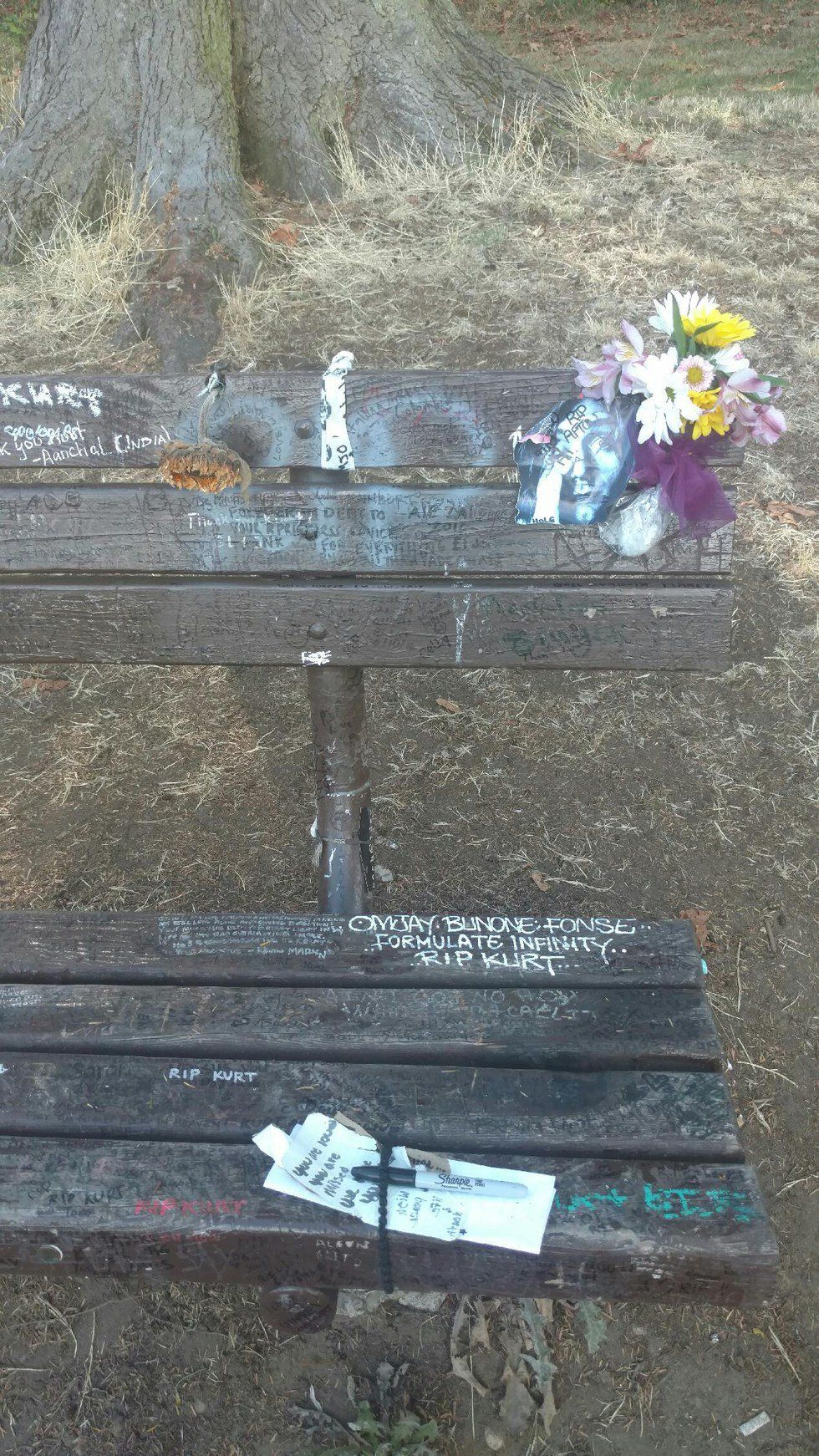
Viretta is small and spare, a set of steps declining down a steep hill to some towering evergreens and ferns fringing a patch of dirt. But I had heard to look for the graffiti. It started on the staircase rail, but proliferated on the two benches in the park.
Variations on “RIP Kurt” predominated. Lyrics ranged from the most popular choruses like “Forever in debt to your priceless advice” to lines from hidden tracks such as “And if you save yourself, you will make him happy/Conclusion come to you.” Others voiced personal messages to Kurt: “Thank you for existing,” sometimes followed by names, dates, and cities. One heralded from Honduras, another from Bali. The X-eyed, tongue-popped signature smiley face reigned supreme.
In addition to these inscriptions, fans had left sharpie markers wedged in the bench slats for future visitors. A black band fastened a dog-eared piles of notes in place. Clumps of wild berries, ribbon-bound wildflowers, a tied bandana, a dessicated sunflower, an eerily blue-lit magazine close-up of Kurt’s face heavy with doodles. These DIY, ragtag tributes resonate with the grunge spirit.
I added my own words, a play on the famous lyrics “Here we are now, entertain us,” :“Here we are now, thanks to you. <3” It felt obligatory that I contribute. I first became interested in Nirvana when I discovered YouTube in summer of 2009. For some reason, watching the yellow lights on the “Smells Like Teen Spirit” video piqued my interest. I very clearly remember thinking, “There’s a story here.” I knew something about Kurt Cobain committing suicide and doing drugs, but felt there was more. I wanted to be a writer and I loved to read, so I often spent long chunks of time at the Eugene Public Library that summer. On one trip, I simply checked out a CD with a baby suspended underwater on the cover and a copy of “Heavier Than Heaven” by Charles R. Cross.
I selected this particular Kurt Cobain biography for no other reason than the title, my poet’s imagination captured by the juxtaposition of the murky, gray “heavier” with the airy, celestial “heaven.” Maybe it was just the right time for me to fall in love with a piece of biographical writing/creative nonfiction after years of reading fiction. Maybe it was the first stirrings of my own adolescence, nascent but powerful. It was the eerie, haunting descriptions of Kurt’s early paintings and poetry, his penchant for the disturbing, his skewed wit.
It was listening to “Nevermind” and then “In Utero” and each time feeling transported to an alternative universe of fearsome and beautiful creatures. “Disease-covered Puget sound” of “doll steak and test meat,” where you could aspire to such ethereal things as “skin the sun” and “cut yourself on angel hair and baby’s breath,” a juxtaposition of razor-wire and silk to rival “heavier than heaven.” It was a world where the plangent lapped into the sinister, the hazy into the mad. “A Leonard Cohen afterworld, so I can sigh eternally.” I felt Kurt had generated a world in each song, populated with the gore-spattered markers of birth, reproduction, and decay: “Most babies smell like butter,” “broken hymen of your highness,” “I lie in the soil and fertilize mushrooms.” I was already wary of cliches, and Kurt Cobain found bizarre, beautiful ways to sidestep cliches. “I wish I could eat your cancer when you turn black” communicates a desperation that “I love you” doesn’t carry. I wanted to be a storyteller. Kurt was a musical storyteller. His song “Polly” actually tells the story of a kidnapped girl raped and tortured with a blowtorch who overpowers her attacker and escapes. What I love most about this music was its power to envelop me. It contains universes. I own a Nirvana beanie and a Nirvana refrigerator magnet in addition to the standard T-shirts and posters. Need more than that? I wrote the application essay that got me into the Clark Honors College at University of Oregon about “In Utero.”
So I did not want to leave my visit at a few words written on the bench. My boyfriend and I began searching for his house, only to find it was right next to Viretta Park, the roof visible over tangles of greenery and pine trees. As we were wandering around the park craning our necks into various unnatural angles, a man showed up and began sauntering around. It was clear he was there for the memorial. Eventually he came up to us and confided in a low voice, “If you want to really see his house, you have to go through that opening and you’ll come up to the fence. You can climb it and see the house and backyard. They’re doing work on it right now, but you can see it.”
The opening in the foliage was sketchy, but we ducked and walked, backs bowed, up to the fence, where another handful of graffiti spidered across the boards. I stood up on the lower part of the fence and peered over as my boyfriend supported my leg. The yard was lush with shrubbery, bushes, and colorful flowers under a paper-white birch tree.
After we ducked out of the gap, I walked up the slope along the mess of plants, hoping to see it from a better vantage point. A spiderweb snapped across my face and I jumped. Turning around, I saw a globular spider mummify a struggling bee in the wreckage of its web. It seemed fitting. I could hear the whir of an engine from the backyard where work was being done, and, faintly, music. I strained to hear. Was it something Kurt would deem fit to play in his backyard, some Shonen Knife or Flipper?
While I was preoccupied, a man in a leather jacket had entered the park and was talking to the first man, propped against the same pine tree. I wanted to ask them about their connection to the park. But my boyfriend told me that while I’d been fangirling, the manner in which the men aimlessly wandered around without making eye contact with each other, only to begin talking without any kind of greeting, made him think they were exchanging drugs. I didn’t care if they were drug dealers; I wanted to ask them about Kurt Cobain. But, ultimately, I was on vacation and did not want undue stress or trouble.
So we left and walked down the hilly, winding Lake Washington Boulevard past gated houses with stucco roofs and palm trees in their yards, until we came to the waterfront of Denny Blaine Park. We headed down to the water, only to stop as piles of clothes popped up on the shoreline and we saw the curvature of buttocks on the bleach-blond man standing at the water’s edge. It appeared to be a tiny, residential, unmarked nude beach.
We sat on a wall facing the water as watched naked men walk by, dicks flapping. Beyond that, we could see mountains and the high-rises of Seattle, horizon curving around it all like a lucid blue bowl. The reflection of the sky and clouds on the water looked like a painting. I could not help but think that having a view like this in your backyard would be a strong incentive to live.
Eventually, we left. An Uber picked us up. As we waited, I noticed ferns and bleeding hearts curtained the Denny Blaine Park sign. As we rode back to the Panama Hotel, I looked at the sleepy gold timbre of September sun on brick buildings and the leaves staining red and orange.
Life, after all, goes on. Kurt Cobain shot himself in April 1994. People died. Babies were born. For example, I was born over two years later, in November 1996. Spencer Alden, better known as the baby featured on the front of Nevermind, is a quarter of a century old. In September of 2009, I spent weekends listening to the Meat Puppets and PJ Harvey as the leaves fell off the walnut tree. A few years later, however, I spent autumn weekends running 5Ks all over Oregon for my high school cross country team. Now I spend autumn weekends writing articles for university publications. I drink coffee now. I drink alcohol now. You don’t stay the dreamy girl listening to the Meat Puppets. You fall in love a couple times. You take a trip to Seattle for the first time with the person you’ve fallen in love with most recently. You check out a hotel room in your own name for the first time and manage your own money and answer emails and work on vacation. You ride an Uber for the first time and stumble upon a crescent of nudist beach.
In 2014, Charles R. Cross published another book about grunge, “Here We Are Now: The Lasting Impact of Kurt Cobain.” His introduction explains he approaches the famous lyric “Here we are now” as a description of the world’s arrival at its current state in light of Kurt Cobain, the resultant changes in fashion, music, gender expression, etc. Life goes on. There we were then. Here we are now.
So many thousands of pages of interviews have been transcribed, gallons of ink expended and word processors taxed for books published, that it seems gratuitous for me to write this article. In a letter from an earlier, botched suicide attempt, Kurt refers to Hamlet. In the play, Hamlet chastises Rosencrantz and Guildenstern for attempting to “pluck out the heart of his mystery.” After all, the mysteries of journals and paintings and rough drafts, of broken relationships and family feuds, of criminal and drug activity have been probed and probed again when it comes to Kurt Cobain. But people keep on writing as they orbit the ultimate mystery, the mystery that occurs within the bone circumference of our skulls and extinguishes in death, the mystery trapped in the cage of the self. They enlarge a single case study, that of a famous icon, because watching the lives of the famous can make some people feel less alone. Watching a life in rehearsal, on display. Never mind that the famous people themselves don’t feel any less lonely, any less free of the skull-penitentiary, nevermind. It is the heart of the human mystery, and it refuses to be plucked out.
But I try, nonetheless, to order my existence into a coherent narrative around the missing piece of the heart of mystery. I read literature, I have soul-searching conversations and philosophical debates, attend college lectures and church, look at art. As I approach a new decade of my life, sitting in the Panama Hotel Tea and Coffee House, I look at the world of 2016 and think, here we are now.

















