
“Nature’s peace will flow into you as sunshine flows into trees. The winds will blow their own freshness into you, and the storms their energy, while cares will drop away from you like the leaves of Autumn.”
As demonstrated in the quotation above, John Muir found spiritual and transcendental qualities in the unspoiled lands of nature. He was instrumental in the creation of Yosemite National Park and the co-founder of the Sierra Club. National Parks wouldn’t be what they are today if it wasn’t for John Muir.
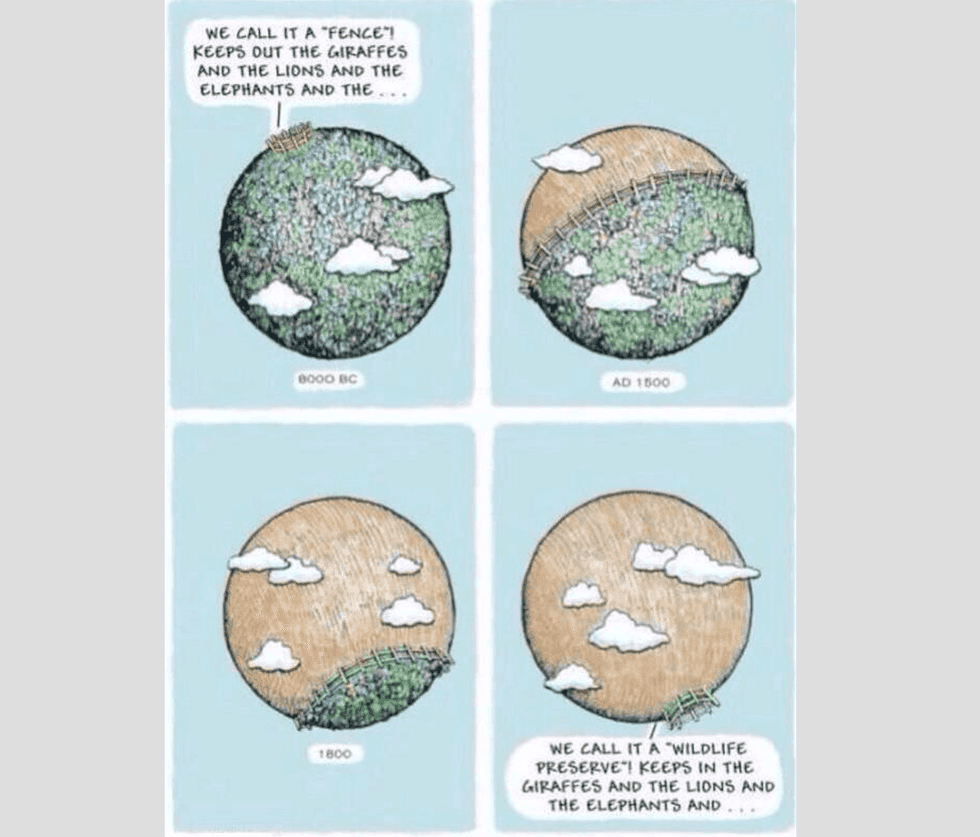
In contrast, our attitude toward protecting wilderness today has become apathetic. With misleading headlines like “There Are More Protected Places on Earth Now Than Ever Before,” the consensus is that we are A-Okay; there appears not much more to be done in terms of national parks. Of course, it is true that there are more protected areas now than there have been in the past. But that’s only because there used to be no need to protect nature: there were less of us, and we lived more sustainably. Soon after the Industrial Revolution, people like John Muir and his rival, Gifford Pinchot, finally started the movement to protect more of our Earth’s pristine landscape.
On the initiative of these individuals, two conflicting movements accompanied the rise in protecting the land: preservation and conservation. John Muir sought to preserve nature because it had an intrinsic value to him: a leave-this-untouched-because-this-is-the-Earth mentality. Gifford Pinchot, meanwhile, led conservationism, which espoused a responsible use of the Earth’s resources: “since nature provides food and fuel for man, conserve these resources for the future.” These two philosophies dominated the environmental discussion for much of the early 20th century.
Today, as the global economy expands, the need to protect the Earth has severely increased. According to Science Magazine, we have 3 trillion trees left on Earth. That's about half as many as there were before humans came along. Now, we are cutting down trees at a pace of 15 billion trees per year. That only leaves us with 200 more years of trees! Furthermore, as only .00018 percent of non-marine biomass, we use a fifth of what nature produces, thus vastly overexploiting the earth.
There are some cool technological solutions to solve this problem: the 5-hour Energy founder, Manoj Bhargava, is tapping into the core of the earth to solve our energy problems forever, drones are able to plants a billion trees a year, and NASA’s solar panels in space will provide constant power from the sun.
But before all that technology comes, we should take into account some statistics. Here are the numbers: of Earth’s entire landmass, 90 percent of it is available as non-human habitat, half of it is wilderness, and 12 percent of it is protected. So, as we wait for technology to catch up and help us reduce our impact, why not bump up the 12 percent of the land that is protected to all 50 percent of the land that is wilderness? Let’s progress from preservation and conservation to reclamation. Let's reclaim the earth for what it truly is: pure, untainted nature.
For me, it’s easy to get on board with reclamation because I just love the earth. If the economic incentive known by conservationists isn’t somehow already good enough for you, let me try to convince you in a few sentences. Look to the jungles: the majestic canopies of trees, hanging over vibrant flora and howler monkeys. Look to the tropical islands: crabs and swaying palms sprinkled on the navy ocean. Look to the mountains: brawny wrinkles of the earth’s crust, overseeing nature with tree beards. Just try to wander out into space and find something as beautiful as our Mother Nature. Finally, know that Earth is our home. We belong here. The least we can do is protect more of it and treat it well.
As for our current state of affairs, convention says not to blame humanity. Yet, the selfish and irresponsible decisions of mankind in the past have landed us on this path that we now know is disgraceful. So, let us step off this path. Equipped with imagination and the morals of humanity, let us walk on the path of sustainability.
Our most thoughtful step to date has been preservation: don’t cut Mother Nature here, there, and over there, for she is our Mother. Beyond applying the bandages of reclamation, I say let's give Mother a kiss, for I don't want to miss my last chance to tell her "I love you."
(Follow John Muir with me on the new path and #StandForTrees)
















