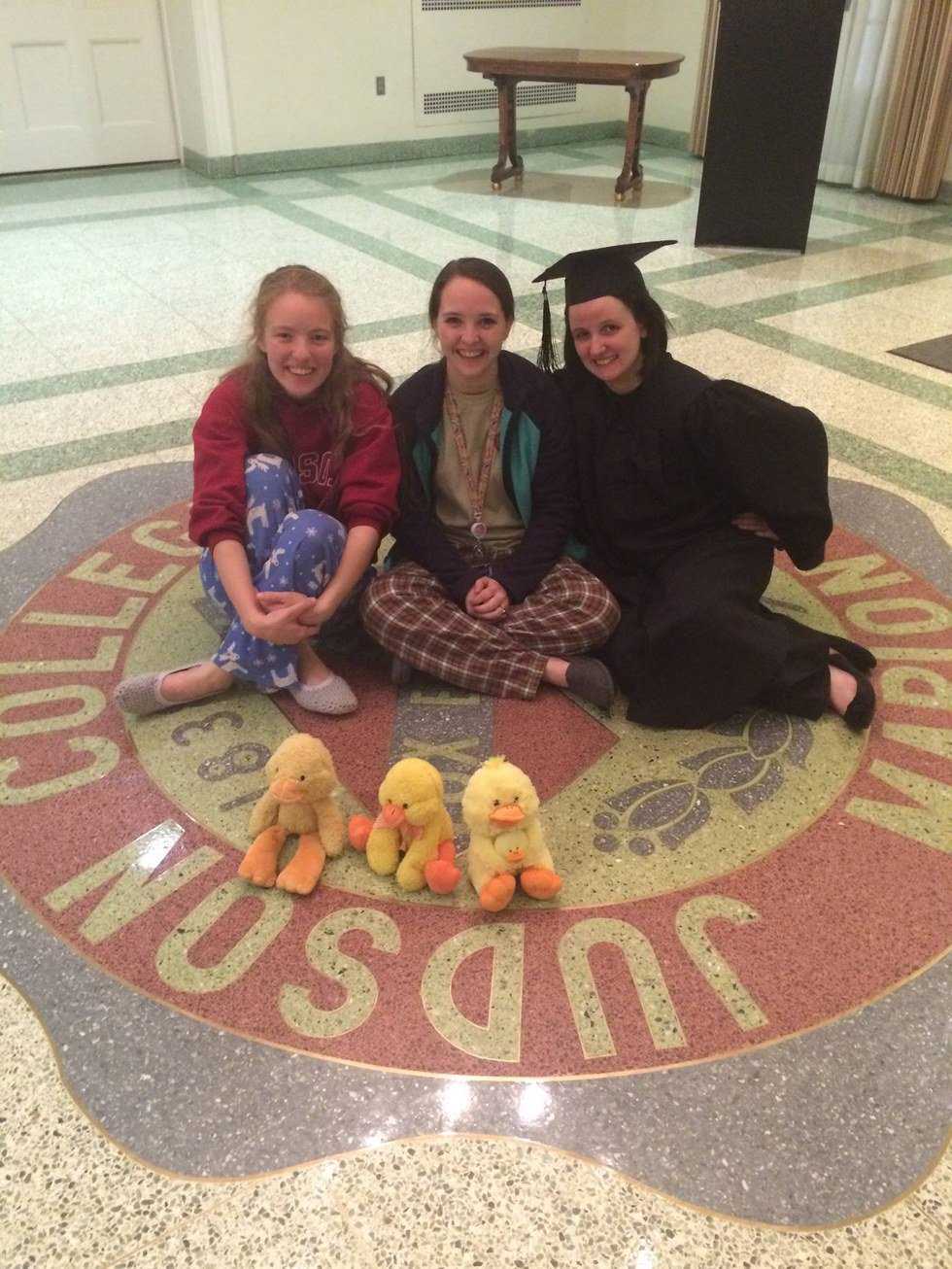
I go to a small, close-knit sisterhood of a college, a tiny fourteen-building household of about two hundred and ninety women where I recognize everyone I see at lunch. It's wonderful, but it's bittersweet; your fellow students become family if you let them, but when those students graduate and wander off to their respective futures, their absence is felt that much more strongly. Every commencement ceremony hurts a little bit more. As I watch the graduates walk across the stage to shake hands with the president one last time, I find that I cannot help but wonder, every time, how in the world Judson is supposed to work without these people who have all been so vital to our daily lives.
The longer I'm here, though, the more I find that adjusting to their absence isn't the real hurdle.
No, the real tragedy occurred to me this summer as I began to prepare for my role as choir president this year, a role which a good friend of mine had held until that point. She was graduating, and I was taking her place in many ways: this semester, I hold her position in the math tutoring lab, I'm taking her role as choir president, and I'm following behind her as the new senior song leader.
As I sat on the floor of my dorm room, sending out copies of the words to the songs Judson girls have sung for decades, it occurred to me: every time I had thought to myself that it would be the death of us to lose this friend, I had been wrong. She was leaving, and that was all right.
Somehow, that hurt more than needing her and not having her. We did not have her, but somehow we still had exactly what and who we needed.
There is a strange sort of security in needing people, I think. From our earliest thinking moments of childhood, our culture teaches us that we will have people there for us when we need them. Some part of us is trained from birth to think that surely people who truly care about us will not leave before we are prepared for their absence.
This is what no one told me about what it meant to miss someone: oftentimes, the departure of precious people from our lives hurts, not because we cannot live without them, but because we find ourselves more and more sure that we can. In turn, that sureness forces us to confront our own increasing maturity and our own independence, which we often translate into loneliness.
For a long time, that scared me. I was afraid of "replacing" people and thus changing my friendships with them forever, and I was afraid that if lives could continue so smoothly in the absence of their favorite human beings, I too would be replaced and become useless and unwanted.
But I am not writing this article to make you sad. I am writing it to give you good news. You see, as more and more of my favorite people come and go, I am beginning to see the light shining through the curtain: independence is often what keeps connections alive after even the saddest partings. No, I don't need my alumnae friends to function, but if I did, then their absence would cause tension between us and make my memories of them turn bitter with a sort of inevitable betrayal. As it is, I function without them, and they without me, so that thoughts of them can hurt less and less over time and our current conversations need not center themselves around sadness.
So if you find yourself missing someone because you are living successfully without them, remember that it is less a curse than a promise. Your independence will keep the bond between you so much stronger than fear ever could.