


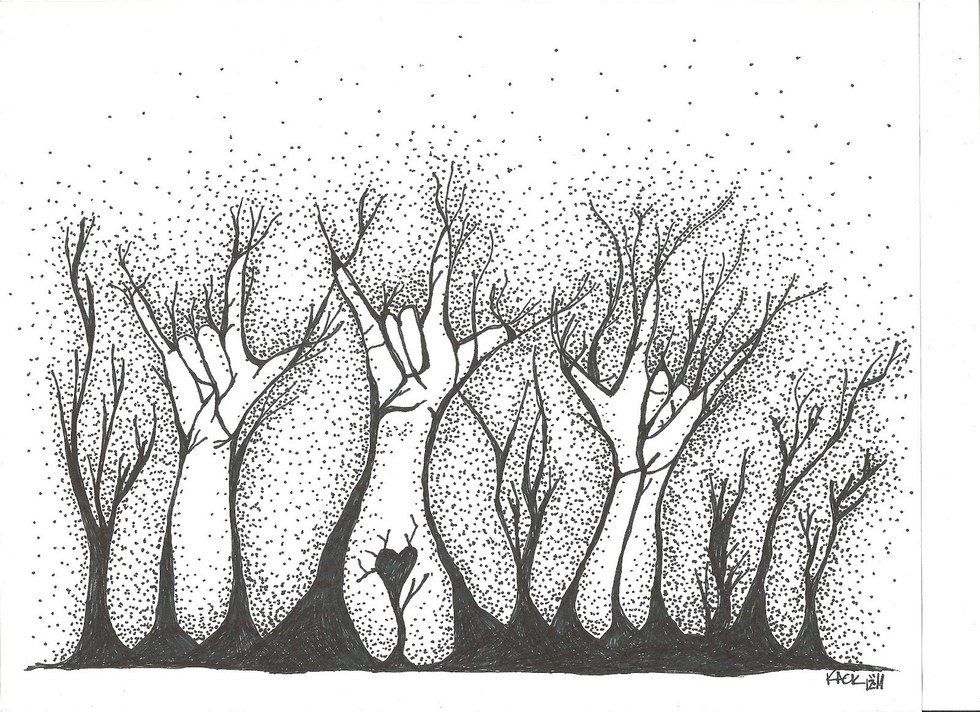
As a four-year American Sign Language student, a huge part of my education has been focused on the importance of Deaf culture and the impactful difference sign language makes on those having to facilitate a dominantly hearing world. While I am hearing and do not share the same experiences as someone who is Deaf, this article is simply for educational purposes and reflects what I have learned as a student.
1. There are different identities of D/deaf.
If you have ever read an article about a deaf woman or learned about the Deaf community you may have noticed the word ‘deaf’ is capitalized interchangeably. The reason for this grammatical change is based on how the deaf person chooses to identify. If they identify as deaf with a lowercase ‘d,’ then they identify as being medically deaf. They recognize they are hard of hearing or deaf upon medical guidelines but generally do not identify as being culturally Deaf. If they identify as Deaf with a capital ‘D,’ they identify as being culturally Deaf. To be culturally Deaf, a person may actively participate within the Deaf community, use sign language, or express a sense of “Deaf pride.”
2. Just like most languages, sign language comes with its own culture.
With sign language comes Deaf culture: an expansive community of the Deaf and Hard of Hearing. It is here they can get together and talk about their experiences growing up and their future within and around the Deaf community. It is for this reason that the Deaf community is so tight knit.
3. Sign language is not universal
A common misconception about sign language is that it can be understood across country borders. While there are some signs that are universally understood, such as “food” or “drink,” due to the implementation of International Sign Language, each country has its own dialect. For example, in England, they utilize British Sign Language or BSL, while American Sign Language is used within the United States. Even some signs differ dependent on what part of the country you live in. For example, if you live in California you may pronounce something different or have another name for an item than someone who lives in Rhode Island; the same can be said for regional signs.
4. Lip reading is not a skill you have simply because you are deaf
Many hearing people believe that deaf people can read lips when in conversation, however, this is not the case. Statistically speaking, it has been found that those who read lips only understand 30 percent of the conversation. This is due in large part to the variation in how people speak. Some people have accents while others may not move their mouth as much in conversation. If you need to communicate with a deaf person and cannot sign, the best ways to communicate with them are to write back and forth on a piece of paper or use the “notes” section on your phone. Don’t assume they can read your lips.
5. Deafness often skips a generation
According to the National Institute of Deafness and Other Communication Disorders, 90 percent of deaf children are born to hearing families. This statistic is widely important as it can partially explain why many deaf people are not exposed to sign language until they enter college. In fact, 88 percent of hearing parents with deaf children do not learn sign language. While there is no one reason for this lack of communication, hearing parents raising a deaf child are often bombarded by literature outlining the pros and cons of sign language in early education and are often encouraged against it, if they wish for their child to speak and be able to interact within the hearing world. However, what literature does not explain is that the use of sign language has no direct correlation to a person’s inability to communicate verbally.
6. “Train gone”
Because many families elect not to learn sign language in order to communicate with their child, many deaf children feel an animosity toward the hearing population. The sign “train gone” is best explained by Thanksgiving dinner. Imagine you are sitting at Thanksgiving dinner with a large family and you are deaf. Meanwhile, everyone else at the table is hearing. They are exchanging stories and laughing but you are unable to catch the story as parts of it are being told by different people on opposite ends of the table. You ask “what is so funny?” and they say “we’ll tell you later.”
However, for many deaf people, ‘later’ never happens. Therefore, within the deaf community, there is a sign called “train gone” that reflects exactly that. If I, a hearing person, were to be in conversation with a deaf person, and I miss a sentence of sign they will sign “train gone.”
7. Hard of Hearing, not Hearing Impaired
In light of political correctness, the deaf community has adapted their own identity away from negative stigma. Deaf people can do anything hearing people can do. They can drive, go to college, be CEOs or doctors. Therefore, and rightfully so, they do not like being called hearing impaired, but rather Hard of Hearing. In addition, a common misconception surrounding the deaf community is the phrase “deaf and dumb.” However, with rising deaf powerhouses Nyle DiMarco, Marlee Matlin and Sean Berdy making an impactful difference in the world, they're showing that deaf people are anything but dumb. These intelligent deaf icons prove that deaf people are just as capable as hearing people.
















