
On average, less than one-third of speaking roles in Hollywood films go to women, according to the Washington Post. So for every one girl that gets to talk, there're two or more males with speaking parts. Sound fair?
In addition to being underrepresented in the casts, the few females that do make it to the big screen typically follow the stereotype of young, thin, and white. The "peak" of female acting careers was found to be around age 30 for women and 46 for men, according to a Time analysis. Not to say that the women who fit these typical requirements aren't entitled to their roles or don't play them to the best of their abilities; it's just that this isn't a fair representation of the women of America.
The 2010 census found that the American population is made up of 50.8 percent female and 49.2 percent male. On top of that, the median age was found to be 38.5 years for females and 35.8 for males. So why is it that about half of our population is female, but only one-third of our actors are? Why are middle-aged actresses not shown on the big screen, although they make up the bulk of American women? If movies are meant to be re-creations of real-life situations (in most cases), then why aren't the people in them representative of real-life?
Apart from the vast gap in real-life and Hollywood-portrayed-life regarding gender and age, there also seems to be a strong bias for thin, beautiful women. It's not that Hollywood doesn't show us beautiful women. It's that Hollywood tends to only show limited types of beautiful women -- traditionally being young, thin, white, and good-looking -- as well as failing to showcase the many other types of outer and, most importantly, inner beauty that women possess across the country and world.
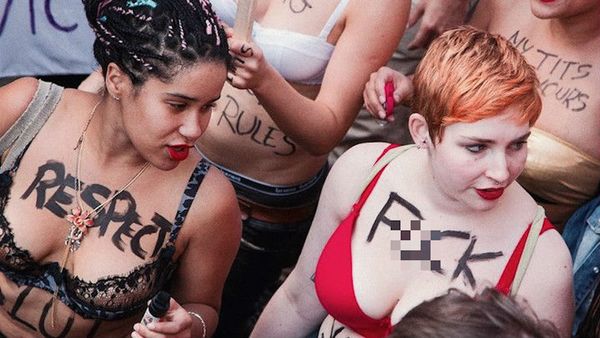
Although there may seemingly be nothing wrong with telling a woman she is good-looking, it's when society begins to base her worth on whether or not she is good-looking that a problem arises. By only hiring women who fit this description, that is exactly what the movie industry has done -- created a phenomena known as hyper-sexualization (with help from other media and marketing sources), in which women are shown with their main purpose as being physical "objects" for pleasure, and looks used as the primary way to establish their worth. Through Hollywood's narrow demonstration of strong, beautiful women and lack of attention to inner beauty, there seems to be a social acceptance of a specific definition of "worthy" and "beautiful." The near worship of the "perfect body" has left real girls and even actresses feeling they don't fit into this small idea of beauty. In reality, women are beautiful in so many diverse ways other than their size, age, race or looks, but movies don't always make a point show that.
Not to say that this beauty epidemic is simply limited to females, either. Males are often faced with unrealistic images of actors with abs of steal that look like washboards, arms that are the size of tree trunks, and jaw lines that could cut diamonds. Just as movies have formed ideal visions of what women should look like, they have also formed ideas of what men should look like. Many of the same hardships that face females are present in different forms for males, but the pressure seems to extend more deeply than simply looks for female roles.
Some of the ways in which the problem can be seen as being more than about just ethnicity, size, looks, or age for females is demonstrated in the lack of variation that female actresses are given to choose from. Female roles are typically predictable and seem to be made from a cookie-cutter; the ditsy hot girl, the ugly nerdy girl, the funny fat girl, or the bitter old women. Men are left with characters that show development and dynamic personalities, while women act as eye-candy for male audiences (26.4 percent of female roles showed some form of nudity in 2014 films, while only 9.1 percent of males' did, according to Forbes) or punchlines for lead male actors' jokes (often further enforcing the above stereotypes and typical roles that women play).
Another aspect of female characters is that they often are shown thinking, worrying, or talking about boys, as well as doing stuff for their male counterparts' pleasure. Apart from movies, reality television often shows women fighting, arguing, becoming easily jealous, or tearing each other down for petty things. In the real world, being a woman isn't about tearing each other down, but supporting and building each other up.
Knowing all that we do as a nation now, it's hard to imagine why these are still issues. Why are women so vastly underrepresented in the film industry? How is it that Hollywood essentially copies and pastes female roles from one movie to the next? Well, we as a nation have been buying it. The only way to reverse past habits is to talk about it and actively seek out solutions, which is what many organizations and programs are now seeking to do through empowerment and education.
Despite the changes that have been going on in our society as of late and the recent steps, albeit small, in the right direction, Hollywood still has a long way to go until it fully represents the diversity and true beauty of women. The real question is, until then, will we continue to let them define what it means to be a woman?