
I knew I needed to read Annie Dillard’s “The Writing Life” after being assigned Chapter Five of the book in my creative writing class. The class was Creative Writing 419, the final class in a three-term series I had been in, by the end consisting of a close-knit seven students and our graduate teaching instructor. My grad student unerringly demonstrated a firm, extensive grip on the field of fiction. She selected the Dillard readings for our final class together, which she structured around the topic of inspiration. Her choice was on-point. In fact, Dillard’s essay “Transfiguration,” in which a lit candle turns a moth into an insectile lantern, inspired the ornately rendered moth tattoo on her arm.
Come July, I checked out a copy of “The Writing Life” from the Eugene Public Library and finished the slim 111-page volume within hours.When I read, I like to bookmark favorite passages in yellow highlighter. Dillard posed a problem. Entire pages would have become blocks of eye-watering neon. Also, it was a library book, and I depend too much on the Eugene Public Library to risk angering the tribe of the librarians.
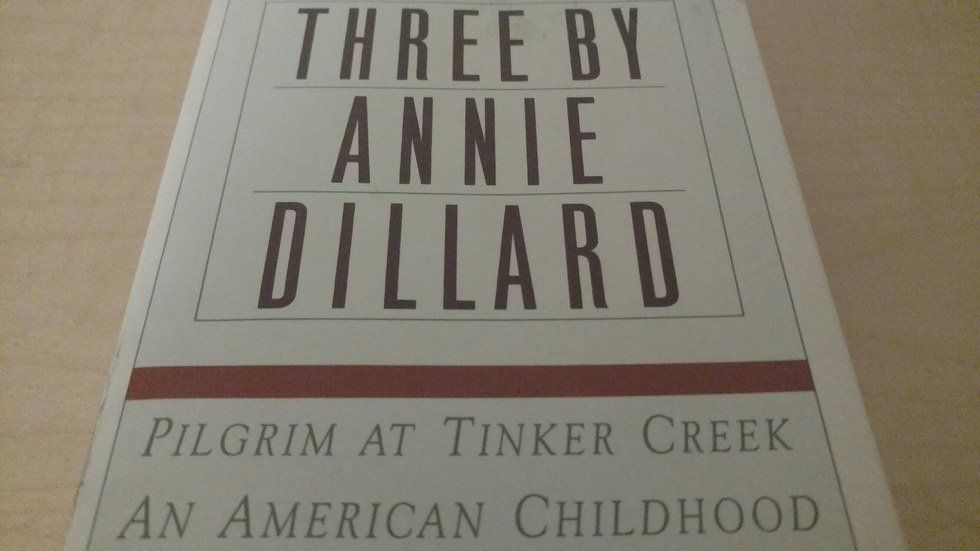
The best solution became purchasing a personal copy of the book. Every sentence contains insight for aspiring writers like myself. I wanted to carry it with me wherever I go because it is just that important to me. Smith Family Bookstore did not currently carry a copy, but I obtained one at Powell’s on a trip to Portland. Actually, I ended up buying “Three in One Dillard,” which includes her Pulitzer Prize-winning nonfiction story “Pilgrim at Tinker Creek” and her essay collection “An American Childhood” in addition to “The Writing Life.” It was a trade-off: the book is too hefty to add to my perpetually cumbersome backpack, but it’s more Dillard for my dollar, Dillard in her boldness and intelligence.
I intended to carry a copy so Dillard would always be with me, an ink-and-paper mentor, a talisman. Dillard opens Chapter Two of “The Writing Life:” “I write this in the most recent of my many studies — a pine shed on Cape Cod.” Location is essential in Dillard. The first passage of "An American Childhood" captures Dillard’s mental landscape: “When everything else has gone from my brain … what will be left, I believe, is topology: the dreaming memory of land as it lay this way and that.” It continues to encapsulate the geological landscape: “The city poured rolling down the mountain valleys like slag, and see the city lights sprinkled and curved around the hills’ curves, rows of bonfires winding. At sunset a red light like housefires shines from the narrow hillside windows; the houses’ bricks burn like glowing coals.” But topology is not the sole way location is essential in Dillard. Her studies, the pine shed on Cape Cod, for instance, register equally essential.
This intel arrives as old news in writers’ circles: the significance of a “room of one’s own.” But I have been at a loss over what my own room of one’s own should look like. Fiction author Elizabeth McCracken visited the University of Oregon last spring and delivered a craft talk in which she asserted, “The way you write is the way you think.” McCracken does not write every day, as many other authors urge. She writes the way she thinks, in bursts. So I engaged in some metacognition and thought about the way I think. It did not bode well.
Fortunately, Dillard changed the way I think. She advises, “Appealing workplaces are to be avoided. One wants a room with no view, so imagination can meet memory in the dark.” This was not how I thought. I favor the Espresso Roma coffee shop near UO, bright paintings on yellow walls, where I eavesdrop on the collegiate clientele and feel secure in the knowledge that imminent departure is doable at any moment. Or the third floor of Allen Hall, the communications building, populated round-the-clock by dynamic journalism students and decked out with three-story-tall windows. If a study space is too devoid, I get anxious. I think of the “Dilbert” comic strip in which Dilbert enters his cubicle thinking, "I prepare to enter the sensory deprivation chamber. I will experience no mental or physical stimulation for hours.” I want to stand up, walk it off, run in circles babbling.
“The Writing Life” illuminated my way. The blank wall is not a dead end; the small cubicle is not a coffin. Even if it were, Dillard reminds, “You can read in the space of a coffin.” Further, “You can write in the space of a toolshed meant for mowers and spades.” I tested her claim and sought out a small, windowless study room on the third floor of the Knight Library in August. It won’t be a sensory deprivation chamber, I told myself. Dillard will be with you. After all, my motive for buying “The Writing Life” was to have her with me. And that small, windowless study room is where I wrote this article.
Warnings against the appealing workplace made the unappealing, the stark wall, the toolshed, the broom cupboard, appealing. Chapter Two of “The Writing Life” recounts one Fourth of July when Dillard’s husband went into town to watch the fireworks. Dillard remained at work in her study, work during which she “read a sentence maybe a hundred times, and if I kept it I changed it seven or eight times, often substantially.” Concentration. Immersion. But a junebug at the window punctures her absorption. She gets up in irritation to part the Venetian blinds, “and there were the fireworks … They were red and yellow, blue and green and white; they blossomed high in the sky many miles away … far sprays of color widening and raining down. It was the Fourth of July, and I had forgotten all of wide space and historical time.”
Initially, I thought the beautiful description of the fireworks must have stirred and roused me so. But no. It was the promise of forgetting “all of wide space and historical time.” I wanted that badly. I wanted to be so at home in my own body and mind, so intent on the the universe spread out on the page, that everything outside the pool of the self dropped away. It seemed an experience of sensual and spiritual bliss. Many writers promise the various transports of writing. Emily Dickinson said, “If I read a book and it makes my body so cold no fire can ever warm me, I know that is poetry.” David Foster Wallace said when he wrote, he “couldn’t feel his ass in the chair.” Concentration. Immersion. Access to new places. Access to myself. Mobility. Mutability. Fluidity. Freedom.
Of course, living the writing life is challenging. As my grad student said, “Everyone and their mother is trying to get an MFA right now.” As Dillard said, “Why not shoot yourself, actually, rather than finish one more excellent manuscript on which to gag the world?” I won’t make much money. I’ll work at a snail’s pace. People will disparage my choice (and have). People will misunderstand and dislike my work (and have). People will hasten to inform me the written word is dead (for real, this time). And those are merely the problems of the world. There are also the problems of the writing. “Every book has an intrinsic impossibility,” Dillard intones.
The rewards are vast. That’s all I can hope. Perusing Powell’s, I saw another Dillard collection entitled “The Abundance.” The front pages bear these words from the Qur’an: “They will question you concerning what they should expend. Say: the abundance.” It struck me as an apt inscription. Expend the abundance and expect the abundance. I expect to feel so cold no fire could ever warm me, to not feel my ass in the chair, to forget all of wide space and time.