
It seems like we're all losing a little bit of hope in the upcoming presidential election. Plenty of voters are deciding to sit this one out, rather than choosing who they believe would be the lesser of two evils. While this may be true, your vote still does matter. Not voting is a spreading epidemic that is actually depleting our democracy at an alarming rate. By not casting your ballot, you're essentially throwing away any chance you had of having your voice heard. If you're over the age of eighteen and contemplating not voting- here are ten things that might help change your mind.
1. You're an adult now, even though you may not feel like it.
The transition into college life most likely slapped you in the face and made you realize that there are things you have to do for yourself now. You have all of these new responsibilities and obligations, and believe it or not, voting is one them. You probably discuss current events on a weekly basis in at least one of your classes, you might as well do something will all of that new knowledge!
2. College voters can actually swing elections.
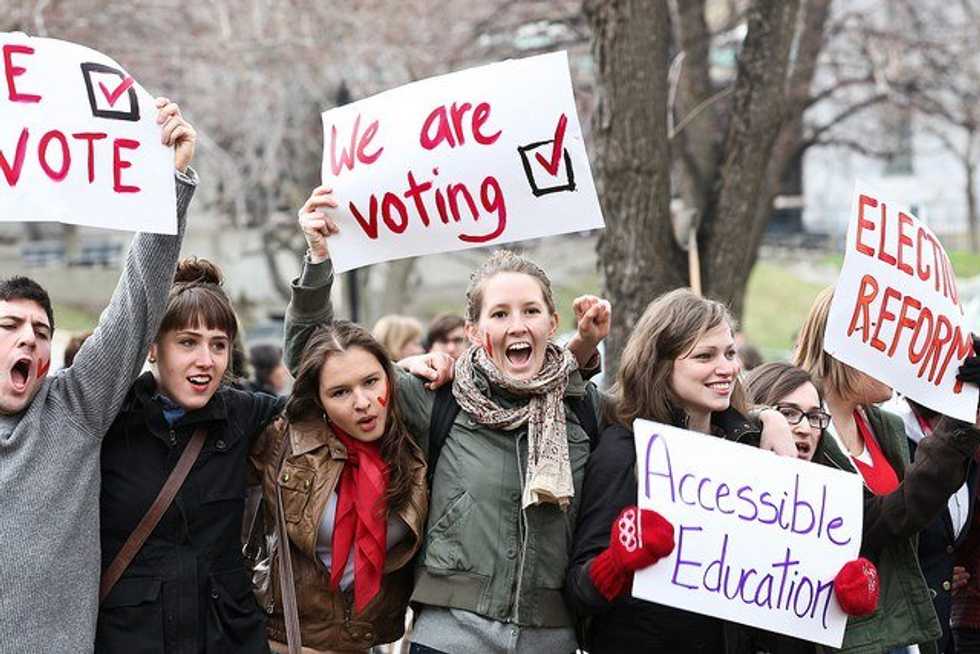
Believe it or not, we as college students are actually a key constituency in every election. You may have noticed a lot of talk around Hillary Clinton trying to be relatable to a teen audience, and as funny as we find that, it's for a good reason! There are over 44 million eligible millennial voters in the current electorate. While it is highly unlikely that one singular vote will change the outcome of an election, in the past, margins have been between 100-500 votes. This is only about a third of the voter turnout at a single poll held at a college campus on election day. If you had every single person in one of your lecture-style classes to vote the same way, you might have the power to boost a certain candidate.
3. It couldn't be made any easier for you.
Speaking of campus polls, about 1 in 5 colleges or universities become the home to voting booths on election day. If you aren't registered to vote when you start college, you'll have many opportunities throughout the year. Most schools house voter registration forms that are available at your request, or that you can print out online. If you register using your college address, election day should be a breeze. If you're registered in your home county, absentee ballots are available online as well. Inconvenience is no longer a valid excuse, especially at our age.
4.The Electoral College is not out to get you.
One of the most common reasons that people don't vote in presidential elections is because they know that the popular vote is not technically the one that decides who the president will be. While this is true, what many people don't realize is that the popular vote and the EC vote are almost always exactly the same. This is because in 26 states, electors are legally bound to vote with their state in the popular vote. The electors don't even get to cast their votes until the week after election day. The fact that the winner is announced on election day is proof that the Electoral College functions mostly as a formality.
5. Someone fought for your right to vote.
If you've heard this one before, it's because it's true. In the first ever elections held in the United States, the only people allowed to vote were Caucasian males that owned land. Since then, millions of members of minority groups and women have fought for suffrage to be extended. Not going out to vote simply because you don't feel like it is almost like discrediting the legitimacy of their argument that voting is a freedom every American should have access to.
6. We're setting the stage for political corruption by staying silent.
The American voting system is considered a model for many other countries who are struggling to achieve a successful democracy. Our democracy is representative, which means we are expected to pick the candidates that we like or relate to the most. This way the leadership can become an accurate representation of our country as a whole. When we have a low voter turnout, only the few that did vote are being represented, while everyone else gets swept under the rug and ignored by policy makers. Low polling numbers give candidates the idea that nobody really cares what they do, and in turn feel that they are free to act on their own accord.
7. At least you'll be able to complain with integrity.
This one speaks for itself, mostly because we all know we're a little screwed no matter what happens.
8. You aren't just voting for president.
Politics don't reset with every general election. They are cumulative, and each past action affects both present and future politics. Something that voters want to see change may not happen right away because it involves an amendment to the Constitution, which are time-consuming and few and far between. When we choose our candidates, we have to make sure we're voting for their policies. We have to hope that they'll get right the first time. Similarly, the president gets to appoint Supreme Court Justices to life-long terms, which will affect the passing of future legislation by many administrations to follow.
9. Candidates don't listen to people who didn't vote for them.
As a student, your main concerns when choosing a candidate to support probably involve tuition hikes and interest on student loans. Stances on social inequalities and environmental issues are also among the most talked about campaign topics for college voters. But candidates do receive demographic statistics following primary and general elections. As a result, they are going to be less likely to take students' concerns seriously when they see that not very many of them turned out to support them.
10. What's the worst that could happen?
Seriously, what do you as an individual have to lose by voting? Rather, is there anything to gain by not voting? If you have the opportunity, knowledge, and opinions that are all required to cast a vote, why wouldn't you?