LGBT - This stands for stands for Lesbian, Gay, Bisexual, and Transgender. It is the most used acronym when it comes to discussing gender and sexual minorities. This acronym is not inclusive to identities that are less known, like asexual and pansexual, for example.
LGBTQIA+ - This acronym stands for Lesbian, Gay, Bisexual, Transgender, Queer/Questioning, Intersex, and Asexual/Aromantic. The plus sign is used to denote that there are other identities that are a part of this community. This is a more inclusive alternative to the better known, aforementioned method of referring to sexual and gender minorities.
Lesbian - A lesbian is someone who identifies as a woman and is attracted to the same or similar genders.
Gay- Gay often refers to men who are attracted to the same or similar genders, but can be used to discuss any same or similar gender attraction.
Bisexual - People who are attracted to both similar and different genders from themselves. There is a lot of ignorance surrounding bisexuality. Some refuse to believe bisexuality even exists. In reality, bisexuality exists and people who are bisexual can be attracted to one gender over another—it does not have to be an even split. Additionally, some believe the label "bisexual" means people who identify this way are not open to relations with trans or non-binary people, but there are many bisexuals who are absolutely open to that.
Transgender/Trans - Transgender or trans means to identify as any gender other than, or in addition to, the one you were assigned at birth. This may mean identifying as multiple genders or identifying as no gender. Note: the term "transgendered" is not typically viewed as acceptable. The "ed" implies something has been done to trans people - as if they were not the same person all alone. Additionally, you should never refer to a trans person as "a transgender." Doing so transforms this descriptive adjective to a noun that seems to define a person, which should not the goal of any label.
Trans woman - A trans woman is a woman who was assigned male at birth but whose gender identity is female.
Trans man - A trans man is a man who was assigned female at birth but whose gender identity is male.
Trans* - Trans* is a term originally designed to be more inclusive to non-binary people and all identities under the "trans umbrella." There are some who take issue with this, though, because it implies that "trans" is not inclusive to other non-cisgender identities. This can make those other non cisgender identities feel like they are not trans enough to identify as trans.
Bigender - Bigender is a term for a person who either varies between two different genders or who identifies as two genders at the same time. These genders can be male or female or they could be non-binary identities.
Genderqueer - People who identify as genderqueer do not fit into the gender binary and do not identify as male or female. It is a catch all term for identities that do not fit traditional conceptions of masculinity or femininity.
Non-binary - Non-binary is also an umbrella term for identities that are not exclusively masculine or feminine.
Agender - Agender literally means "without gender." This is a term for someone who does not identify with any particular gender. A person who is agender may identify as being of a non-binary gender identity or as someone who does not have a gender identity at all.
Pangender/Omnigender - Pangender is a gender identity in which a person can experience multiple genders, either simultaneously or varying over any amount of time, that can even extend beyond genders that can currently be defined.
Queer - Queer was originally used as a slur, and that should be kept in mind when it comes to using it as an umbrella term for other people. There is a possibility that it could still be offensive. It has been reclaimed and used a nonspecific way to describe non-straight sexualities.
Questioning - Questioning is a term for those who are still not sure of their gender or sexuality. This is a term for those who are still figuring it out or reevaluating these parts of themselves.
Intersex - Intersex is a term for a variety of different conditions that cause an individual's sexual anatomy to deviate from typical definitions of biological, male/female sex. These conditions can be completely harmless and require no medical attention whatsoever.
Asexual - Asexual is a term for someone who does not experience sexual attraction. It is notable that someone who is asexual may still masturbate or experience arousal, they just do not experience attraction to specific people as people of other identities might.
Aromantic - An individual who is aromantic does not experience romantic attraction. They do not lack emotional abilities and they are not incapable of connecting, they just do not have a need or desire for romantic relationships.
Demisexual - A person who is demisexual does not experience sexual attraction until they have formed an emotional connection with a person.
Gray-Asexual - Gray-Asexuality is a term for people who do not identify as sexual or asexual. They may experience a low amount of sexual attraction, lack sex drive, enjoy and desire sex only under specific circumstances, experience sexual attraction but not enough to act on it, or only rarely experience sexual attraction. Gray-Asexuality is essentially a term for anyone who falls somewhere between sexual and asexual.
Pansexual/Omnisexual - People who are pansexual experience sexual attraction toward people of any, or no, sex or gender. Many describe their experience as being attracted to people regardless of sex and gender. That is, sex and gender have no role in their attraction to people.
Race - a family, tribe, people, or nation belonging to the same stock, a class or kind of people unified by shared interests, habits, or characteristics.
Ethnicity - a particular ethnic affiliation or group. Ethnic is defined as of or relating to large groups of people classed according to common racial, national, tribal, religious, linguistic, or cultural origin or background.
Nationality - Nationality refers to membership or affiliation with a particular nation or nation-state. There is confusion surrounding this term and its meaning—with some associating it with country of residence. Country and State both refer to political bodies that self govern. Conversely, a nation is a term for a group of people who are a part of the same culture but are not necessarily joined politically. An example of a Nation that is not a country is the Cherokee Nation; a Native-American nation that exists within the United States.
Spanish - the language of Spain, Mexico, and many countries in Latin America, the Spanish, the people of Spain, Spanish people.
Mexican - person born, raised, or living in Mexico, a person whose family is from Mexico.
Therefore, Latino people are not Spanish, BUT may speak Spanish. Mexican is not a language.
Both Spanish and Mexican are terms describing national identity and can not be used to replace the terms Latino or Hispanic.
Latina/Latino - a woman or man who is a native/inhabitant of Central and/or South America.
Hispanic - of or relating to the people, speech, or culture of Spain or of Spain and Portugal and of, relating to, or being a person of Latin American descent living in the United States; especially: one of Cuban, Mexican, or Puerto Rican origin.
There is a complex debate surrounding Latina/Latino and Hispanic as descriptors of identity. Recently, the term Latino/Latina has grown enormously in popularity—which some attribute to the more inclusive nature of the term. The term Latino includes mixed races like people of African and Latin descent whilst the term Hispanic does not. Some claim the term Latino has geographic origins—meaning of Central or South America, or the Iberian Peninsula—while Hispanic has linguistic origins—meaning Spanish-speaking. In that sense, Hispanic would also exclude those of those geographic origins who did not speak Spanish ie; Portuguese-speaking people, like Brazilians.
However, it must be mentioned that studies have shown that the people who would normally be recipients of either the Latino or Hispanic label actually prefer to be referred to by their national identity, as in Mexican, Puerto Rican, etc., or just as American.
Negro - a member of a race of humankind native to Africa and classified according to physical features (as dark skin pigmentation). Many older black Americans identify as Negro because, before 1966, it was the term used by Black political activists and academics. Although some older black-Americans still identify with this term, it is not acceptable in academic or social use. For example, when Senator Harry Reid used this term in 2008 to describe Barack Obama, there were cries for him to resign.
African-American - an American who has African and especially black African ancestors. The term African-American is excluding those who descend from other continents, like those with Caribbean and/or Central or South American origins, and therefore, cannot be used as an umbrella term for anyone with dark skin.
Black - of or relating to any of various population groups having dark pigmentation of the skin, of or relating to the African-American people or their culture, typical or representative of the most readily perceived characteristics of black culture. Black is now the popular term because it is inclusive of all those who are of darker pigmentation, but who do not have African ancestors.
People of Color (PoC) - This has become a commonly used term because it includes all non-white identities.
Oriental - of, relating to, or from Asia and especially eastern Asia. To describe an Asian person using this term is offensive for a multitude of reasons. The term oriental in this sense roughly translates to Eastern. Describing a person as Eastern is extremely Euro-centric and therefore, problematic. It is important to describe a culture in its own terms. Most importantly, it has been expressed by many Asian-Americans that they would prefer to be identified by their national identity.
Why do these terms Matter?
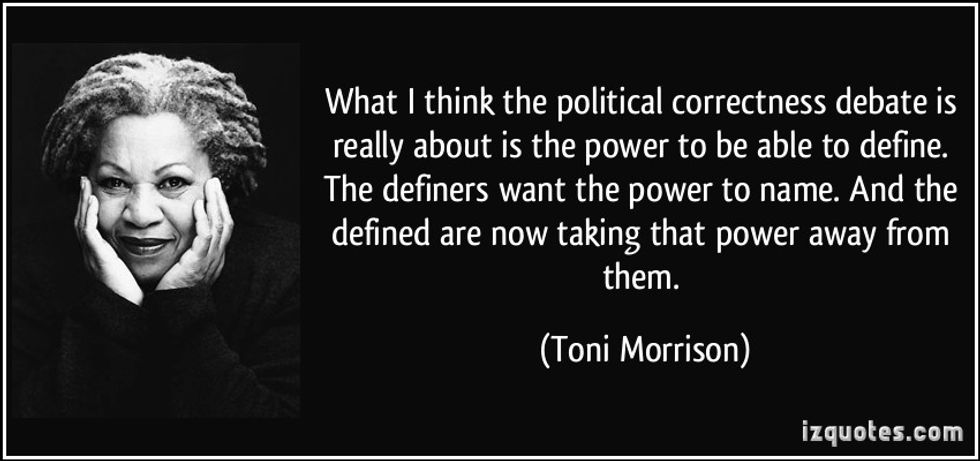
Although there is debate surrounding the culture surrounding political correctness—especially considering how certain terms do not reflect the way in which certain communities would like to be addressed i.e.; African-American. It is important to understand these terms so we can continue having a positive dialogue. We need to understand the meanings of these terms in order to use them correctly and describe these communities the way they wish to be described. We have to be sensitive of all of these identities, because neglecting to understand them or the way they identify implies you do not care about their identity and that you do not view their identity as valid.
It is essential to note that this list is not extensive and certainly not exhaustive. There are more identities than can be explored in a single article. Identities that are not listed above are every bit as valid and important.
It is also important to acknowledge that labels are not mandatory for every human being. Some feel labels are too confining.There is nothing wrong with not describing your experience with a specific label. Your identity exists whether you find a word for it or not. However, labels often do come attached to respective communities. Labels can lead you to groups of people whose experience is similar to your own. This can be helpful, especially considering these identities often experience oppression and discrimination.