

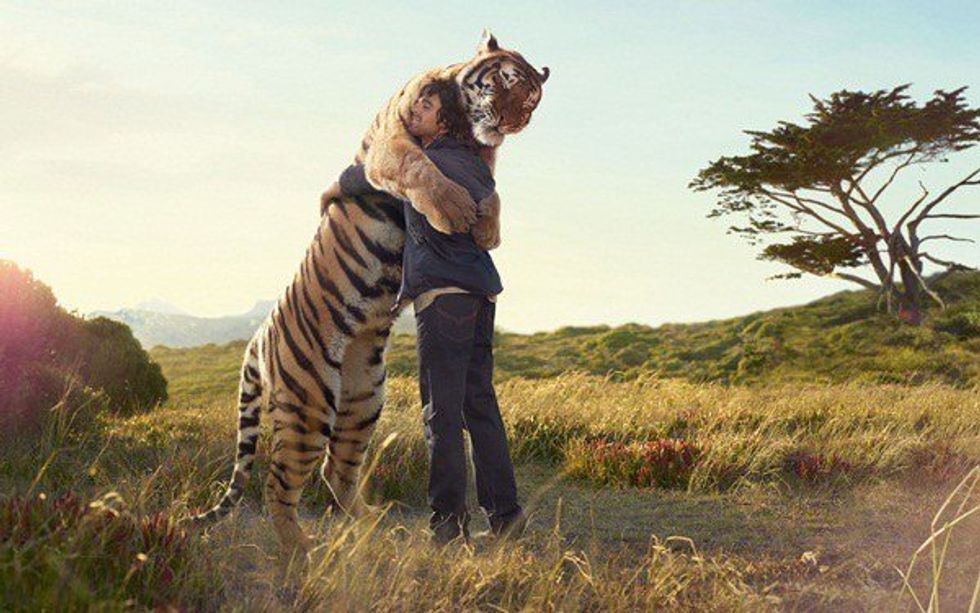
Why is it that when you go to the movies and watch an action or war movie, you are saddened by the fictional death of one horse but not by the fake deaths of hundreds or thousands of people participating in the war? Why would you value the life of a species that is lower than you over that of your own kin?
Well, let's first analyze why our pets are "lower than" or at least different from us.
1. Pets have no reason; they do not ponder the past or future.
Cats and dogs do not have reason. They cannot think "why." For example, a dog cannot ponder why his or her master eats eggs in the morning or eats cereal on the weekends. They can identify a recurring pattern of action (my master woke up in the morning then ate eggs), but they cannot understand the reason why -- they do not even have the means to understand language. (The reason pets can identify some words like "no" or "walk" or "fetch" is because of the association of an action with a sound, learned through repetition, and because the word directly affects and is important to them.) Pets do not have the notion that time exists outside of themselves, or, in other words, they can remember their past experiences and act differently because of them (this is a form of training) and can maybe predict that something is going to happen to them depending on how they act in a certain situation, but they cannot predict or even hypothesize about the lives of other pets (example: a dog cannot wonder if there are other dogs out in the world dying of hunger). Pets simply live for themselves. Yes, there is some sort of recognition of the past and future, but it is not to the extent to which humans understand and believe it. A man wants to study hard to get good grades in college so that he can get a good job, which leads him to receive a good salary so that he can purchase a large house; pets obviously cannot think in this way.
2. We cannot negotiate with pets.
Human beings cannot negotiate with pets because they are so different from us. Their lack of rationality, lack of ability to understand language (completely) and the way we understand it, lack of ability to sympathize/empathize (dogs cannot think, "I, a dog, wonder if there are other dogs starving in the world; I know how that feels"), and lack of ability to live for ideas (a human can live a "good lifestyle" or can live his/her life in a way so that he/she is attempting to be a "good" person, but a dog cannot think of or live by unachievable ideas like equality, goodness, piety, etc.) prove us unable to to negotiate with pets. For example, a man cannot ask a dog not to pee inside for the sake of goodness, because the dog does not understand what goodness is.
3. It's impossible to clarify whether or not pets experience life the way we do, but pets are fundamentally different from us.
One might argue that it is impossible to clarify or prove any of the claims listed above. A person might believe that there is no way to prove that animals do not live the way we do (and therefore aren't equal to us), simply because of the fact that we cannot fully communicate with them. We cannot understand their thoughts the way we read each other's (as human beings) through conversation. What we can prove is that dogs are both scientifically and fundamentally different from us. There is a "dogness" that is different from our "humanity," and the mere fact that we do not bark, do not pant, and are not covered in fur should lead us to understand that dogs are different from human beings.
So, why treat dogs differently than humans if we are all animals?
Socrates says that treating a species that is different from us, the same as us, is similar to treating that species badly. Why should we treat a species that naturally lives differently from us, the same as us? Why should we submit our pets to our laws of government, our unspoken laws of society, etc.? We shouldn't. Cats and dogs are naturally different from us, so we should treat them differently -- whether that is better or worse than how we treat ourselves is up to us to decide.
Why do we treat our pets better than the average human being? Why do we doubt the loyalty of friends but never question the loyalty of our pets? Why are we saddened by the death of dogs more than the death of a person -- say, a criminal?
Well, did you ever ponder the idea that the mere fact that dogs are "lower" or different from us causes us to respect them even more? Did you ever think that because dogs live solely for themselves (and for their present needs), and do not complicate the world with crazy/intense perceptions of past and future, we admire them?
Household pets are so easy to admire because they do not do wrong on purpose. Sure, your dog might pee on the floor after you trained him not to pee on the floor, but your dog only did this because he needed to urinate. According to the current human understanding of household pets, your dog does not have and cannot have any preconceived notion against you.