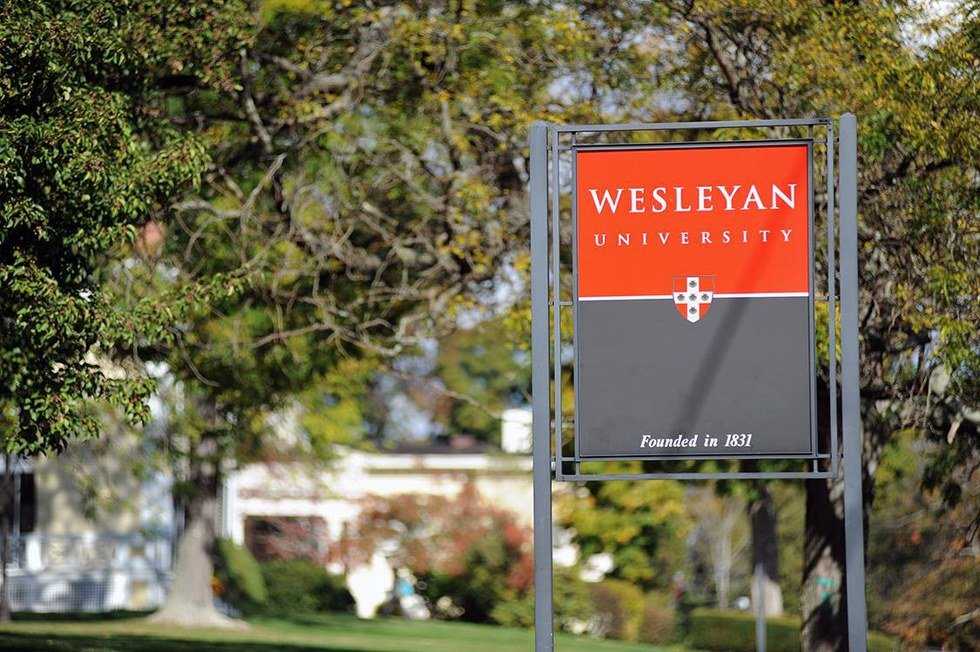
The history of coeducation at Wesleyan is a rare and complicated one that begins with the institution’s founding as an all-male university in 1831. Since then there have been four distinct, chronological periods of the history. From its founding until 1872, women were not admitted. From 1872 to 1912, women were enrolled as an “experiment.” From 1913 to 1967, women were again not admitted. Starting in 1968, women were again admitted, but during the short period from 1968 to 1970, only a small number of female exchange and female transfer students were accepted. Finally, from 1970 to the present, the school has been fully coeducational.
Wesleyan University became coeducational in 1872, when women in America still were not able to vote. The primary argument against coeducation was women’s being unable to perform at a comparable level as the men who were enrolled. Male students feared that female peers would cause moral issues for the men and that women would “lose their femininity” in the male-dominated environment.
Furthermore, the women who were at Wesleyan at this time were treated extremely poorly by the administration and their male peers. By 1900, women were “completely excluded from ‘publications, public events, and honors elections,” as well as seated separately at commencement and given their degrees after the men, and constantly taunted and threatened with physical violence. All of the first four women to graduate in 1876 were accepted into Phi Beta Kappa for extraordinary academic performance.
Despite the fact that the women demonstrated their obviously-competent academic abilities, there was heavy opposition to their tenure as students. In 1898, 26 years after women had first been accepted, both the Boston Daily Globe and the New York Times reported on a “mass meeting of undergraduate students…to protest against the system of coeducation.”
Eventually, in a trustees meeting on June 27th, 1900, it was decided that the administration was “in favor of limited coeducation,” agreeing to set a quota for women that limited them to “20% of the overall student body.” The trustees also proposed the creation of “separate [classes], honors listings, commencement ceremonies, chapel exercises, and Phi Beta Kappa criteria. However, this proposal did not satisfy the frustrated students. By 1909, it was abundantly clear that “women’s admittance has been an experiment,” and the experiment had reached its end. 1909 was the year at which Wesleyan stopped admitting women, and the class of 1912 was thus the last class to graduate female students for the next few decades
One motivation for this change was financial: many affluent alumni were not in favor of coeducation, and their donations were vital to the school’s operation. Another proposal is that Wesleyan’s move to coeducation failed because “its closest competitors were elite male-only colleges.”
The disallowance of women from Wesleyan angered many of the women who had graduated from the University, namely Elizabeth Wright from the class of 1897. When Wesleyan ceased to accept women, women in Connecticut were left “with no in-state option, a situation some called a ‘disgrace to the state.’” Since Wesleyan would not accept women, Wright and a group of other female graduates of Wesleyan petitioned the state of Connecticut for the resources to start a women’s college. They argued that “Connecticut’s first college solely for women…would be useful to the state, because it would train women to better their economic situations, which in turn would uplift society.” They were ultimately successful, and the Connecticut College for Women was founded in 1911 in New London, Connecticut.
As the 1920s came to a close, the Great Depression changed the financial standing of the college dramatically. In 1931, Wesleyan became a part of the “Little Three” with Amherst and Williams, but there was a lot of financial pressure concerning Wesleyan’s ability to run as an institution and also compete with the other two schools. However, the induction of Victor Lloyd Butterfield as President of the college in 1943 started a whirlwind of change for Wesleyan, including a return to the question of women’s education.
President Butterfield oversaw a variety of changes in Wesleyan’s institutional framework, including a three-acre expansion of the campus property and the creation of the Wesleyan University Press. The Press brought in lots of funds and influenced the Board of Trustee’s 1962 decision that “the college should become a little university” in terms of its “institutional identity.”
In 1956, President Butterfield wrote to the Board of Trustees and the Governor of Connecticut about the use of the nearby Long Lane School property for use as a coordinate college for women. However, in 1957, the governor determined that this was not a cost-effective plan for the state. Nevertheless, President Butterfield commented in a feature article for the school’s newspaper, The Argus, that “the idea for a coordinate college for women had not been abandoned by Wesleyan.” Indeed, the administration was still considering what to do in the mid-1960s.
At a meeting in late June in 1966, a committee with President Butterfield and numerous members of the Board of Trustees met to discuss the possibilities for women’s undergraduate education. The committee developed four proposals of varying degrees of coeducation, and the proposals were reported in The Argus in November.
- The first consisted of “complete coeducation with common facilities for men and women,” with only dormitories and athletic facilities divided by sex.
- The second proposal was a “coordinate college with a large degree of contact between the women’s and men’s college,” where the libraries would be separate and the school would be geographically distant, but extracurricular activities would be coeducational.
- The third proposition was similar to the second, but with separate extracurricular activities and divided classes for the first two years and coed classes for the second two years.
- The final proposal outlined a “completely separate women’s school founded by Wesleyan.”
On May 14th, 1968, The Argus ran a front page article headlined, “Women Return to Wes; Board Vote Decides.” The article described that “women’s dormitories and a dining hall will be constructed on a coordinate campus adjacent university buildings” and that “a single University administration is planned and classes will be coeducational.” It took a rocky start to get there, but since 1970, Wesleyan University has been fully coeducational.