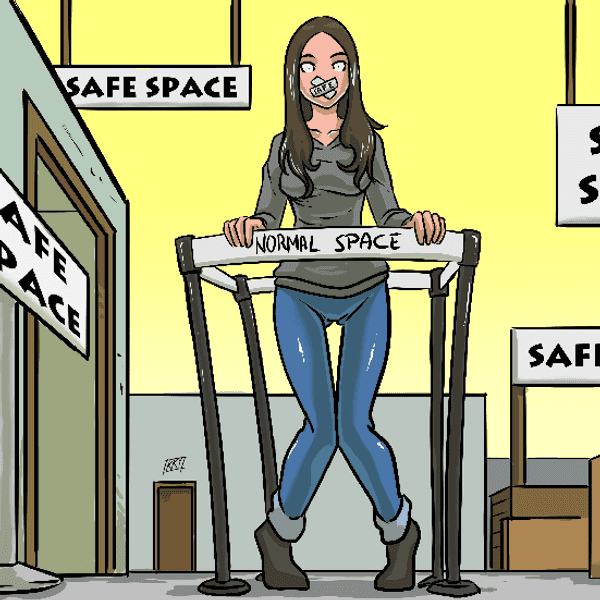

As of the 25th of August, the University of Chicago has issued a warning: they will be be disregarded the concept of ‘safe spaces’ and ‘trigger warnings’ within their walls. The reasoning for this is primarily due to their view of these concept’s counterproductive nature to discussion.
Now, I’m sure that most people over the age of eighteen and by the time of this article is published understand what a trigger warning is. To put it simply, it’s a disclaimer that something is about to be shown/said which may induce anxiety-inducing memories of trauma. They were created to promote sensitivity toward others.
A "safe space" is, while quite self-explanatory, often less known. Again, to put it simply, it’s a place where one is free from ‘triggering’ discussion or surroundings; you’re able to feel mentally and emotionally safe while in these safe spaces. They were made for the same goal in mind as trigger warnings.
Now, you might be asking “why would U. of C. want to take away something like that?” It sounds horrible to rid your campus of something that is supposedly supposed to promote happiness.
Well, like all social issues, this is one that is heavily nuanced. In fact, we won’t even begin to cover it all in the small text frame we have. So, let’s wade around on the shallow end of this deep pool, give some news, and present some general views on the matter.
The concept of trigger warnings and safe spaces are ones made with the best interest of those whom have suffered unpleasantry in their lives. But, much like all social issues, these can be used and abused for those with an “agenda” in mind. The suppression of discussion is a tactic that’s been used for over a millennia, after all; it keeps people from addressing pertinent issues. By making it a social rule that you can’t talk about a certain issue, you effectively shut them down for fear of ostracization.
This draws its root at the problem of censorship. Many believe that through the censoring of discussion, society will stagnate. And, well, they’re not wrong. Society has gotten this far because of the conversations we have. We dare to dream about an ideal world, and work toward making that happen slowly. Being sensitive to other’s plight should go hand-in-hand with those ideals, so why has this spiralled out of control?
That problem lies in the human nature, I would like to think. You can’t stop people from using - and abusing - what’s good and what works. The path of least resistance to get what you want is always preferable.
So, what about the other side? Well, you’ll find that they’re not doing much better.
Political Correctness (PC), as defined by the general populace, is respectfully addressing something more appropriate for them. For example, saying African-American to address a Black person. Or, simply saying person of color to speak of an ethnically non-caucasian. Of course, it goes beyond race, like addressing someone by correct gender pronouns and such. However, you get the general idea.
Works well in theory, right? Most things do.
Of course, this has come under fire for being a blatant attempt at censorship. People who decry this are often correct. Yet, so many miss the point of the movement. The Political Correctness movement was made with the intent to help those in a disadvantageous place in society. Marginalized individuals would be able to have a voice without being subject to labels that make them feel uncomfortable; this is the prime concern of PC.
What you will find is that, while some have a point about the PC movement being used for suppression, others simply dislike it because it means their unacceptable behavior is no longer tolerated. Much like a child who has gotten away with a lot in their lives, they throw what’s akin to a tantrum when their whims are no longer met.
This is, without a doubt, the crux of one of the anti-PC fallacies. Jokes made in jest of another person is fine, only to the person making them. However, you run the risk of hurting one another, and in a society of social creatures, that isn’t acceptable in the least.
U. of C. was firmly on the side of debate over coddling, as evidenced by the article. Recently, they’ve come under fire for it as well, with many students stating that they aren’t acting in the best interest of those whom have been hurt in the past. They accuse U. of C. of attack those with trauma by this bold declaration.
To me, they most likely have a more skewed stance than what would be considered neutral, but they aren’t firmly in the ground of letting people say what they wish. What’s being advertised is an environment where no one is censored, everyone is respectful, but no one is safe from having their ideas challenged.
Which, in itself, is exactly how our world should be run. A place where things are challenged, but everyone is respected for their opinion. Of course, this is an idealistic view, and I’m just one man behind a computer screen. Loads of studies have gone into this - check them out for yourself.
Don’t be afraid to debate, but don’t be disrespectful. Don’t try to keep information suppressed because of your feelings, but be entitled to your stance.
Like I said, it’s a nuanced issue. Let’s see how U. of C. tackles this one.