
High unemployment has always been one of our nation's highest concerns. However, a growing concern is the question of a fair wage in our society. A just government would never believe it is morally permissible for this corporation to exploit the poor for their benefit. Everyone deserves equal economic, political, social rights and opportunities. A just government must protect the values, safety and security of society, and for this reason the United States should require that employers pay an amount of money paid large enough to provide (a person) with basic necessities to live an acceptable life. This is a living wage, and must be paid to all employees within the United States.
Living wage has tangible positive benefits, and has been proven to work for the betterment of our economy.
Living wage policies have proven that better-paid workers are more likely to remain in their job for a long time and have increased productivity. According to research done by Jenny Kegel, “Arizona, Connecticut, Colorado, Florida, Missouri, Montana, New Jersey, New York, Ohio, Oregon, Rhode Island, Vermont, and Washington have all increased their minimum wage... As a result, the employment rate is up in all those states by an average change of 0.99% compared to the first 5 months in 2013, which saw an average change of 0.68%... 12 out of the 13 states saw employment increase. Nine out of the 13 saw growth that is beyond the national median rate."
A study from the National Employment Law Project shows that in many industries, employees are much more dependable and hard working when the company and employers offer a high-quality work environment, benefits, and good wages. Throughout these studies, the benefits of offering a living wage are obvious. Workers receive much-needed pay and benefits, while also improving the economy and encouraging a growing workforce. The United States government must pay a living wage because without it society is at risk of socioeconomic disadvantages such as wage inequality and poverty. It is the government’s duty to protect it’s citizens safety and security as well as maintain social structure. One of the best ways to do this is by providing a living wage.
Not only is a living wage reliable, it is also the most just solution to growing our economy.
While a capitalist society succeeds in helping with basic necessities, motivation, improvements, and the creation of wealth, it is even more successful at rewarding selfish, aggressive behavior. Capitalism does this by “valuing profits over people, promotes material values over moral values, dispenses power without social responsibility, and treats people as commodities to be discarded” (Ph.D., Obery M. Hendricks Jr.). The government would create a more equal and just society by implementing a living wage. Without regulation, we allow this system to take control of our society and dehumanize workers.
If the United States government stands behind its people, the only option is to humanize the system by requiring employers to pay a living wage, so that all employees may meet their basic needs. A just society must consider whether or not employees make enough each year to survive, while also improving their situation and becoming active members of society. If the United States does not require a living wage than we destroy that capability and do not allow for the progression of our economy or our society. A government mandated living wage would avoid the negatives that capitalism is known to create, but still benefit from the competition of the private sector. We want members of our society to not only to be effective producers but also to be effective citizens.
The backlash against the fight for higher minimum wage isn't helping anyone.
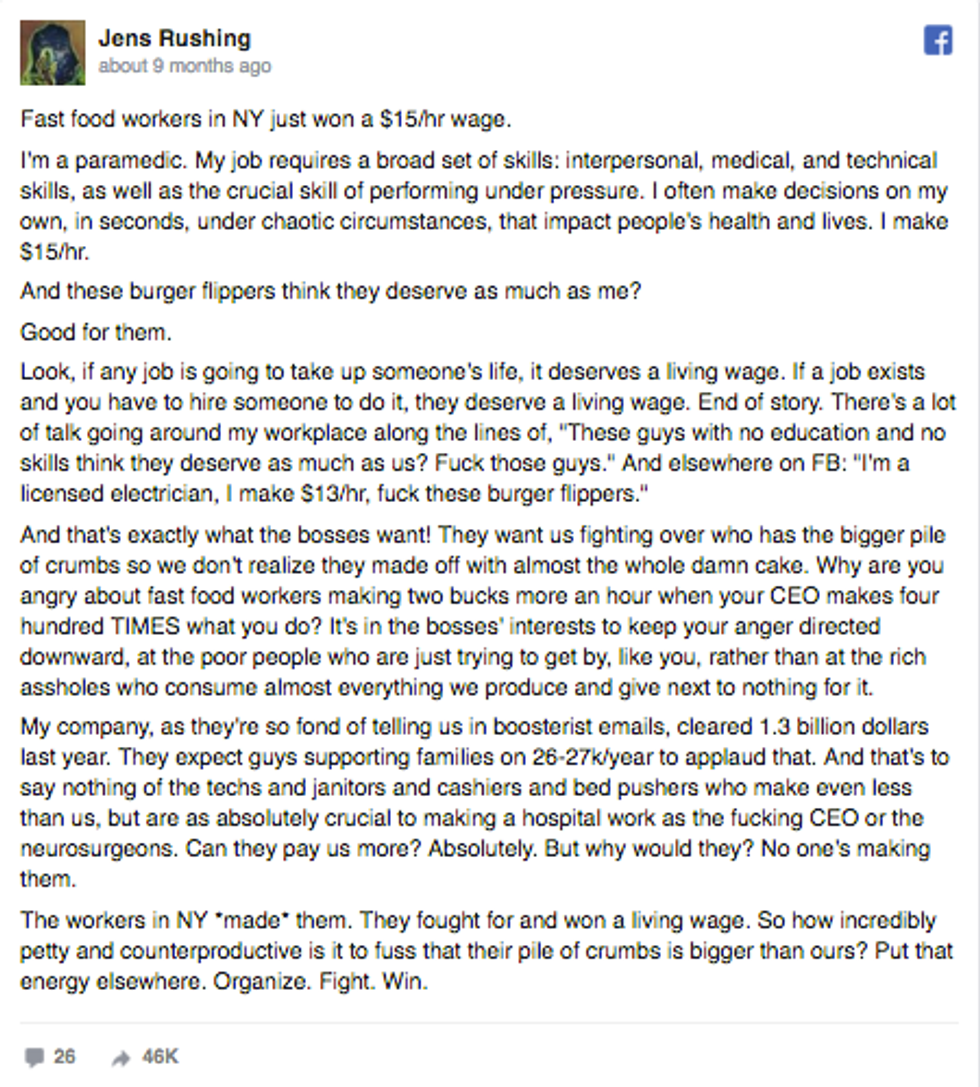
In July of 2015, a Facebook post by Jens Rushing went viral. The post summed up the real fight. The key phrasing in his defense of the new minimum being: “If any job is going to take up someone’s life, it deserves a living wage. If a job exists and you have to hire someone to do it, they deserve a living wage.” The post has, as of now, been shared nearly 47,000 times, and most of the feedback on it is positive.
It is the duty of just government to require a living wage. In 1981, facing the realities of impoverished citizens, Pope Leo encouraged for governments to “Let the working man and the employer... agree freely as to the wages; nevertheless... that wages ought not to be insufficient to support a frugal and well-behaved wage-earner.”
There are many risks to the working class when we do not openly discuss wages including the struggle with low wages and harsh working conditions. The United States government has a moral obligation to regulate the impact of wage disparities in order to uphold social justice and avoid class warfare. A government that does not ensure living wages for workers is not performing its duty of upholding life, liberty, and the safety of society. No matter what is in the status quo or what the conditions are currently, a just government’s duty is to protect it’s citizens and reduce negatives in society. To do so, that government must require employers to pay a living wage.