Last week, I was sitting at the doctor's office waiting to be seen. In an effort to lessen the number of hours I spend immersed on my phone, I decided it would be best to pick up a magazine instead. My hand reached for the closest one possible and fished a three-year-old National Geographic magazine. As I was flipping through the pages, my eyes were suddenly attracted to a photograph. The image was of a Caucasian mother, father, and their two children, happily picking vegetables in the fields. This family was nicely dressed with unbelievably massive grins as the sun shined on their polished faces. A chuckle came upon me and the elder lady sitting next to me looked over her shoulder, curious to know what I found so amusing.
Two weeks before, I had taken a grassroots and farm workers class, and our final was to take a weekend trip to Bakersfield to gain first-hand experience about the hardships these families endure. At this present moment, I wanted to look over at the elderly lady and inform her that this illustration was the farthest image possible from an accurate portrayal of life on the fields.
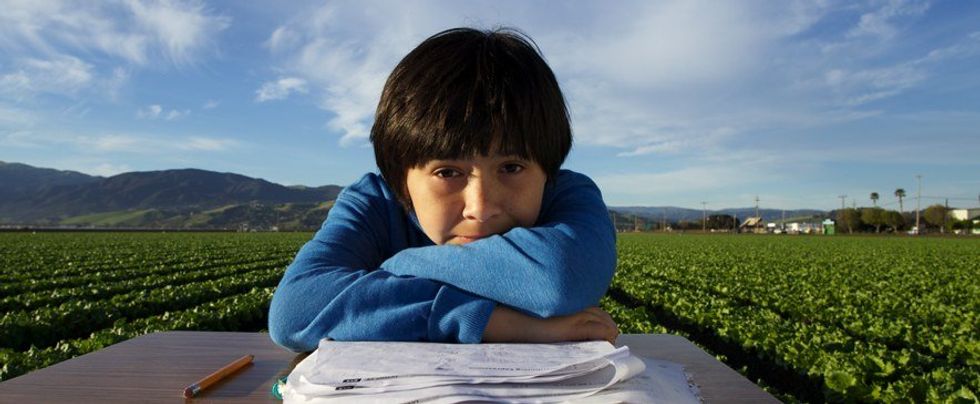
Throughout my semester in the class, the piece that left the biggest impression on me was a film by PBS called "East of Salinas." This film resonated with me because the life of the child in the movie closely resembled the lives of many of the children I spoke to during my stay in Bakersfield. "East of Salinas" focuses on the life of Jose Anzaldo, a third grader living in Salinas Valley, California. Jose's parents work the fields, cutting lettuce for American supermarkets. Despite waking up at 3 a.m. with his mother, moving schools multiple times a year, and going unfed because of financial insecurity, Jose is an intelligent and charismatic child. His teacher, Oscar Ramos, quickly discovers Jose's brilliance and optimism. Although Mr. Ramos encourages his student to continue his success inside the classroom, in hope that he may obtain a life that reaches far beyond the lettuce fields, Oscar Ramos is aware that Jose is undocumented. Being born in Mexico, Jose and his family live in incessant fear that they may be detained by police or immigration services. Not only that, but this circumstance meant that Jose will never be able to receive financial assistance if he were to go to college.
PBS describes this film as "A story about immigration, childhood and circumstance." I would add that this piece includes an overwhelming motif of fear, which can be starkly contrasted with the grins on the faces of each family member in the National Geographic magazine. It is imperative that human beings comprehend the reality that these farm workers experience. Their lives are not the embodiment of happiness, but rather the antithesis, as they are perpetually dreaded with worries regarding: health, finances and survival.