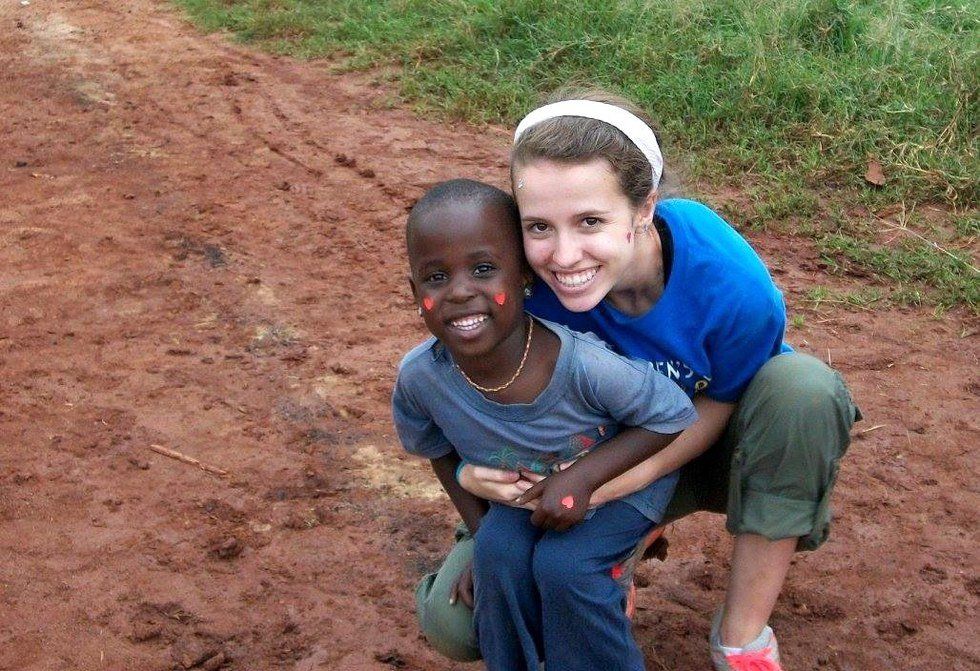
The sun beating down made me sweat through the long pants I wore to cover my legs in modesty. It scorched the dark red dirt that covered the earth, dust staining my shoes despite my scrubbing them down. Most of all, though, it burned the soles of my feet. When you don’t have any shoes, this becomes a problem. This was most evident in a young boy I fell in love with in my eight days at an orphanage in Uganda last December. I carried his small frame across the sunny patches of ground to the shade, to avoid blistering his bare feet. Wasswa is 4 years old and lives at St. Mary Kevin Orphanage Motherhood with 180 other children who have lost their parents to rebel soldiers that tore apart their country, or through the AIDS epidemic. He is only one of the 2.5 million children left orphaned in Uganda, but he is the one who stole my heart and taught me important lessons about life.
I resisted traveling to Uganda with my mother out of fear after media and videos such as “Kony 2012” left my perception of that corner of the world skewed. Child soldiers weren’t walking the streets, and Ugandans were working to restore pride in their country. I didn’t realize that getting on that plane for a 23-hour flight was going to change my life forever. Stepping off the plane, my eyes met contrasting scenes. There were policemen guarding the airport with rifles, yet the customs officials and secretaries greeted me with smiles. The people outside stopped and stared at my pale skin, long brown hair and numerous suitcases. A white person isn’t an everyday sight in Kajjansi, Uganda, and for the first time in my life, I was the minority. But for every person looking at me with hostility and confusion, there were ten others saying hello and welcoming me.
Arriving at the orphanage, my mom and I were welcomed with hugs and were kissed by children small, tall, of all ages. Scars could be seen on their arms and most wore clothes with holes. The lucky ones had a single sandal on. After a few days, my shadow, Wasswa, came to me with only one flip-flop. It had been fixed a day earlier with a line of string by an older boy, as nothing is just thrown away when you don’t have many belongings to begin with.
Unable to speak English, he communicated through gestures and translations from older children. His other shoe was lost, and after spending the better part of the afternoon on the hunt for it, it was nowhere to be found. My mind went back to my two dozen pairs of shoes lining my closet, impulse buys from every trip to the mall. At an orphanage, if you lose shoes, it could be months before it’s your turn for a new pair. After carrying him around the rest of the day to avoid burning his dirt-covered feet, I knew that I couldn’t leave him without a new pair of shoes. Taking a trip to the market to buy a new pair, I understood that it wasn’t fair to the 179 others who all needed something. But on that day, at that moment for that child, we needed to solve his one problem. Never have I seen anyone so grateful to receive anything when he screamed “THANK YOU!” as we handed new, never-worn, red flip-flops to him, slightly too big for his tiny body.
That’s when I grasped the difference between wants and needs. There’s nothing wrong with the way we live in the U.S., but most people here will never experience what it means to truly need the most basic things in life. To find the difference between the two is really to see what is worth putting your energy into.