The man in the Oval Office has his pants on fire.
This isn’t click bait, fake news, or alternative fact, it’s true. Two-and-a-half months into his presidency, it is apparent that Trump possesses a “skill” unlike any of his predecessors – the ability to fabricate stories with the effortlessness and conviction of a pathological liar.
PolitiFact, a Pulitzer Prize-winning fact checker, deems nearly 70% of Donald Trump’s statements as falsehoods. In stark contrast, former President Barack Obama’s statements were factually true 75% of the time.
To many Americans, Trump’s relatively steady approval rating is perplexing. How can people continue to support a leader who continues to spew lie after lie? Aside from media partiality and plain ignorance, recent publications examining human reasoning have offered psychological explanations for Trump’s unwavering baseline support. Many of Trump’s supporters, betrayed by their own cognitive instincts, become increasingly extremist and steadfast in their beliefs.
Putting aside Trump’s most egregious offenses (which include xenophobia, misogyny, and racism), this is a dangerous prospect to consider. With a record-high 77% of Americans perceiving the country as divided, the faulty limitations of reason have already begun to rear its ugly head under Trump. The president's polarizing leadership, loose moral code and propensity for lying incites conflict, invites bigotry and jeopardizes the nation’s advancement. For all these reasons, Donald J. Trump is simply unfit to serve as the 45th President of the United States.
Trump has mastered a scarily powerful technique to secure support – the blue lie. Hovering between well-intentioned white lies and selfish black lies, blue lies are untruths that are both self-serving and beneficial to others within the same group. For example, plagiarizers covering up for one another or crooked organizations denying collusion. On a political spectrum, this means pushing out statements that may be unfounded but ensures followership. Trump’s most recent offense occurred earlier this month when he baselessly claimed that former President Barack Obama wiretapped him during the 2016 elections.
Although the assertion has since been debunked by both the FBI Department of Justice and House of Representatives speaker Paul Ryan, the damage has already been done. A CBS poll conducted this week showed that 74% of Republican respondents believed that Trump “was [likely] wiretapped or otherwise subject to government surveillance while he was running for president”.
At first glance, this is a curious phenomenon. How can it be that even when presented with fact, three-quarters of Republican respondents remained steadfast to Trump’s unfounded claim? The answer lies in confirmation bias, an instinctual reasoning flaw that affects everyone, including those on the other end of the political spectrum.
First identified and named through a series of social experiments at Stanford in the 1960s, confirmation bias describes people’s tendency to accept information compatible with their existing beliefs while rejecting information that suggests otherwise. Alarmingly, this intuitive but flawed way of thinking has never been more prevalent. Arlie Hochschild, professor emerita of sociology at the University of California, Berkeley has found that confirmation bias thrives in the angry, hyper-polarized environment of today’s political climate. So, what about Trump has made him so effective at exploiting people’s cognitive shortcomings?
We can trace it to people’s empathetic tendency to seek stories, and not necessarily facts, in order to address unexplained phenomena. Extended to the political spectrum, this natural inclination bolsters Trump’s appeal. Just as anti-vaxxers subscribe to unscientific beliefs, Trump’s supporters have been mesmerized by the “us against them” narrative he tactfully crafted. By plotting white, rural, blue-collar Americans against immigrants, refugees, Muslims, Mexicans and minorities, Trump has offered his primary demographic a plausible, albeit inflammatory and (mostly) unsubstantiated explanation for their struggles under the Obama administration.
To be fair, Trump is not the only guilty party that has taken advantage of people’s flawed reasoning abilities. Trump’s party has been quick to point out the media’s agenda-based reporting, stating that it is “disrespectful" and “[incites] mob mentality”. Correspondingly, the American public’s trust in the mainstream reporting has sunk to a new low, with only 32% expressing a “great or fair amount of trust in the media”.
Undoubtedly, the mainstream media must work towards becoming more comprehensive and honest. However, in this battle of hypocrisy, it is clear that reporters are committing the lesser of two evils. Media reporting, although subject to internal biases, retains a certain level of integrity to serve its purpose of informing and sparking conversation. Trump, on the other hand, casts forth blatant lies while dismissing all unfavorable stories as fake.
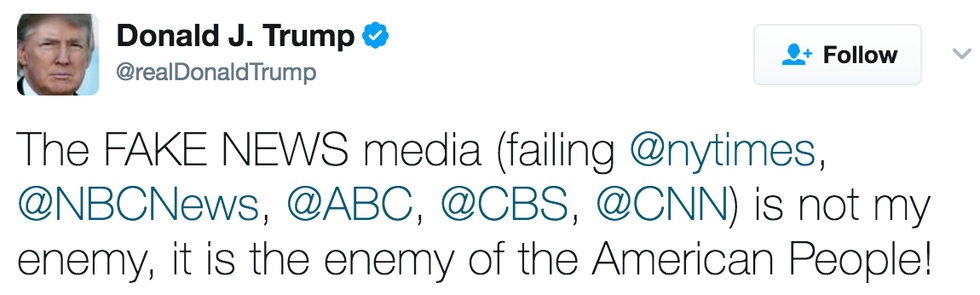
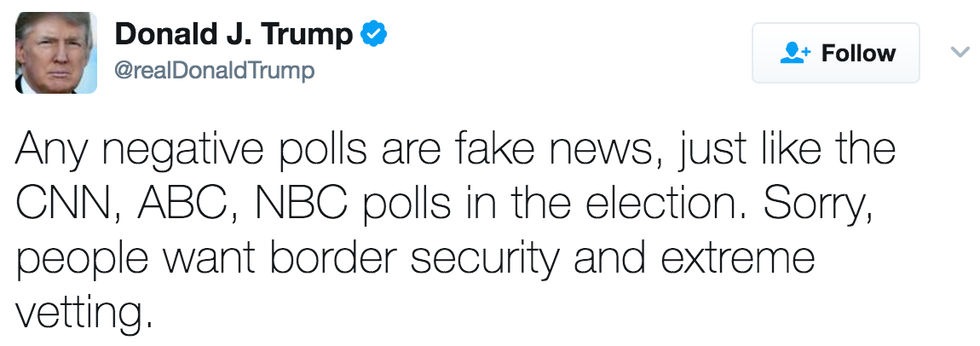
George Lakoff, a linguistics professor at University of California, Berkeley, condemns the President's actions to redefine “fake” as “disadvantageous.” By doing so, Lakoff asserts, Trump has “undermine[d] the function of the truth in a democracy”. Evidenced by the proliferation of fake news, conservatives and liberals have begun to drift into different realities, choosing to only believe opinions congruent with their existing beliefs and becoming repeated victims of confirmation bias.
As an unfortunate result of people’s natural cognitive limitations, Trump’s influential blue lies are greedily accepted as truth, spreading false information while intensifying party bonds. Trump has been able to induce such a strong sense of identification that to his supporters, factual criticisms become personal attacks, triggering defensive mechanisms such as confirmation bias and blind denial.
From a purely psychological standpoint, Trump’s presidency is profoundly problematic. Through shameless lies and alternative facts, Trump has not only made it increasingly difficult for his citizens to stay properly informed, he has also created an unbridgeable divide – eliminating the middle ground where discussion and progress is made. By painting each issue black or white, right or wrong, Democratic or Republican, Trump seats people at opposite ends of the spectrum, with little chance for dialogue or mutual understanding.
What do you call a cultural melting pot when the ingredients don’t blend?