
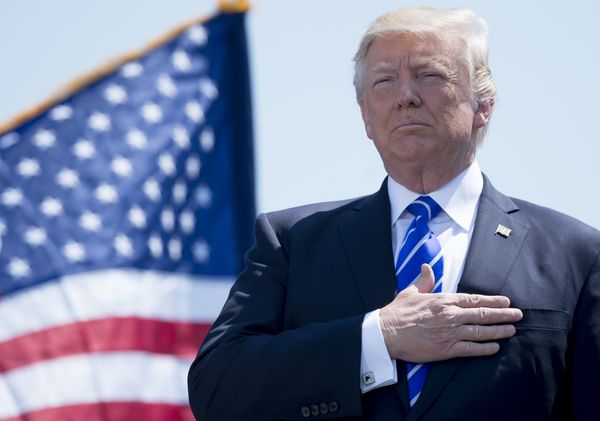
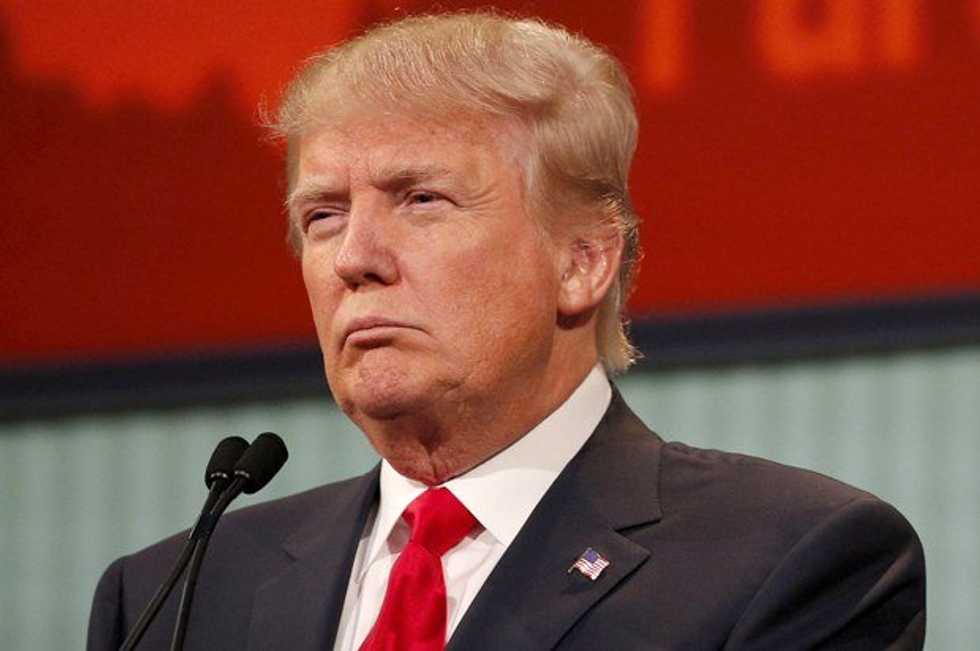
I want to be abundantly clear: electing Donald Trump the next President of the United States would be catastrophic in so many regards. Women, people of color, the LGBTQ community, undocumented Americans, Muslims, and people with disabilities are just a few groups who will undoubtably suffer under a Trump presidency. But when we talk about the fate of our nation and what our next president needs to be, it is important we remember: Trump is problematic, but he is not new to the White House.
Let's start with the OP (original President), George Washington (1789-1797)
 Washington holds many titles in US History, including "father of this country" and the first "Mr. President." He also held some other titles, including "master," called this by the slaves he inherited from his family's tobacco plantations in Colonial Virginia. Rumors have it that he personally opposed slavery, but that didn't stop him from becoming one of the wealthiest people in the colony of Virginia thanks to his tobacco slaves. Nor did it stop him from bringing eight slaves with him to the President's House in Philadelphia. Fun fact: Pennsylvania laws at the time would have granted freedom to any slaves living in that state for over 6 months, but Washington circumvented that law by maintaining that he was not a resident of Pennsylvania and so his slaves would not qualify. For someone who "opposed slavery," he sure did benefit from it.
Then there's the father of the "Era of Good Feelings," James Monroe (1817-1825)
 Monroe is commonly known as the last of the "Virginia Dynasty," the clique of consecutive Virginians elected to the highest office of the US Government. He is also the man who negotiated the Louisiana Purchase with France in 1803. You know...that deal that nearly doubled US territory and magically claimed land owned by millions of Native Americans and whose population was almost 50% African slaves? Yeah that one. But we should give him some sympathy, seeing as how he never fulfilled his childhood dream: owning a large and politically powerful plantation. He did try though, eventually owning numerous plantations across Virginia and frequently separating slave families to meet the needs of each plantation. Overseers treated slaves notoriously harshly to force production, but ultimately Monroe's plantations never turned much profit and he often sold slaves to pay off incurred debts.
Soon to be removed from the $20 bill, "President of the People" Andrew Jackson (1829-1837)
 The internet has been abuzz with the recent decision to replace Jackson with abolitionist pioneer Harriet Tubman on the US $20 bill, and this has led to many Americans finally trying to understand what the problem with Jackson is. I mean, isn't he the founder of the American Democratic Party? Well yes, but there's more to the story (which by the way says a lot about the foundation of the Democratic Party). For starters, to continue the trend of past Presidents, Jackson owned hundreds of slaves in his Hermitage Plantation in Nashville, Tennessee, from 1804 until his death in 1845. But, perhaps more notorious was Jackson's "relationship" with the Native Americans. It began during the War of 1812, when then-General Jackson killed over 800 Creek warriors at the Battle of Horseshoe Bend in 1814. Jackson later led a campaign, at the orders of President Monroe, against the Seminoles and Creeks during the First Seminole War. And, you guessed it, President Jackson later incited the Second Seminole War of 1835. He passed the Indian Removal Act of 1829, his first "legislative triumph" as President, which ultimately led to the infamous Trail of Tears during which over 4000 Cherokees died. Great guy.
Okay we get it, the first couple presidents weren't so great. But the last century or so has been good right? Let's look at Woodrow Wilson (1913-1921).
 Wilson was President 100 years ago today, while the world was embroiled in World War I. He went on to receive the Nobel Peace Prize for his support of the League of Nations (the precursor to the UN). So he must've been much better right? Wrong. For starters, Wilson's father was a passionate defender of slavery, himself owning many slaves, and the Wilsons were proud members of the Confederacy during the Civil War. As President, Wilson refused to show public support for women's suffrage because it was "too divisive" of an issue, though (white) women were given the right to vote while he was President. Wilson's personal history with racism is even more concerning; while President of Princeton University, he openly discouraged Black people from applying for admission, preferring to maintain favor with white students and alumni. He wrote a book, History of the American People (1901) in which he says "The white men were roused by a mere instinct of self-preservation...until at last there had sprung into existence a great Klu Klux Klan, a veritable empire of the South, to protect the Southern country." This man was our President for eight years.
Even the last forty years have seen presidents elected who have perpetuated inequality and violence. Take the Republican Party's deity Ronald Reagan (1981-1989)
 First of all let's address the fact that Reagan's "trickle-down economics" had a hand in ruining this country's economy. Even current Republican politicians are coming out and admitting this. But besides his disturbingly anti-middle class economics, Reagan is seen by many as a pioneer in the tumultuous relations between the US and the Middle East, North African, and Muslim worlds. In particular, his ordering of bombings across Libya in 1986 in response to a terrorist bomb that exploded in Germany earlier that year (sound familiar?) There was also the Iran-Contra affair, in which Reagan and his administration were revealed to be selling weapons to Iran during the Iran-Iraq War and using that money to fund the Contra rebels fighting the communist Nicaraguan government. Domestically, Reagan began the infamous War on Drugs in 1982 that ultimately led to a wildly disproportionate incarceration of Black Americans. He also upheld institutional homophobia through his response, or lack thereof, to the AIDS epidemic, which at the time was predominantly affecting gay men. By the time he even publicly acknowledged the epidemic, over 20,000 Americans had already died from the disease, and his administration funded the minimum amount they could for AIDS research.
What I'm trying to address is that the bigotry and violence incited by Trump, though horrific, is not new. This country has a history of electing men to the office of President knowing full-well their prejudices and inhumane intentions. In other words, stopping Trump will not solve the problem. This country is built off of racism, sexism, homophobia, genocide, and slavery. Whether we elect one person to be President will not undo centuries of history; we can only do that by wholeheartedly embracing progress and keeping ourselves and one another consistently educated. We cannot simply redefine what it means to be President, we must redefine what it means to be American.

















