

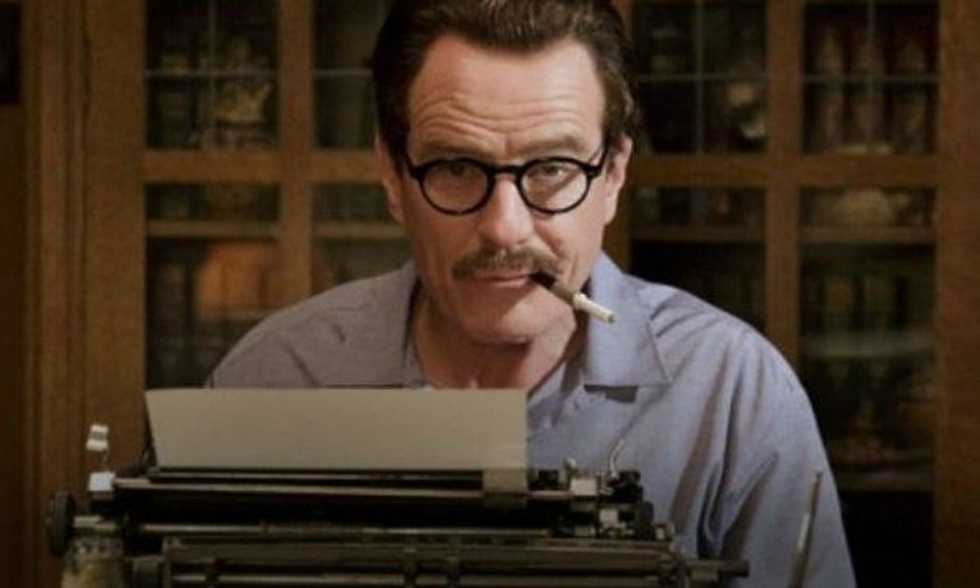
A great story does not a great movie make. Jay Roach, the man who made his name directing the Austin Powers series (and who after this should certainly go back to making those types of films) was basically shooting fish in a barrel when he chose to direct the story of one of the most iconic men of the Hollywood Blacklist, Dalton Trumbo.
It’s the story of a man who wrote classics like Roman Holiday and the Brave One under false credits and pseudonyms when he was accused of being a Communist. It’s the story of how the film industry was shaken to its core in a moment where we came close to exuding fascism as a country-wide sentiment. It’s the story of one of the darkest chapters in 20th century American history. Oh, it’s a great story – and as I left the theater, that’s all I heard the audience members say. It’s too bad that they forgot they already knew the story, or could easily have heard the story in innumerably better biographies or History Channel documentaries, and instead have just been faced with something that I almost refuse to call a film, but at best would classify as an HBO-level TV movie.
From its over-lit production design, to its ninth grade-level on-the-nose writing (the explanation of communism Trumbo gives to his daughter, and thereby the audience, is just painful), there is nothing cinematic about this film. Rather, it is a string of obvious scenes that really don’t go much deeper than telling us that McCarthyism is bad, Trumbo had to deal with a lot of shit, and that he may have been a hypocrite. There are so many perfunctory yet failed attempts at emotion (e.g. Trumbo going to jail) that I only realized from the presence of overwrought music that I was intended to feel something. Sadly, it was only boredom and contempt.
There’s a line in the film where Trumbo tells Otto Preminger, “If every scene is brilliant, your film will become monotonous.” He may as well have been talking about the actor who portrays him, Bryan Cranston. He indeed is a brilliant actor, but not when he tries to inflect EVERY SINGLE SCENE with the same ‘brilliant,’ self-important cadences that feel nothing if not staged as he reads every line, even and especially the unimportant ones, as if it were all a part of a big Heisenberg monologue that indeed did work so brilliantly in moderation on Breaking Bad. At least he’s better than Michael Stuhlbarg, whose piss-poor performance as Edward G. Robinson is a complete abomination as drama, cipher, or even nightclub imitation. And don’t even get me started on the guy who misguidedly thought he was pulling off a half-decent imitation of John Wayne! For a film whose characters are well-known legends of Hollywood, you’d think the filmmakers would want performances that are dramatically resonant if they can’t even come close to being impressions worthy of an off-night on Saturday Night Live.
This isn’t an absolutely terrible film. If you know nothing about the Hollywood Blacklist, you may learn something (though I’d start first by viewing the vastly superior Good Night and Good Luck, for one thing). You’ll be entertained, enough (though that really shouldn’t be enough for a film like this that should mean so much more). It will be as if you were watching some filler HBO programming at home on a Tuesday night, and indeed, maybe this will play better where it belongs, on television. But as far as being a cinematic statement for one of the most historically important stories of the last century, and especially for a man who was one of cinema’s greatest wordsmiths, we deserved far better.

















